
Trade fair held before rendezvous season begins
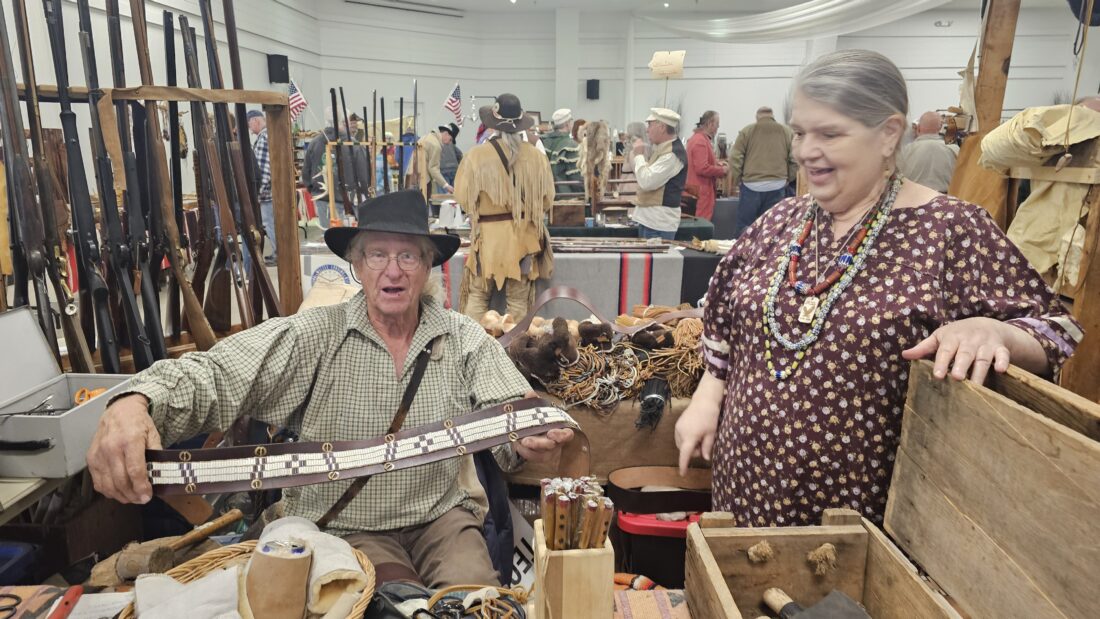
Leatherworker Dick Bennett and artisan Susan "Susie"Hansen, who creates wampum belts, beadwork, and moccasins, showcasing their crafts at the New Ulm Trade Fair and Living History event.
NEW ULM — The 45th annual New Ulm Trade Fair & Living History Event brought a strong crowd of traders, re-enactors and history enthusiasts to the Royal Oak Event Center Saturday.
The event, which focuses on the 1750-1850 fur trade era, featured more than 40 vendors and about 85 tables filled with handcrafted goods.
Items included story candles, furs, beads, knives, tools, clothing, pottery, tinware, porcupine quill work, baked goods, various history books, and frontier-era firearms.
Many vendors arrived in period clothing and offered live demonstrations of traditional frontier skills such as leather-working, silversmithing, beadwork, quillwork and tinsmithing.
Organizer Mike Emery, who has run the event for most of its history, said the fair has become a longstanding tradition.
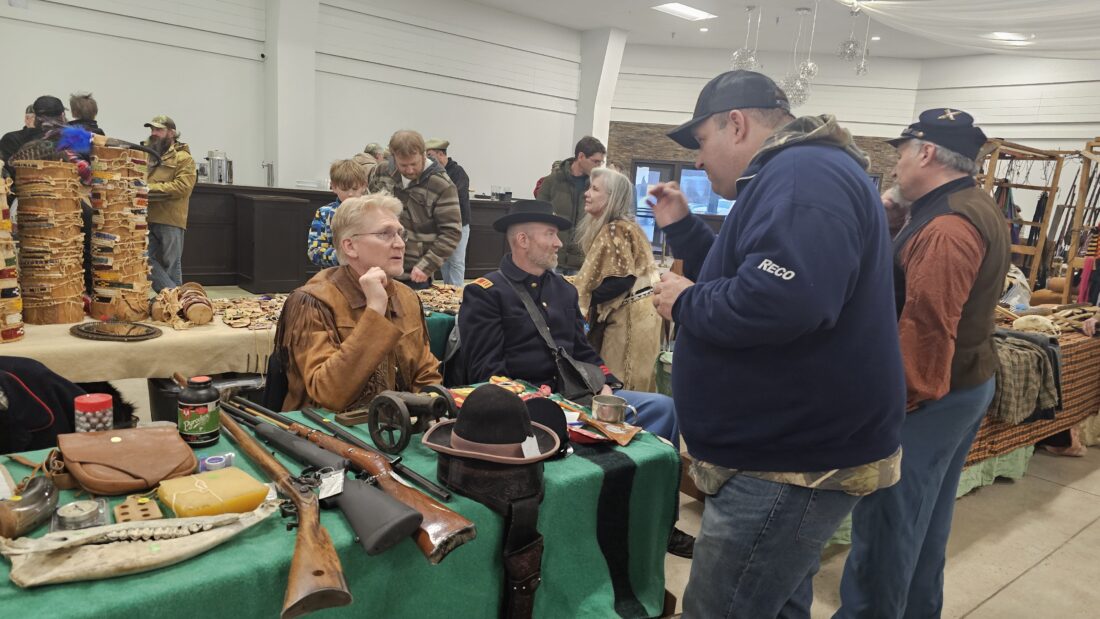
Vendors engaging with customers at the New Ulm Trade Fair.
“This event has gone on for 45 years,” Emery said. “Everybody kind of likes it. It’s historically been the start of the summer season.”
He said the fair serves as a crucial indoor gathering for many participants to socialize and acquire necessary supplies before the summer rendezvous season begins.
The fair originally operated as a nonprofit club event for its first 25 years, primarily organized by local New Ulm residents.
Emery later took over operations, with assistance from his son, Matt Emery. It was held at Turner Hall for many years before moving to the Royal Oak Event Center five or six years ago.
Matt Emery noted the change in venue.
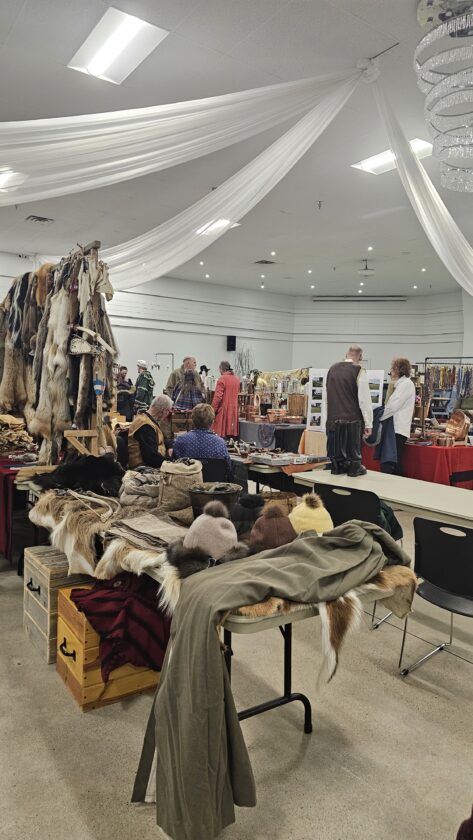
A wide view of the Royal Oak Event Center, showcasing the numerous tables and vendors at the New Ulm Trade Fair.
“We kind of hated to lose Turner Hall,” Matt Emery said, acknowledging the history and nostalgia associated with the old location. “But we’ve been real happy here, a lot more room, a lot more accessible.”
Leatherworker Dick Bennett demonstrated the process of punching holes and shaping leather for custom-made belts.
Nearby, Susan Hansen, known as Susie, displayed wampum-style belts, beadwork and moccasins.
She explained that her wampum belt was a copy of one worn by Daniel Day-Lewis in “The Last of the Mohicans.”
Hansen, who is also a silversmith, said she has made four pairs of moccasins for traditional dancers at powwows, with her husband completing the intricate beadwork.
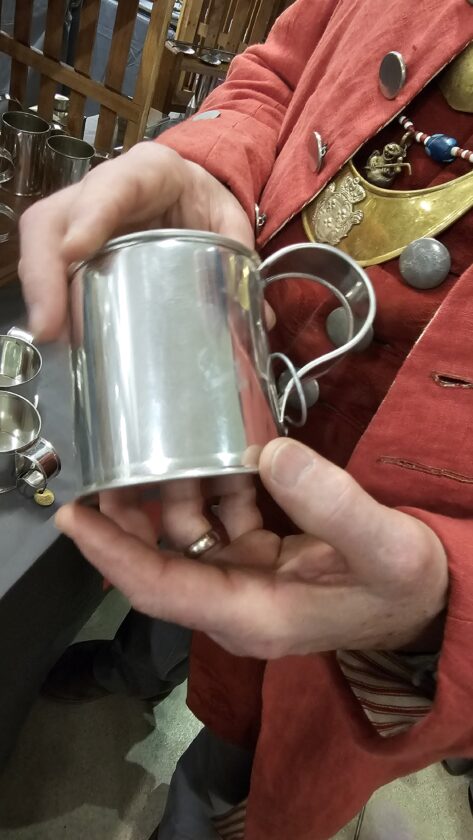
Christian Hagemann, the tinsmith, with the tin cup that inspired his 31-year career in historical tinware.
She also incorporates trade silver into her pieces, planning to adorn new belts with silver heads around each piece of trade silver.
Christian Hagemann, a tin and copper artisan from Nebraska, had one of the largest displays with five tables of historically accurate items including cups, lanterns, candle holders, coffee pots, teapots and cookware.
Hagemann started his craft in 1994, is celebrating his 31st year as a tinsmith. He uses mostly historical methods, noting that the only modern concession is his use of a soldering iron instead of a traditional soldering copper with flame and heat, though he reverts to original techniques for historical interpretive programs.
Hagemann’s journey began with a simple tin cup he purchased in 1974 for $10 from a tinsmith in Maryland. He reproduced that cup and gradually expanded into more complex pieces.
“Once you understand the basic technique of assembly, you’re only limited by your imagination,” Hagemann said, explaining that customer requests often drive his creations.
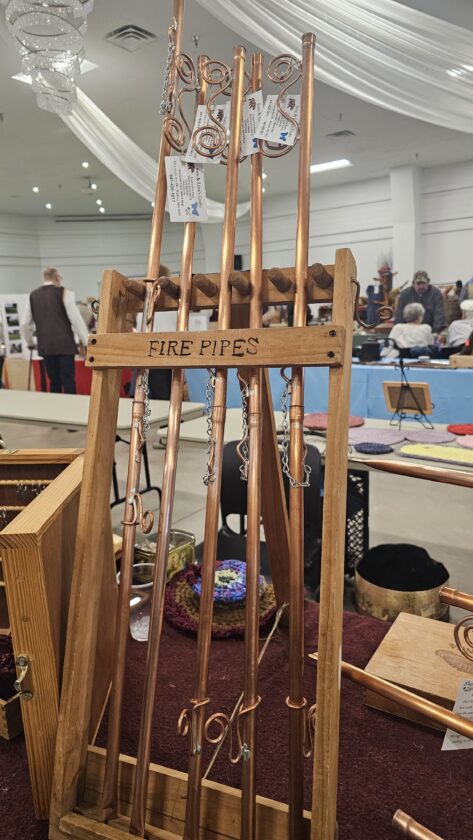
Sam Faust's fire pipes, used to blow on embers and start campfires.
He also demonstrated a unique historical reproduction: an automatic candle snuffer, a clever device that extinguishes a candle when it burns down to a certain level.
Hagemann explained the broader significance of tin plate in American history.
“Tinplate literally transformed civilization because it changes how we eat, what we eat, when we eat and where we eat,” Hagemann said.
He described how tin-plated canisters made food preservation possible through canning and pasteurization, allowing people to eat vegetables in winter and carry preserved food on long journeys, including across oceans.
He said there were three guarantees with tin plate: it will rust, it will leak and the handle will fall off. Still, he said it served as the plastic of its day, defining plastic as “any material which can be transformed into a useful object.”
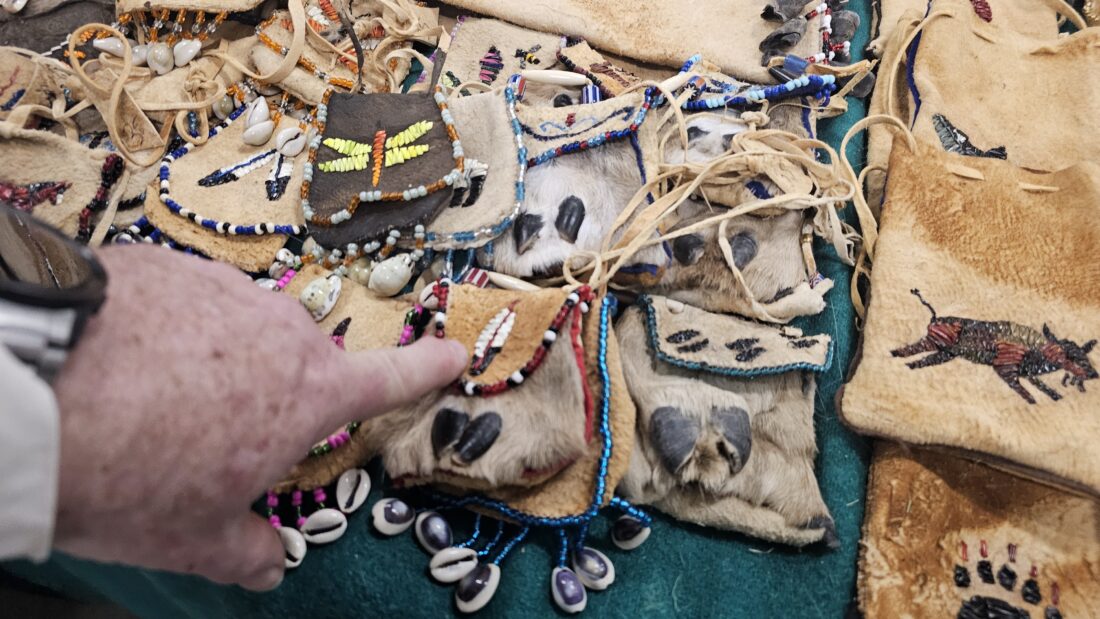
Porcupine quill work on display.
Sam Faust, who is visually impaired and accompanied by a guide dog, has been making fire-starting tools and fire pipes for more than 30 years. The pipes allow users to blow on embers to start campfires.
The event also featured live music by Dave Rambo and Elliott, musicians who perform at rendezvous events including the Big Island Rendezvous.
Vendors traveled from across the Midwest to participate, including from Illinois, Iowa, Nebraska, North Dakota, South Dakota and northern Minnesota, boosting local tourism.
Lehi Gertz of Gertzski Bee’s sold honey-based lip balms made from her own beehives, herbal salves, and handmade soaps in numerous scents including lavender, chai latte, sandalwood rose, bergamot, jasmine, mint eucalyptus, and coffee vanilla.
Gertz also offered an herbal salve with arnica, yarrow, calendula and plantain, which she explained is effective for bug bites, wounds, and even drawing out splinters.
Gertz said many attendees come from long distances.
“There’s a lot of people that come from up north, like Bemidji,” Gertz said.
Some vendors and visitors expressed concern about the incoming winter weather and considered leaving early, while others planned to stay in local hotels.
Concerns proved valid. A National Weather Service blizzard warning for Sunday resulted in drastically reduced attendance. Vendors reported only about four customers came through the doors that day. Organizers closed the fair early at approximately 1 p.m. Sunday as conditions worsened.
The New Ulm Trade Fair at the Royal Oak Event Center serves as an annual gathering point for re-enactors, collectors and families interested in frontier history.
-
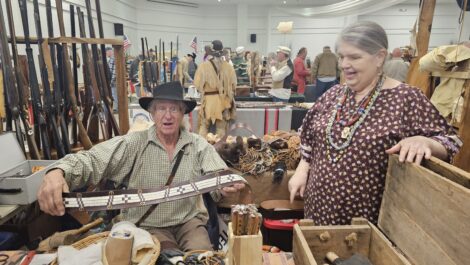
- Leatherworker Dick Bennett and artisan Susan “Susie”Hansen, who creates wampum belts, beadwork, and moccasins, showcasing their crafts at the New Ulm Trade Fair and Living History event.
-
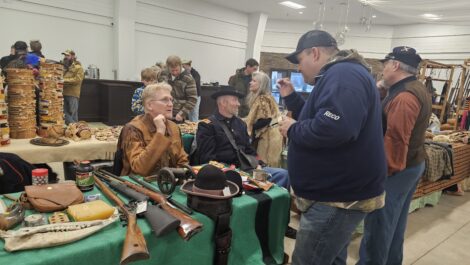
- Vendors engaging with customers at the New Ulm Trade Fair.
-
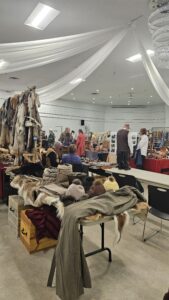
- A wide view of the Royal Oak Event Center, showcasing the numerous tables and vendors at the New Ulm Trade Fair.
-
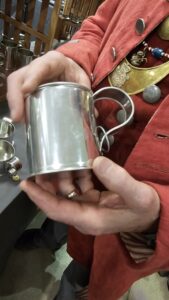
- Christian Hagemann, the tinsmith, with the tin cup that inspired his 31-year career in historical tinware.
-
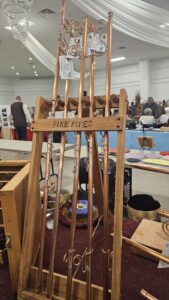
- Sam Faust’s fire pipes, used to blow on embers and start campfires.
-
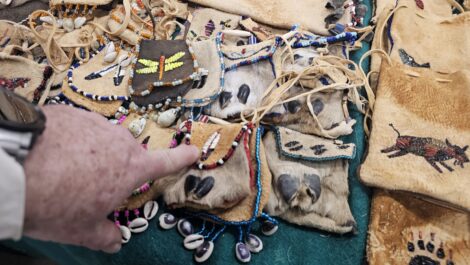
- Porcupine quill work on display.
Local News
More than a full crib
Library unwraps community collage for Wanda Gág’s birthday
Arctic blast socks region
NEW ULM - The mid-March blizzard that was forecast to hit this past weekend arrived on scheduled. According to ...
‘Vote on Election Day’
Trade fair held before rendezvous season begins
