‘We want people to meet them’
League of Women Voters continues series with NU school board
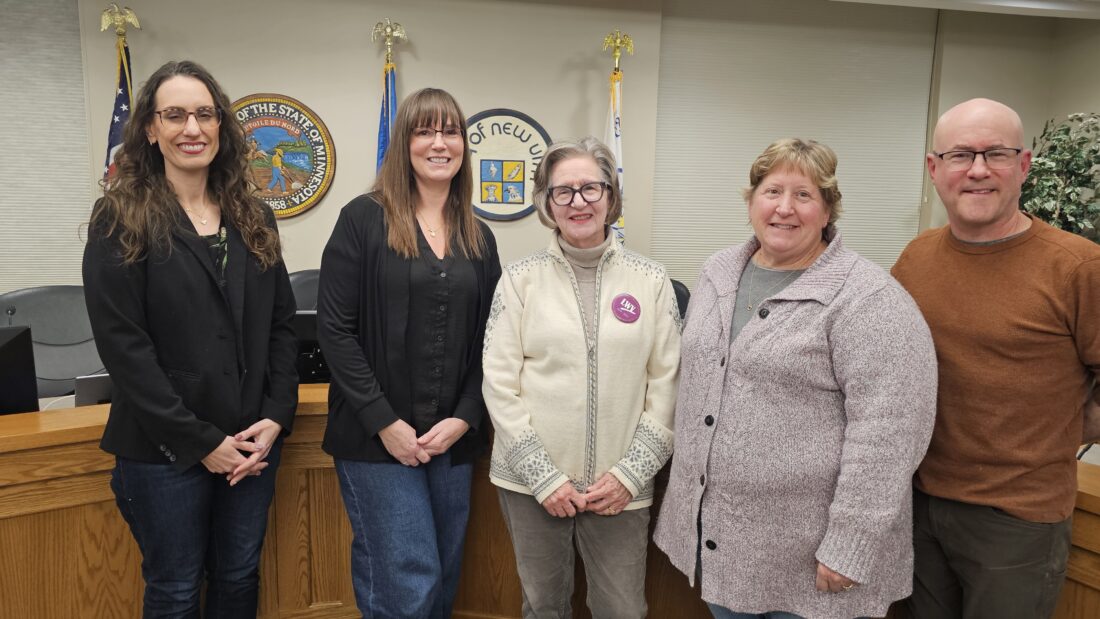
From left, board member Sarah Leslie, board member Amanda Groebner, LWV president Ruth Ann Webster, board member Christie Dewanz and board memberMatt Ringhofer at the “Meet Your Elected Officials” forum Monday at New Ulm City Hall.
NEW ULM — District 88 School Board members outlined their responsibilities, current challenges and future goals during the League of Women Voters’ “Meet Your Elected Officials” forum Monday evening at New Ulm City Hall
The board emphasized collaboration, student opportunity and the growing impact of funding pressures on local schools.
The forum, the second in a three-part public education series hosted by the League of Women Voters, featured New Ulm school board members Sarah Leslie, Amanda Groebner, Christie Dewanz and Matt Ringhofer. Jonathan Shiro and Melissa Sunderman were unable to attend the forum due to a scheduling conflict with another meeting.
The series is designed to help residents better understand the roles of elected officials already serving in office and the decisions that shape local government.
League of Women Voters President Ruth Ann Webster said the program differs from candidate forums because the focus is on educating the public about the realities of serving in elected office rather than campaigning.
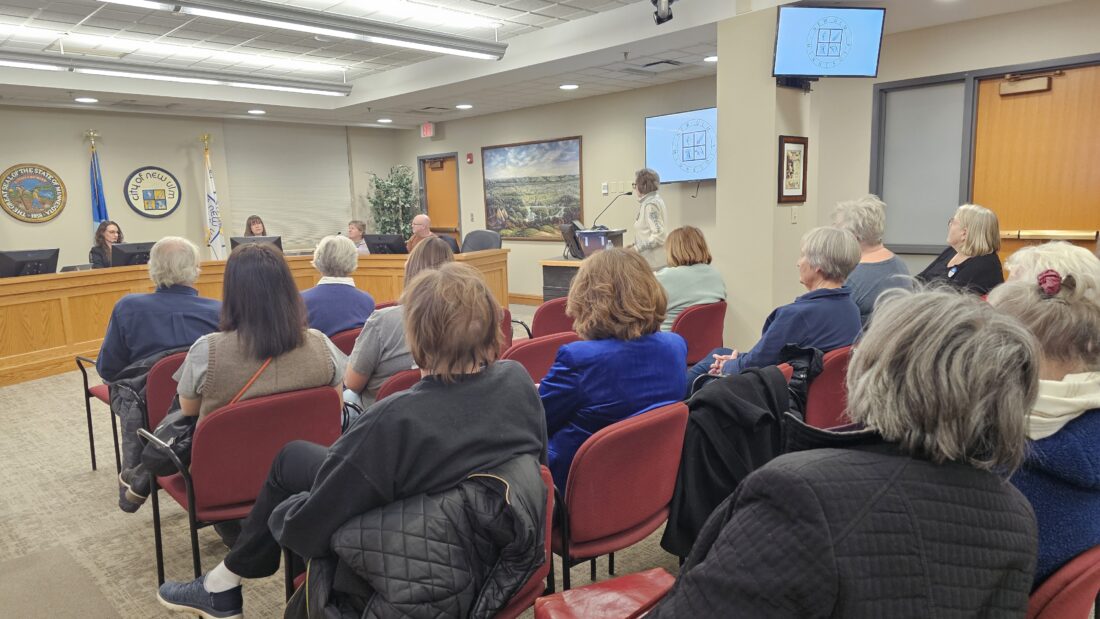
Community members listen attentively during the League of Women Voters’ “Meet Your Elected Officials” forum Monday at New Ulm City Hall.
“These folks have already been elected and are serving in their roles,” Webster said. “We want people to meet them, hear about the challenges they face and understand the pride they take in their work.”
Board members described school board service as both time-consuming and complex, involving committee work, contract negotiations, policy decisions and ongoing collaboration with administrators, staff and community members.
Leslie, who is completing her first year on the board, said the experience has involved a steep learning curve.
“It’s been like drinking from a fire hose,” Leslie said. “There is so much information to learn, from negotiations to budgeting to curriculum. I’m fortunate to be working with a very experienced board that has helped show me the ropes.”
Much of the board’s work takes place outside regular meetings through committee assignments. Members typically serve on multiple committees addressing areas such as curriculum, activities, finance and negotiations, with recommendations later brought before the full board for discussion and action.
Groebner, who serves as board clerk, said teamwork and mutual respect are essential to the board’s effectiveness.
“We all come from different backgrounds and have different beliefs, but our main goal is the students,” Groebner said. “Even when decisions aren’t unanimous, we move forward together as a board.”
Funding pressures were identified as one of the most significant concerns facing the district. Board members noted that decisions made at the state and federal levels, including funding formulas, curriculum mandates and testing requirements, often have a direct impact on local districts, sometimes requiring new programs or reporting requirements without additional financial support.
Dewanz said careful budget planning will continue to be critical as districts work to maintain programs while managing rising costs.
“We have great programs and opportunities for our students, but we have to be very mindful of our budgets,” Dewanz said. “We want to continue supporting students without cutting staff or limiting opportunities.”
Mental health needs among both students and staff were also discussed. Board members emphasized the importance of creating safe learning environments while addressing teacher burnout and expanding access to student support resources.
Ringhofer, who has served on the board for more than a decade and works professionally in education, said supporting educators is essential to student success.
“It’s not an easy profession,” Ringhofer said. “If we want students to succeed, we need to make sure teachers feel supported and valued and have the tools they need to do their jobs effectively.”
Another ongoing challenge is the recruitment and retention of educators. Groebner said fewer college students are entering the teaching profession, raising concerns for districts across Minnesota and nationwide.
“We need to make teaching a profession people want to enter and stay in,” she said. “That means competitive compensation, strong support systems and recognizing the important role teachers play in our communities.”
Despite the challenges, board members highlighted a number of successes across the district, including strong participation and achievement in athletics, music, theater and academic programs such as Knowledge Bowl. They also pointed to expanded Career and Technical Education opportunities that offer hands-on learning, industry certifications and potential college credit for students.
“These programs help students explore career paths,” Dewanz said. “Some may enter the workforce right after graduation, while others gain valuable experience that helps guide their future education.”
Board members also praised the addition of student representatives at school board meetings, noting that the program provides valuable insight into student life, school activities and emerging concerns among the student body.
“It’s one of the highlights of our meetings,” Ringhofer said. “Hearing directly from students helps us make better, more informed decisions.”
Panelists encouraged residents to remain engaged with local education issues by attending board meetings, reviewing district communications and participating in community conversations about school priorities. Webster said the League of Women Voters hopes the forum series will strengthen connections between residents and elected officials while improving public understanding of how local government operates.
The League of Women Voters’ “Meet Your Elected Officials” series will conclude March 23 with a forum focused on Brown County commissioners, giving residents an opportunity to learn more about county-level governance and the issues shaping the region. League organizers said the goal of the series is to strengthen civic understanding by helping residents connect with officials who are already serving and making decisions that affect the community. The forums are broadcast locally and made available online to encourage community participation and public understanding of local government.
-
- From left, board member Sarah Leslie, board member Amanda Groebner, LWV president Ruth Ann Webster, board member Christie Dewanz and board memberMatt Ringhofer at the “Meet Your Elected Officials” forum Monday at New Ulm City Hall.
-
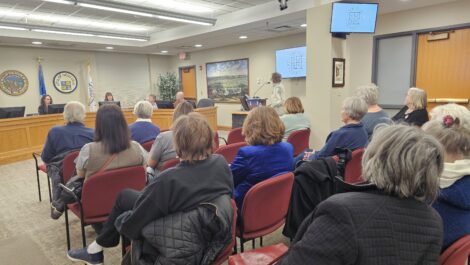
- Community members listen attentively during the League of Women Voters’ “Meet Your Elected Officials” forum Monday at New Ulm City Hall.