A hub for German language
Sprachklub also preserves German culture and community
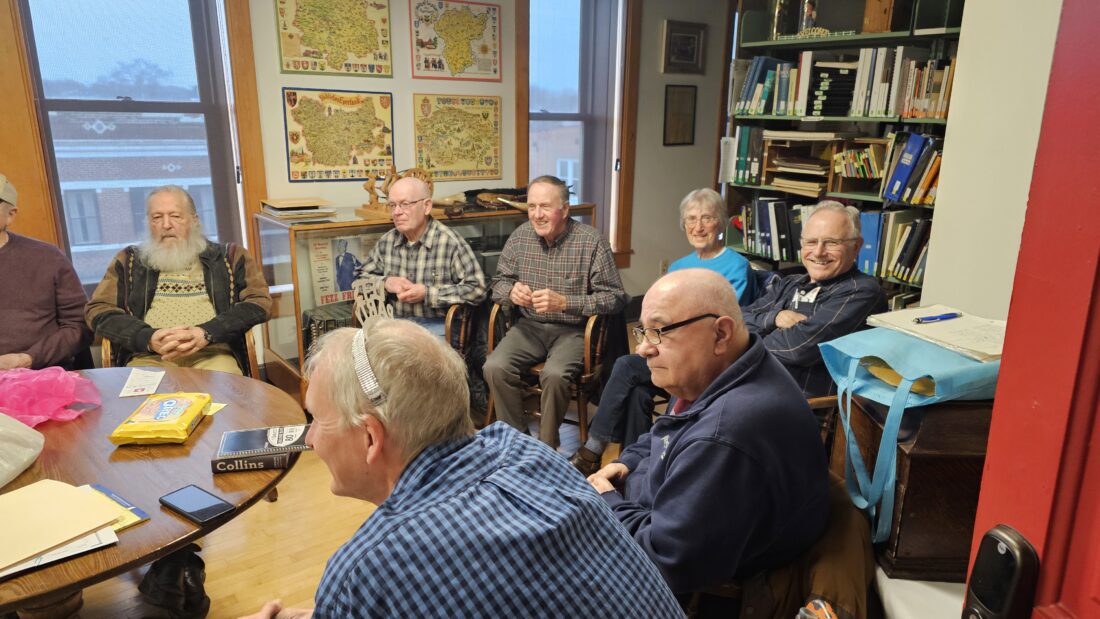
The New Ulm Sprachklub creates an intimate circle for German language practice and storytelling. The group, founded about 12 years ago by George L. Glotzbach, continues to preserve German language and culture in New Ulm through conversation rather than formal instruction.
NEW ULM — On Sunday, 18 participants gathered at the German-Bohemian Heritage Society rooms on the third floor of the Grand Center for Arts & Culture, speaking German, sharing stories, and crowning the New Ulm Sprachklub’s native speakers with festive “let’s party” crowns.
The meeting was a temporary change of venue from the usual Martin Luther College cafeteria due to the Christmas break and included heritage speakers, native Germans, and a visitor from the Mankato German-speaking group.
The club has been a hub for German language, culture, and personal histories for more than a decade. It meets most months from September through May on the third Sunday from 1 to 3 p.m. and draws residents from New Ulm and nearby towns including Nicollet, Mankato, and St. Peter.
The club’s roots go back about 12 years, when George L. Glotzbach, known as “Mr. New Ulm,” founded the group.
“George wanted a place where people could just come together, speak German, share stories, and have fun,” said Harvey Stadick, a local farmer who stepped into leadership after Glotzbach died. “George started it, and kind of left it to me. We just try to have a good time every third Sunday.”
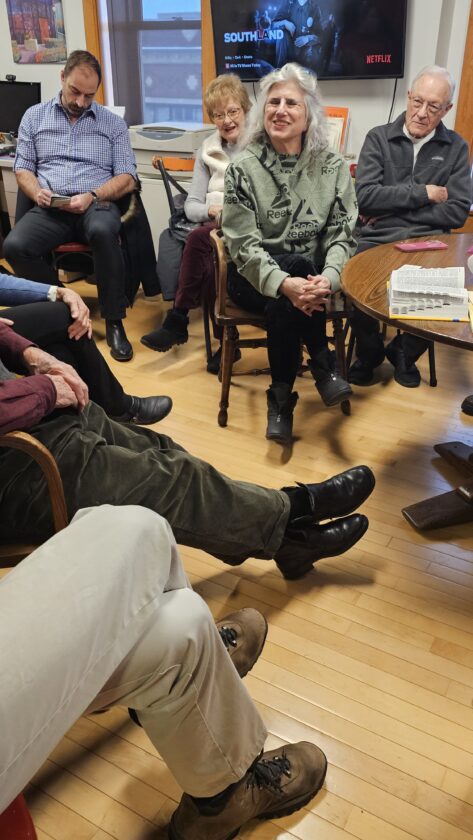
Rosemary “Rosie” Geer, a member of the New Ulm Sprachklub for seven and a half years, encourages heritage speakers to share their stories and speak German during the club’s monthly meetings.
Other early members, including Al Stabana and Roy Joel, helped shape the club’s informal tone.
“It was never about being perfect,” Stadick said. “It was about enjoying German, enjoying each other, and keeping the culture alive.”
“Most of us in the club are heritage speakers,” said Rosemary Geer, longtime participant and moderator. “I guarantee you, people don’t know that term. We try to encourage people to express themselves, and we don’t care about mistakes.”
Heritage speakers, she explained, are people who grew up hearing German at home, in church, or in their communities, often speaking regional dialects like Bohemian German rather than formal High German.
“Even if English became their main language,” Geer said, “they still have a strong connection to the culture, the stories, and the expressions their families passed down.”
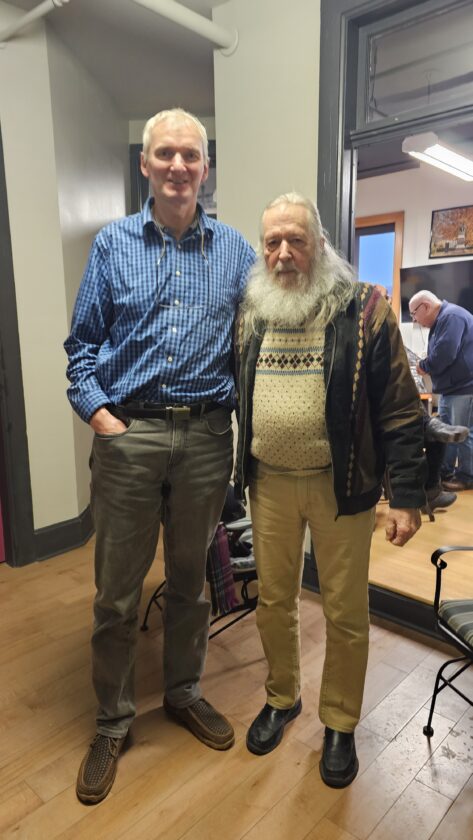
Native German speaker Boje Siebels (left) from the Mankato German-speaking club and local German speaker and New Ulm Sprachklub member Henk Exoo at Sunday's meeting.
Meetings are conversational rather than formal classes. While High German is the primary language, a natural blend of German and English, called “New Ulm German,” often fills in the gaps.
“It’s kind of like Tex-Mex,” Stadick said. “When people don’t know the word in German, they just throw in English.”
Meetings are intimate, allowing for lively conversation and personal storytelling. Among the participants is Heidi Hinkley, fluent in German, who often adds linguistic insights.
At Sunday’s gathering, she pointed out that the name “Rothschild” literally means “red shield” in German.
“It’s fascinating how language carries history,” she said.
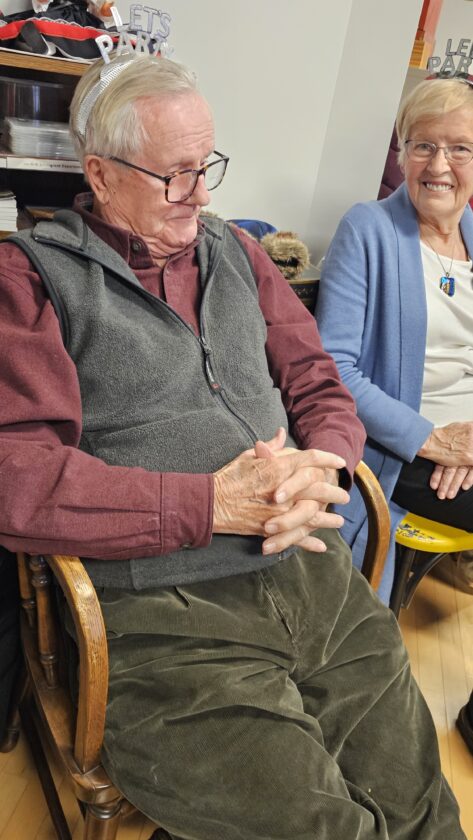
Gerhard Christ, wearing a crown to honor him as a native German speaker, sits next to fellow native speaker Heidi Hinkley at a recent New Ulm Sprachklub meeting in New Ulm, MN. If you want, I can also polish these captions slightly so they read more smoothly for publication while keeping the details intact.
The club fosters regional connections. Boje Siebels, a fluent German speaker from northern Germany who represents the Mankato German-speaking group, attended the meeting.
Native speaker Gerhard Christ shared his journey from Germany to the United States. In 1950, amid Cold War tensions, Christ sold beer to American soldiers in Germany, eventually gaining sponsorship to come to the U.S.
“One of those guys from the 109th Combat Engineer Battalion in South Dakota National Guard sponsored me to come to this country,” Christ recalled. “I came by ship from Rotterdam. It was five days long in an Atlantic storm.”
Christ faced immediate obligations upon arrival.
“The last person I talked to on the boat said, ‘You have three days after you arrive in Rapid City to register with the draft board,'” he said. After a long bus ride, he worked as a stained-glass craftsman in Milwaukee and enlisted in the U.S. Army, returning to Germany as a soldier despite not yet being a U.S. citizen. “All they had to have was a green card,” he explained.
Christ met his wife Judith in Minneapolis while working as a sales representative.
“We got engaged when I picked her up for midnight mass on Dec. 24, 1964,” he said. They married in May 1965 and honeymooned in Germany, where Judy marveled at the German Catholic mass.
“They sing it all. They’re all singing,” Christ recalled.
Christ described his motivation for attending the club. “We don’t come here to learn German. No. We come here to educate the people about what Germany is all about.”
Stadick described the heritage speaker experience.
“We’re just here to have fun,” he said. “Anybody speaking English is welcome too. We don’t worry about mistakes. It’s all about enjoying the language and culture.”
Stadick and his wife are preparing to celebrate their 60th wedding anniversary in February with an open house in Searles. A charming detail emerged from a speaker who was part of Harvey’s wedding party: “My wife and I both were in the wedding. Ah, and that’s where we met.”
Stadick shared a fascinating family connection to history, revealing, “I am related to Fletcher Christian who mutinied on the Bounty,” adding that genealogical research by his wife suggested “Captain Bligh was actually the good guy and Fletcher Christian was kind of the bad guy.”
Geer said the club benefits from the mix of heritage and native speakers.
“People bring expressions, stories, and dialects from their families. It’s amazing. It’s living culture. And when native speakers are here, we celebrate them with crowns and applause. It’s just a joyful, respectful thing.”
Stadick added, “George started this club to keep the language alive, and that’s still what we do. We honor the native speakers, celebrate the heritage speakers, and share our history. That’s the beauty of it.”
The Sprachklub continues to welcome new members and visitors, regardless of fluency level.
Through storytelling, music, and shared traditions, the club preserves German language and culture while connecting generations.
“It’s more than language practice,” Geer said. “It’s a community. It’s a celebration. It’s joy.”
For those interested, the New Ulm Sprachkclub normally meets at Martin Luther College cafeteria on the third Sunday of each month from September through May, 1 to 3 p.m., though special events or holiday breaks may bring temporary venue changes.
-
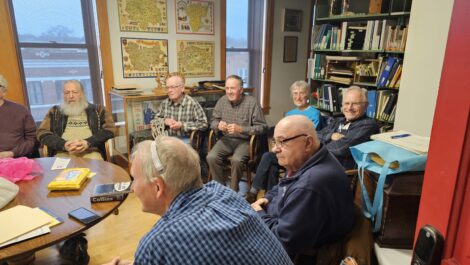
- The New Ulm Sprachklub creates an intimate circle for German language practice and storytelling. The group, founded about 12 years ago by George L. Glotzbach, continues to preserve German language and culture in New Ulm through conversation rather than formal instruction.
-
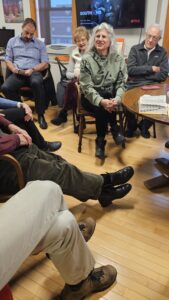
- Rosemary “Rosie” Geer, a member of the New Ulm Sprachklub for seven and a half years, encourages heritage speakers to share their stories and speak German during the club’s monthly meetings.
-
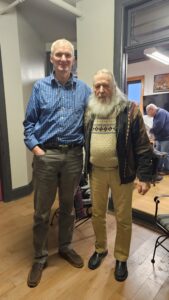
- Native German speaker Boje Siebels (left) from the Mankato German-speaking club and local German speaker and New Ulm Sprachklub member Henk Exoo at Sunday’s meeting.
-
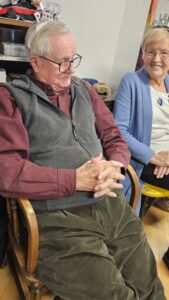
- Gerhard Christ, wearing a crown to honor him as a native German speaker, sits next to fellow native speaker Heidi Hinkley at a recent New Ulm Sprachklub meeting in New Ulm, MN. If you want, I can also polish these captions slightly so they read more smoothly for publication while keeping the details intact.
Local News
NU Public Utilities offers cold snap tips
NEW ULM — New Ulm Public Utilities (NUPU) staff offers a number of tips to avoid frozen water pipes and reduce ...
Two women leading the charge ‘to talk about it’

Fairfax doctor known for making house calls retiring after 57 years
A hub for German language
New Ulm man accused of burglarizing smoke shop
NEW ULM — A 46-year-old New Ulm man faces four felony charges following a Jan. 14 burglary at the Smoke N Cloud ...