Focus on fraud
Local legislators cite fraud as main issue of 2026 legislative session
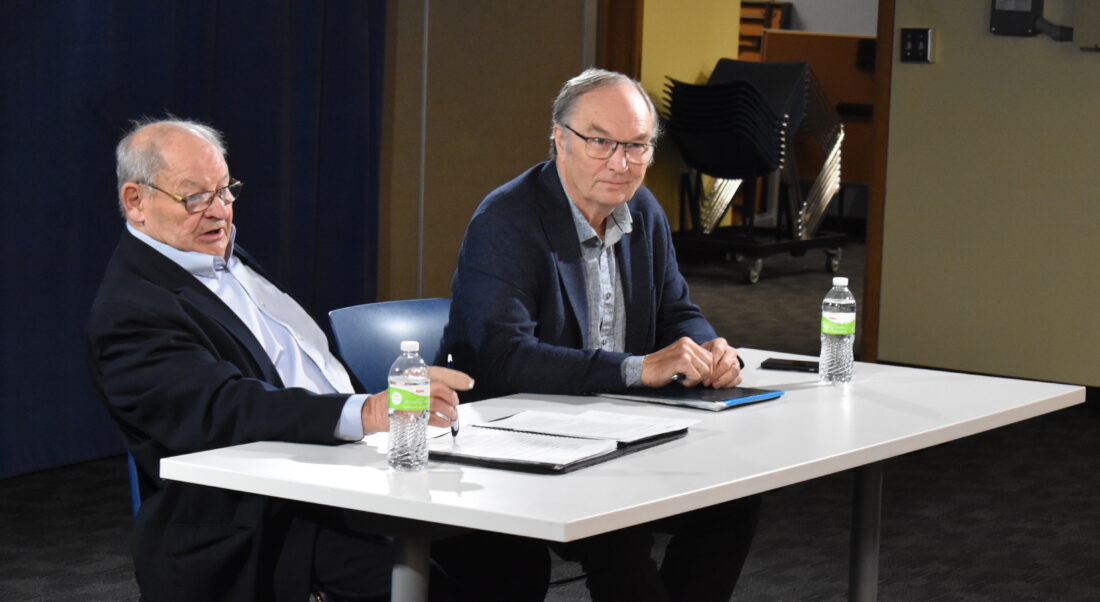
Tuesday’s legislative town hall featuring State Sen. Gary Dahms, R-Redwood Falls (left), and State Rep. Paul Torkelson, R-Hanska (right) focused on fraud. The two lawmakers believe the state’s fraud scandal will be at the center of 2026 Minnesota legislative session.
NEW ULM – State Sen. Gary Dahms, R-Redwood Falls, and State Rep. Paul Torkelson, R-Hanska, made it clear that fraud would be the top topic of Minnesota’s 2026 legislative session.
The two legislators held a town hall discussion on Tuesday at the New Ulm Public Library. At the start of the town hall, Torkelson addressed the recent news that Gov. Tim Walz was not running for re-election.
“Frankly, I am not too surprised that he decided not to run,” Torkelson said. “He is getting a lot of criticism on these fraud issues that have been going on for a long time, but have reached a boiling point on the national level.”
He cited the Feeding the Future fraud case that amounted to hundreds of millions of dollars.
“It’s been an ongoing problem since COVID,” he said. “It felt like the state government was shoveling as much money out the door as quickly as they could to stimulate the economy and we didn’t really have the accountability in place that we should.”
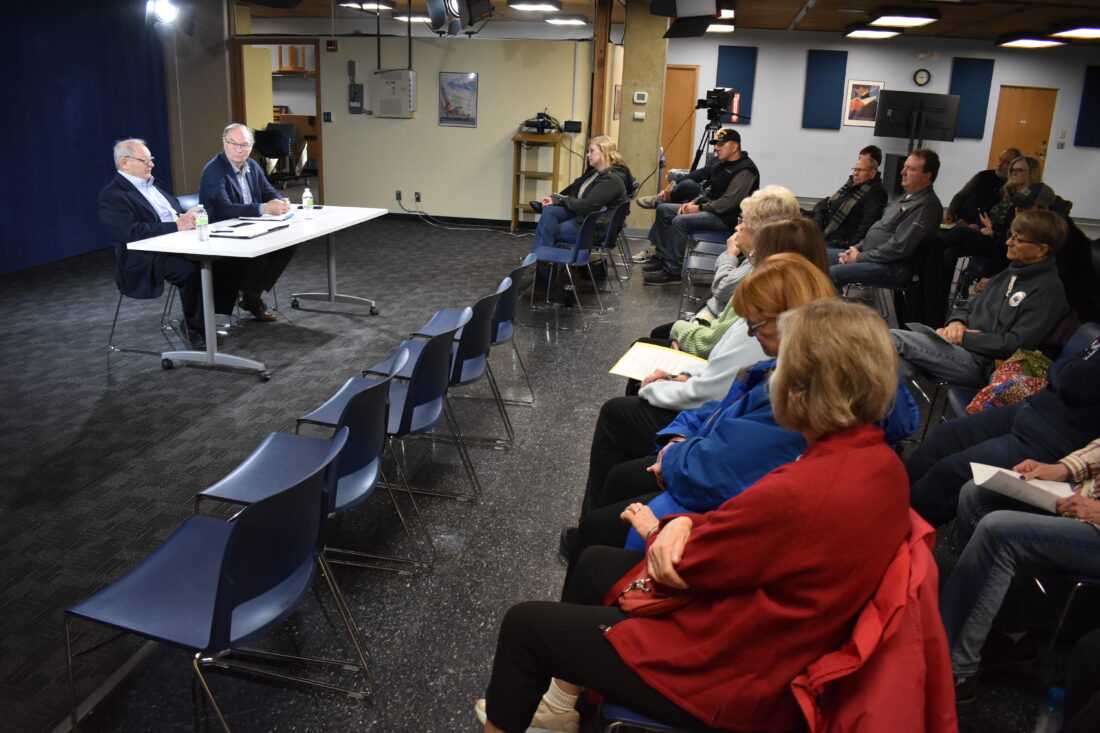
State Sen. Gary Dahms, R-Redwood Falls (left), and State Rep. Paul Torkelson, R-Hanska (right), take questions from constituents during a town hall discussion at the New Ulm Public Library ahead of the 2026 Minnesota legislative session.
Torkelson said last year the GOP and DFL were tied in the House of Representatives. This led to the appointment of co-chairs in each committee. The only committee with a Republican majority was the Committee on Fraud.
“It is still operating today and is looking at these fraud issues in Minnesota,” Torkelson said.
Asked if someone on the local government should be tasked with making sure nonprofits are more accountable, Torkelson said accountability was the missing piece of the equation.
“It is really the responsibility of the administration that the funds that are doled out to people who will use it appropriately,” Torkelson said.
Dahms said he believed some of the fraud occurred because people working at the state department were unaware of the regulations for issuing funds to nonprofits.
“We have to make sure everyone is on the same page,” Dahms said. He added the problem was not limited to nonprofits, saying there were other areas of fraud that needed to be investigated.
Dahms said the fraud investigations began with Feeding the Future, but during the investigation, it continued to expand out into other organization, including education departments with the “ghost student” fraud.
Torkelson said there was a program created that gave aid to college students, but there were not restrictions on how the funds were spent.
“Students would apply to the program, get a grant, take the money and then not show up for class,” he said. “The problem was with the way the program was designed. There was no accountability built into the program, so it was abused.”
Torkelson added that there were innocent people who could have used these programs, who lost out because of the fraud.
Asked if the state needed to add auditors or an inspector general, Dahms said the Republicans in the House and Senate tried to pass a bill to create an inspector general position two years ago, but it failed to pass. Last year, the bill passed through the Senate, but the House DFL did not take up the bill.
Dahms said the bill will be coming back this year.
Torkelson said he believed the bill would probably receive more attention this year, but believed it should have been passed earlier.
Other topics outside of fraud included a potential bonding bill. Torkelson said there was a strong chance a bonding bill would be approved this session. He said there was a decent bill last year that focused on infrastructure improvements and this could happen again this year. New Ulm’s Center Street lift station was one of the potential bonding projects on the list.
“It has been on the list for a while,” Torkelson said. “We hope to get that across the finish line.”
Torkelson said the state budget for the 2026-2027 biennium was passed in 2025 and signed into law. He said is possible that Walz could propose a supplemental budget, but he did not anticipate a lot of additional spending beyond the bonding bill.
Dahms said he was also optimistic there would be a bonding bill. He was not certain what the spending budget would be. He said they would need to wait until the February forecast was complete.
Dahms also addressed the recent political violence that hit Minnesota with the murder of Rep. Melissa Hortman and her husband Mark Hortman, as well as the shooting of Minnesota State Senator John Hoffman and his wife Yvette Hoffman.
Dahms called the shootings a tragedy and that Hortman worked hard in the legislature and there was absolutely no reason someone should lose their life for working toward what they believe in.
As a result of the shootings, there was increased security at the state capitol and greater efforts to protect legislators at home.
Later in the meeting, Morgan Blackstad, founder of Minnesota United Against Domestic Violence, asked the legislators about the need for criminal reform.
Blackstad said domestic violence was a public safety failure that allowed repeat offenders to plead down charges and return to the community to commit other acts. She cited the recent double murder of Justin Reinarts and Tabitha Trescott, in which the alleged suspect had a criminal history of assault charges.
“When the state has the power to protect, but chooses not to, who bears responsibility for what happens next?” Blackstad asked.
Torkelson said he had spoken with Blackstad before on this issue and was willing to review and evaluate the proposals she had for combating domestic violence, which he agreed was a serious and ongoing problem.
The lawmakers were also asked about any state laws regarding Artificial Intelligence (AI). Dahms said there is a lot of discussion about AI from the Republican and Democratic caucuses, but he was not aware of any specific laws being drafted.
Dahms expressed some concern for the growing number of data centers needed to maintain AI.
“They take so much electricity to run and so much water to cool,” he said. “Do we have those resources available?”
Dahms said there are discussions in the state senate about data center requirements, but no bill is coming forward.
One of the final questions of the town hall was on whether there was any way to prevent billionaire’s from using money to influence elections.
Dahms said he did not believe there was currently a workable way to prevent big money influence.
Torkelson said it was difficult to make any changes to campaign financing reform because this typically fell under the First Amendment and free speech, meaning those with money could use it to fund elections.
“I would hope the electorate is smart enough to figure out what is truth and what is being blown out of proportion, but I am not always sure that is possible,” he said.
The 2026 Minnesota State Legislative session is set to begin Tuesday, Feb. 17.
-
- Tuesday’s legislative town hall featuring State Sen. Gary Dahms, R-Redwood Falls (left), and State Rep. Paul Torkelson, R-Hanska (right) focused on fraud. The two lawmakers believe the state’s fraud scandal will be at the center of 2026 Minnesota legislative session.
-
- State Sen. Gary Dahms, R-Redwood Falls (left), and State Rep. Paul Torkelson, R-Hanska (right), take questions from constituents during a town hall discussion at the New Ulm Public Library ahead of the 2026 Minnesota legislative session.
Local News
County minimum elected official salaries set
NEW ULM — Brown County Commissioners unanimously approved a resolution setting minimum salaries for elected ...
Focus on fraud
Brown Co. Board cuts public notice costs
NEW ULM — Brown County will now advertise its transportation project bids on the county website. In an effort to ...
State Street Theater seeks volunteers for ‘Spruce-Up’ day

‘Truly an honor’