New Ulm Public Schools District reviews its report card
Students improving in math, holding strong in reading and waiting on science
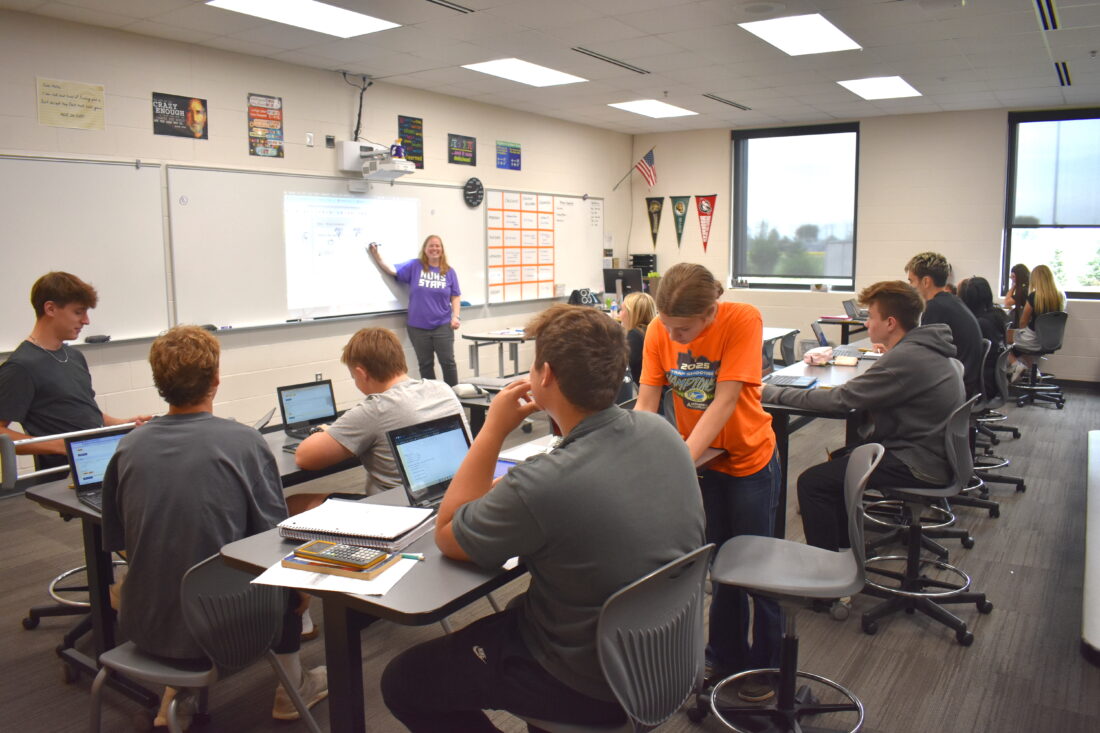
New Ulm High School teacher Jessica Hemiller gives trigonometry instructions to 11th and 12th grade students.
NEW ULM – The Minnesota Department of Education (MDE) released the 2025 report card, and New Ulm Public Schools saw major improvements in math scores and continued to show high proficiency in reading.
Each year, MDE releases a benchmark report measuring the percentage of students meeting the standards on the Math and Reading tests. This year, 35% of Minnesota students were proficient in math, and 51% were proficient in reading. By comparison, the New Ulm Public School District had higher proficiency with 55% of students proficient in math and 62% proficient in reading.
New Ulm High School Principal Mark Bergmann was pleased with these scores but believes the district could continue to grow. The district already saw significant improvement over last years in math proficiency.
Bergmann said New Ulm’s 2024 math proficiency score was the lowest he had seen in his tenure as principal. Less than half of students were proficient in math, with only 43% meeting or exceeding the standard. The school was determined to shift math proficiency in 2025 and was ultimately successful. Math proficiency increased by 12% with 55% of students proficient in math.
Bergmann said they were able to achieve this proficiency shift by focusing on the school’s weak areas.
“That’s why we collect the data to help us study where we need improvement,” he said.
The test data is divided into different subject areas called “strands.” Each strand is given a benchmark score to determine if students are meeting the standard in that area. In some math strands, New Ulm students were exceeding the standards, but in others they were failing to meet the standard.
Bergmann said the school was able to focus on the strands that were below standard.
The challenge for New Ulm Public was making sure each student had taken the necessary math courses before taking the MCA Math test.
Bergman said high school students are required to take the MCA Mathematics test in 11th grade; however, the test includes questions that cover the entire math curriculum. Some of the juniors taking the test had not yet completed the coursework before taking the exam, resulting in lower scores.
To correct this problem, the school began introducing some of the coursework in the earlier grades to better prepare them for the test.
Bergmann said they were in effect teaching for the test, but the strategy worked.
In reading, New Ulm public’s test scores remained the same between 2024 and 2025 with 62% efficiency, well above of the state average of 51%.
Bergmann said with reading, NUHS students have always maintained a high proficiency but as with math, he believed the school could do better.
The reading benchmark data was also broken down into strands to determine which areas to focus on for improvement, but unlike with math, there was no obvious problem areas in reading for New Ulm public students. According to the data, NUHS is meeting proficiency in every reading strand. However, the school was not exceeding proficiency in any areas of reading.
Bergmann compared it to being on a high school football team with a 4-4 record.
“It’s not a bad team, but they are not winning any championships,” he said. The only way to improve is to keep drilling with students.
One of the approaches the school is taking is to make reading proficiency a curriculum-wide goal. Bergmann said to improve reading proficiency, it might seem like a good idea to have the English Department work harder, but said it needed to be every department’s responsibility.
“You do as much reading in social studies as you do in English,” Bergmann said.
Bergmann, a former science teacher, called reading “the nucleus of all learning.” He believed that with a strong reading foundation, students could have access to the depth of knowledge in any subject.
The school is also working with the FastBridge program to help screen students for dyslexia.
Bergmann said there are interventions available to help students with dyslexia, but it only work if they know which students need help.
The FastBridge reading interventions are usually done in ninth grade, with students taking the MCA Reading test in 10th grade, giving the school lead time to prepare student.
Aside from the MCA test data, Bergmann is proud of NUHS’s scores on AP and ACT tests. NUHS scores higher than the state average and the national average for AP Human Geography, AP American History and AP World History. Bergmann said the school’s World History AP scores were the crown jewel for the school, with an average score of 4.19 out of 5.
In ACT scores, the school averaged 23.3, compared to a state average of 20.7 and a national average of 19.4.
Bergmann was also pleased with the school’s science scores; however, the 2025 report card data for science was not yet available. Bergmann said the state gave a new science test to students this year and
The MDE is still determining how to score in terms of whether the standard was met.
In the past year’s the New Ulm public has scored high in science.
“Last year in science, our students blew the state out of the water,” Bergmann said. In 2024, New Ulm students were 69% proficient in science, with 27% of students exceeding proficiency.
“We are really interested to see what a new test will do to our scores,” Bergmann said.
Bergman said that, unlike the math and reading tests, in which students took the exam in 10th or 11th grade, the science test was done after students completed their biology course.
Bergmann believes this is a better way of giving the test and has raised question about why the same thing cannot be done with the math assessment. He has raised this question before, but the state has given no explanation.
Local News

Filzen named Tourism Person of the Year
Bartels receives Hub Club’s Service to Ag Award
Brown Co. board OKs propane tank location
NEW ULM — Brown County Commissioners unanimously approved placing a portable propane tank in the northeast corner ...
Zimmerman pretrial hearing delayed until March
NEW ULM – The omnibus pretrial hearing for Randy Zimmerman for the first-degree murder of Justin Reinarts and ...

Three-peat champions