
Equity: are we ready for change?
Trending
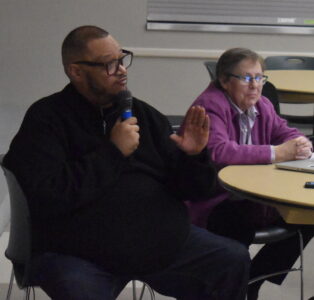
NEW ULM -- A special Equity Training presentation was held at the New Ulm Community Center Thursday, with speaker Steven Wilson.
Wilson is a community engagement specialist from the Minnesota Department of Human Services. Wilson has helped communities and organizations with equity work for years. His goal is to conduct grassroots equity work and address disparities in the community.
Wilson began the talk by asking those in attendance to define equity. The common answer was equity was fairness with just practices and policies. Equity is different from equality in that equality implies treating everyone the same based on the assumption of shared experiences. Equity is understanding that not everyone has a shared background.
Wilson said after the death of George Flyoyd, it became clear there was still a great racial disparity in Minnesota and the state had not been the same since.
He said according to demographic statistics, about 25% of Minnesota's population will be people of color by next year.
"Are people actually ready for this change?" Wilson asked.
During the presentation, Wilson was added by Beth Grainger, a former social service professor. Grainger provided state statistics. According to the American Communities Survey conducted between 2013 and 2017, Minnesota had some of the largest disparities between Whites and Blacks in the nation.
In Minnesota, the poverty rate for Whites was 7% but for Blacks, it was 32%. Unemployment was 8% for African Americans and 3% for Whites. Bank lending practices also found African Americans were more likely to have loan applications denied.
Homeownership was cited as one of the greatest drivers of this disparity. Land and home ownership are higher among Whites in Minnesota. Historically, there have been the greatest obstacles in homeownership among African Americans due to racial covenants.
A racial covenant was a practice in which a community would prohibit a person of color from buying homes in a neighborhood. Sometimes the deed to a home would prohibit selling the home to a person of color.
Grainger said racial covenants are no longer legal in the United States, but some of this language is still in deeds to older homes.
Wilson said when he purchased his first home in Minnesota, the deed said "Do not sell this to a negro."
Grainger confirmed there were certain portions of Minneapolis that African Americans were prohibitive from living due to redlining. These housing disparities were not limited to the Twin Cities.
Grainger cited an article in the Mankato Free Press from last year titled "Racial Covenants and Mankato." The article documented seven residential areas (and one cemetery) with racial covenants in Mankato, some of which were imposed as late as the 1950s. Grainger said she could not find any articles about racial covenants in Brown County.
Even though racial covenants could no longer be legally enforced, the impact was still felt. Entire generations were unable to build wealth from their homes.
"How do we make things fair?" Wilson asked, "How do we see things from a different lens?"
He believed that without community conversations, nothing would be resolved and people would keep repeating the same struggles.
Human Rights Commission member Casey McMullen asked Wilson and Grainger what the New Ulm community could do to be more welcoming to different groups.
"There has to be community collaboration," Wilson said. "Actually, truly respecting the opinions of what you hear, and you need to have follow-through."
Obehi Okojie, a pediatrician at New Ulm Medical Center said in her experience, the loudest voices in New Ulm were those who felt diversity was hurting New Ulm.
Wilson called this the privilege of feeling threatened. People who historically have been privileged by a system are threatened when there is a potential change.
"They are afraid of change because they are comfortable where they are at," he said. "They have a history of being comfortable."
Wilson reminded the audience that the second worst riot in American history occurred in Minnesota following George Floyd's death.
"We have an elephant in the room that needs to be addressed, what ever community decides to address that elephant, is the community that will be ahead."
Wislon's advice for working toward equitable communities was creating authentic relationships, active listening with humility and following through on empathy.
"The best communities are the ones that are the most unified," he said.
Human Rights Commission will host the next equity training class in March. The focus of the next class will focus on diversity in schools.