Reflecting on reconciliation ride
-
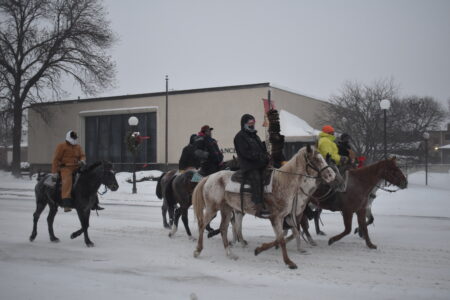
- Dakota riders on the 38+2 Reconciliation Ride go through Downtown Minnesota Street with Staff Holder Wilfred Keeble in front. Keeble said many riders felt profound sadness when they walked through New Ulm.
-
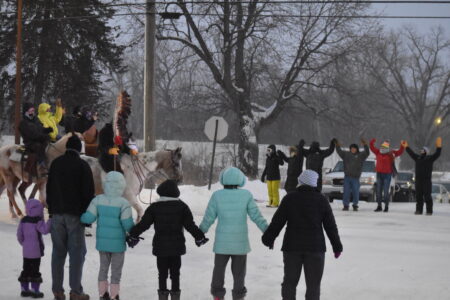
- The crowd waves and clasp their hands as the 38+2 Reconciliation Ride led by Staff Holder Wilfred Keeble walks through New Ulm Dec. 23, 2022. Keeble said the ride has helped many throughout the years work through generational trauma.
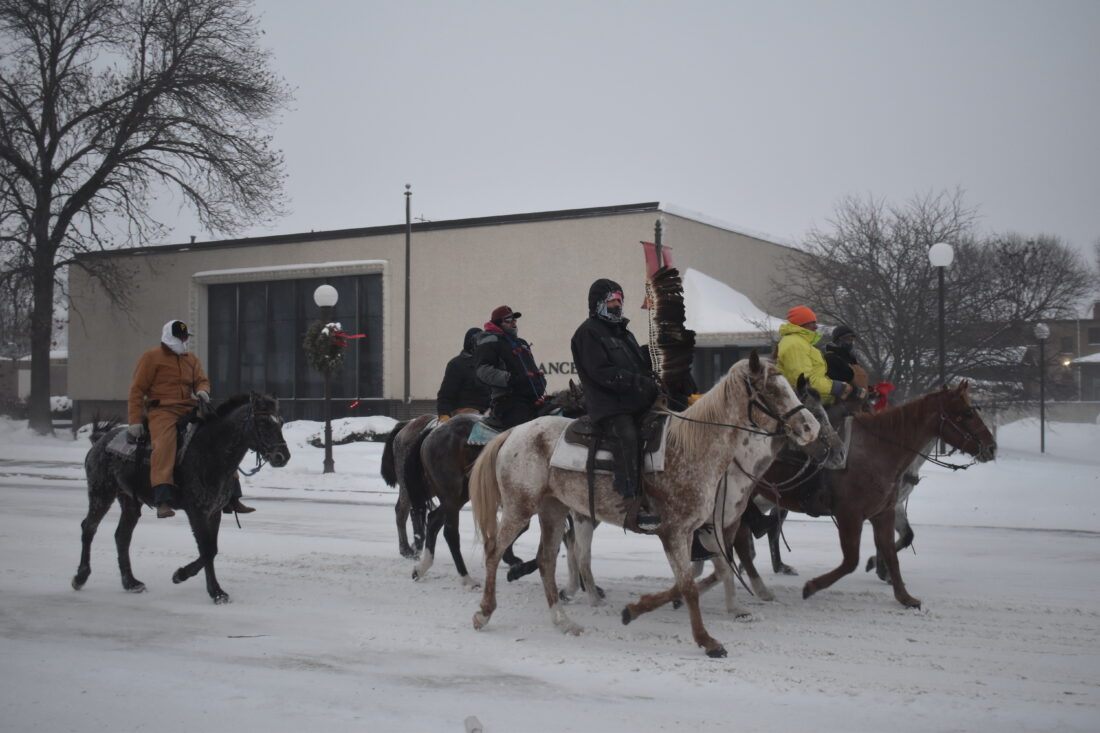
Dakota riders on the 38+2 Reconciliation Ride go through Downtown Minnesota Street with Staff Holder Wilfred Keeble in front. Keeble said many riders felt profound sadness when they walked through New Ulm.
NEW ULM — For the first time since 2004, the 38+2 Reconciliation Ride did not take place.
The ride was a storied tradition for many Native Americans, who at one time or another rode from Crow Creek or Lower Brule SD to Mankato MN. Original rider and Lead Staff Carrier from 2015-22 Wilfred Keeble said the Dakota uprising was an important part of their history and why they marched.
“There was encroachment, westward expansion, genocide, corrupt politics, and treaty violations,” he said. “There were a lot of things that upset the people. It was all made to be okay because the US government would make a treaty with them. The last straw was when some people were denied food rations; they rose up and took food by force because they had kids and elderly who were starving. One remark thrown at them was “Let them eat grass.” That was the attitude against them.”
The aftermath of this uprising was the hanging of 38 Dakota men in Mankato on Dec. 26, 1862. Initially, 303 Native Americans had been sentenced to death. Abraham Lincoln looked over each case, and whittled it down to 38. The plus two came as two more men were hung two years later. After this time, Keeble said the suffering continued as they were not able to continue practicing their religion and way of life.
“We had to go to the Indian agent officers and ask them how we deal with the loss,” he said. “They told us to take a bottle and drown our sorrows. They would preach the Bible. We couldn’t practice our ways so we had to use their way. A lot of people tried to hold on to the old ways. There was a place in Canton SD called the Hiawatha Insane Asylum. With the stroke of a pen, anyone could be sent there if they weren’t deemed sane. Many preachers were sent there to squash who we are so we could adapt to mainstream society.”
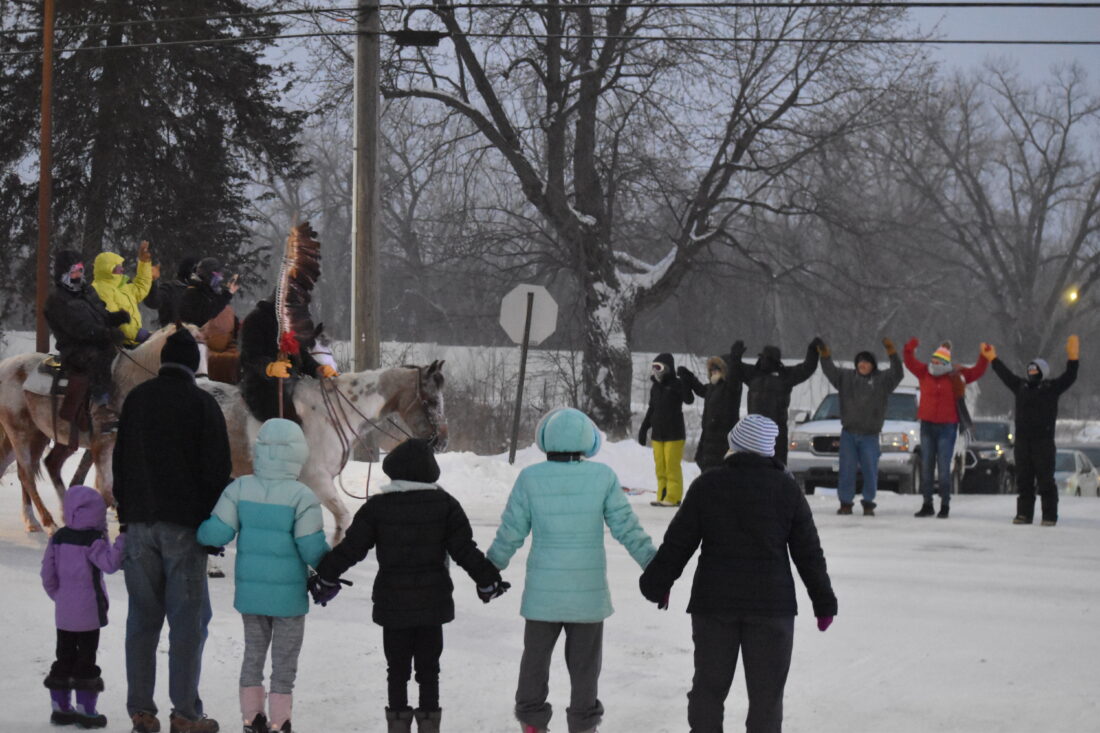
The crowd waves and clasp their hands as the 38+2 Reconciliation Ride led by Staff Holder Wilfred Keeble walks through New Ulm Dec. 23, 2022. Keeble said the ride has helped many throughout the years work through generational trauma.
The idea originally came to Spiritual Leader Jim Miller in a dream. Keeble, who talked to Miller extensively throughout his life, said Miller’s dream called for a ride between Crow Creek SD and Mankato. The Crow Creek reservation was where the Mdewakanton Dakota tribe of Minnesota was exiled after the Dakota War.
Miller was told in his dream this ride would be one of reconciliation and healing, traveling from where they were exiled to the place where their Dakota brethren were hanged. Keeble said riding on horses was an integral part of the ride, as the animal world aided the healing process.
“The horses were very helpful in the healing,” he said. “Our ancestors knew this and understood the kind of help the animal world was. The eagles, bears, wolves, horses, buffaloes, deer, elk. They are all helpers and our ancestors understood the relationships they had with animals.”
Though the event would grow in attendance and support as the years went on, the initial reception was frigid. Keeble said the first year the ride was done, they were stopped by Minnesota troopers and told they had to stay in South Dakota on their authorization.
“The first reaction was the same reaction the ancestors got in 1862,” he said. “They didn’t understand what they were doing. There wasn’t any understanding between natives and non-natives. They came in and said ‘Hey, if you’re going to do this you have to do it this way.’ With this ride, we were sharing cultures and vice versa. That’s how it was supposed to be done. Re-evaluate our relationship. I give, and you give. Not the usual I give and continue to give and you take. That relationship needs to change.”
On top of reconciliation and healing, Keeble said the event was also a prayer ride. It wasn’t until 1996 with a revision of the Religious Freedom Act all Native American religious ceremonies were included. Keeble said the ride is a way for them to fully practice their beliefs and prayers when they had been stifled for decades.
“The natives of this continent were granted full religious freedom in 1996,” he said. “The original inhabitants here were granted full religious freedom, in our own home.”
During the last reconciliation ride in 2022, they went through New Ulm for the first time. Keeble said the riders experienced sadness and sorrow, from the experiences their ancestors had gone through during the Dakota war.
Keeble said he was first told by Miller in 2018 the rides would soon be coming to an end. Miller told Keeble closure would come and they would finish the reconciliation ride. When it was announced to the public, Keeble said the emotions he saw were shock, bewilderment, disbelief, and sadness.
Though the 38+2 Reconciliation Ride was coming to an end, Keeble said Miller knew there were still many rides going on besides theirs. Keeble said the Women’s and Children’s ride from Santee NE to Crow Creek SD was one example of a ride he had been involved in recently. The ride seeks to honor missing and murdered indigenous women and children (MMIWC). Keeble said a horse blanket donated by Crow Creek has been to several places.
“We asked what we could do,” he said. “We know with the horse blankets it was something we could do. Nobody knows how many [MMIWC] are out there. After we got the blanket from the Women and Children’s ride we took it into Mankato. The following summer, we took it on the women’s and children’s ride and took it into the capital in Pierre South Dakota.”
Since the last reconciliation ride, Keeble said the biggest thing that happened was the death of Miller in February. The loss was mourned by many, as Miller and the rides had a profound impact on thousands of both native and non-native peoples. Overall, Keeble said he believes the mission was successful in helping many reconcile and find healing.
“A lot of them talk about healing the generational trauma. A lot of them, even non-natives are praying with us. It helps more than anything with understanding. Last year, the streets were lined with people in Mankato. They were praying with us. It helped a lot of people. The ride reached around the world.”
It is currently unknown if the reconciliation ride will be brought back in future years. Currently, the Miller family is mourning Jim Miller’s death, as it is customary in Dakota culture for there to be a year of mourning. Tribal elders will gather in 2024 and determine the future path through traditional prayer and discussion.
Local News
Hundreds hunt for Easter eggs
Wabasso water project delayed
WABASSO — A water treatment project in the city of Wabasso is temporarily on pause due to “unforeseen ...
NU native “Swede” Wagner joins MN Music Hall of Fame
Wabasso wrestling future bright, 6th-grade team wins state
Aqua‑Bunny makes big splash