
Cemetery tour presents New Ulm’s pioneers
Trending
NEW ULM -- Remembrance activities for the 1862 US-Dakota War continued on Sunday with a tour of the pioneer section of the New Ulm City Cemetery.
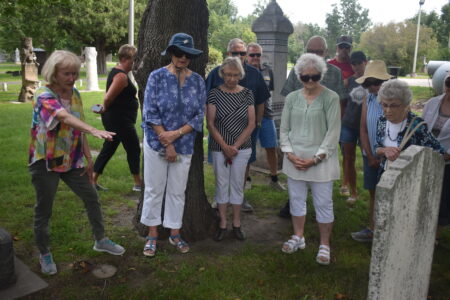
Wayne Wagner, Darla Gebhard, and Sue Ullery were on hand to lead attendees through the cemetery's storied history. Each guide had their own group and took separate routes, telling different stories and providing a unique experience from the others.
Gebhard told several stories during her version of the trip. She told the tale of how baker Jacob Castor lost his life trying to bring back food to the safe zone during the battles of New Ulm. He disguised himself with a buffalo pelt to avoid detection by the Native Americans. Unfortunately, his plan was not known and when he ran into the safe zone he was shot and killed. A lesser known piece Gebhard covered was what happened after his passing.
"On this side you will see his wife remarried," Gebhard said. "Elizabeth Castor married Conrad Zeller, who had also lost most of his family members out in Milford where over 63 people were killed in the conflict. What you’ll find if you read the settlers histories is many of them quickly remarried to continue living. You could not farm if you didn’t have a husband. And if you were a husband left with a lot of children you quickly needed to find a wife in order to carry on and continue making a living after this disaster."
A long-standing tradition covered by Gebhard was the laying of tokens at the life-size monument of Allie Peterson, who died at the age of eight in 1883 due to a congenital heart defect and has a
"When I was young, we used to hike out to the cemetery," Gebhard said. "We would look at Allie and we would be in awe [because] this was unusual. Then when I started working at the museum, Allie took on this whole persona. You had to come out to the cemetery at night. You had to get out of the car and you had to touch the monument. Then you had to leave a token to prove you went all the way in and touched him. Now Allie gets coins all the time and I have little stuffed animals and sometimes they do plant things."
Dina Skalicky was one of the attendees in Darla Gebhard's group. As Gebhard's sister, she has been on the tour many times. She said a particular set of knowledge and story have piqued her interest the most.
"I enjoy re-hearing the symbolism for the stones. I forget [the meanings]. She never forgets, but I do. And I enjoy that. My favorite [story] is the little boy [Allie Peterson] and putting the pennies on the stone, that’s my favorite part."
The commemoration of the US-Dakota war will conclude Thursday, August 24 with Bits and Bites of History featuring Jerry Weldy from 7-8 p.m. It will focus on the war of 1862 outside of Brown County and be held at the Brown County History Museum Annex.