Assessments: Hermann severely ailing
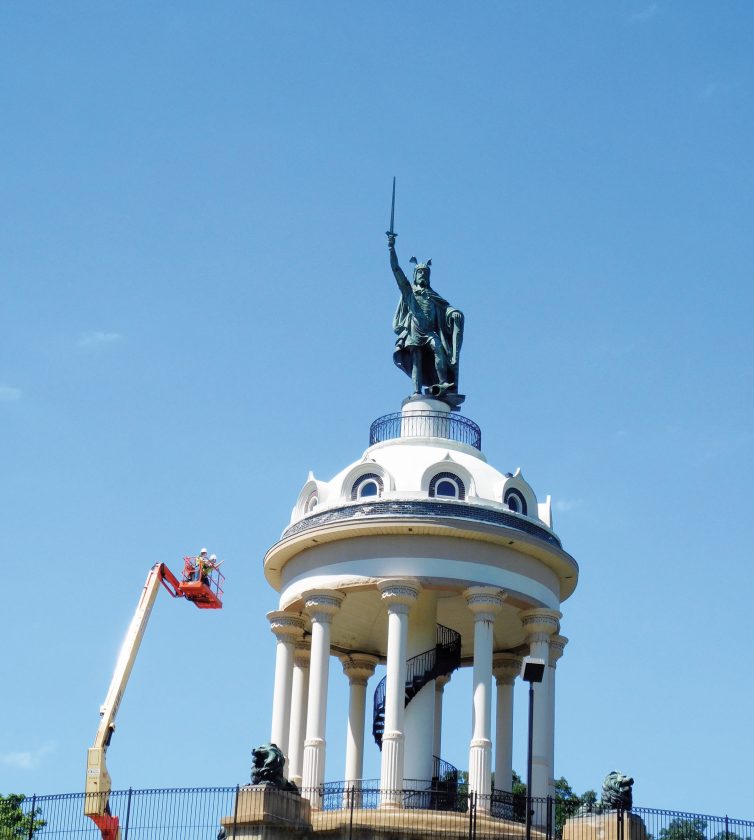
NEW ULM — Hermann’s condition needs improvement, according to a report on the physical state of the monument to be submitted Tuesday to the City Council.
The iconic monument needs extensive reconstruction or restoration and possibly complete replacement, according to the information provided in the council’s meeting agenda.
The report on the monument includes findings from an assessment by MacDonald & Mack Architects in June 2019 and core drillings to assess the monument’s structure done by Midwest Engineering in February.
City staff will propose a three-step plan for addressing the monument’s needs:
• deconstruct the monument and document the process,
• draft an architectural reconstruction plan,
• reconstruct the monument based on the reconstruction plan.
Similar materials would be used in the reconstruction, such as granite, limestone brick, concrete, steel and glass.
Significant funding will be needed for the project, according to staff. Possible funding sources could include state grants, bonding, federal and city appropriations and private grants or donations.
A tentative timeline for the project has the monument deconstructed during 2026- 28 with reconstruction from 2028-30.
In other business, the council will consider updating the city code to include licenses for on-sale micro distiller cocktail room licenses and micro-distillery off-sale intoxicating liquor licenses. The city recently received an inquiry about applying for these licenses, but neither was detailed in the city’s codes.
The on-sale micro distiller cocktail room license would require an applicant to hold a micro distillery license issued by Minnesota Alcohol Control. The license authorizes the on-sale of distilled liquor produced by the distiller for consumption on the premises of or adjacent to one distillery location owned by the distiller.
The license holder may apply for a Sunday license without the requirement of having a food license. However, they may operate a restaurant at the distillery. The fee would be set by the local municipality.
The micro-distillery off-sale intoxicating liquor license allows the off-sale of distilled spirits — one 375 milliliter bottle per customer per day of product manufactured onsite. Off-sale hours of sale must conform to hours of sale for retail off-sale licensees in the licensing municipality; and no brand may be sold at the micro-distillery unless it is also available for distribution by wholesalers.
Local News
Hundreds hunt for Easter eggs
Wabasso water project delayed
WABASSO — A water treatment project in the city of Wabasso is temporarily on pause due to “unforeseen ...
NU native “Swede” Wagner joins MN Music Hall of Fame
Wabasso wrestling future bright, 6th-grade team wins state

Aqua‑Bunny makes big splash