
Writer captures the legendary stories of the lumberjacks
Trending
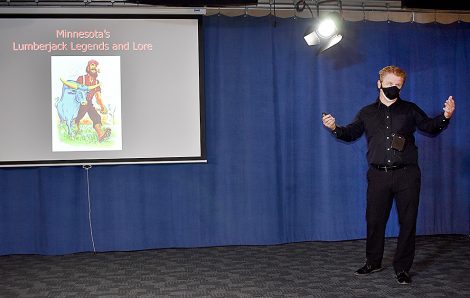
NEW ULM -- Author and researcher Chad Lewis visited the New Ulm Public Library Monday to share tall tales and legends about lumberjacks.
Lewis has spent the last 30 years traveling the world looking for the strange and unusual. This includes visiting odd roadside attractions or searching for the mythical creature. The two interests collide with lumberjack legends. His presentation covered the history of the lumber industry and the legends that were created from it.
In Minnesota, the lumber industry was at its heyday from 1800 to the 1900s. During this period lumberjacks would live lumber camps through the winter. Lewis said lumberjacks worked during the winter for several reasons. First, there were no mosquitos. Second, it was easier to pull sleds of logs along ice roads. Third, many of the lumberjacks were farmers in warm months.
Lumber camps were built to last a season. The lumberjacks stayed in camp all season, living in a bunk camp. It was in the bunk camps the lumberjacks shared stories. The more stories were told, the more they were exaggerated and embellished.
Lewis said the most famous lumberjack legend is Paul Bunyan. Several states claim to be the birthplace of Bunyan, including Minnesota. Lewis said the oral tales of Bunyan began in Tomahawk, Wisconsin in the winter of 1885; however, the first written account came in a Minnesota newspaper, The Duluth News Tribune in August 1904.
Lewis said one of the misconceptions about Bunyan is his physical appearance. In the early days, Bunyan resembled a caveman. In a 1916 drawing, Bunyan looked like a prehistoric wild man. His image slowly changed over the years and eventually took on his giant statue with red flannel look. Babe the Blue Ox would be added to legend later, followed by other supporting characters.
In Minnesota, there are several Paul Bunyan attractions scattered around the state. Some are statues, but others claimed artifacts related to Bunyan, including the massive walleye he caught in Rush City or the giant bobber he used in Pequot Lakes.
One of the most famous Bunyan artifacts is his ax. For years, the Minnesota Gophers and Wisconsin Badgers football teams compete over control of his ax. Lewis said Wisconsin currently had controlled the ax more than Minnesota, but only by a difference of two games. Minnesota will have another chance to recover the ax this year.
Bunyan was far from the only legend created by lumberjacks. Lewis said during this period the great woods was considered endless and no one knew what creatures lived in them.
The hodag was a popular legend. The animal resembled prehistoric dragon-style monsters. The creature is believed to be created by Eugene Shepard. Shepard even claimed to have captured a hodag and would exhibit the creature for the public. It was exposed as a hoax, but that made people want to see it more.
Lewis said every year he is contacted by people who want to hunt a hodag. According to legend, the hodag was not that dangerous because it only eats white bulldogs. This is the reason there are so few white bulldogs.
The hugag was a giant moose-like creature that has no knees. It sleeps by bracing itself up against a tree. Lumberjacks would cut a tree halfway through to a let a hugag knock the rest of it down.
Many of the legends told of creatures that were resentful of lumberjacks destroying their habitat. The agropelter was a monkey-like creature that would wait on the treetops and attack people passing through the woods.
Splinter Cats were large cougar-like animals that hunted animals in trees and would smash head-first into the tree to scare out animals. Sometimes they mistook lumberjacks for trees and crashed into them.
As the lumber industry changed, the need for lumber camps went away and the culture is gone with it, Lewis said, and many of the original stories are lost to history. He explained that historians, sociologists and folklore writers never recorded the original stories because most of them were seen as too obscene. For this reason, most legends are more modern creations.
Lewis said the lumber history of the midwest will never be forgotten. It is impossible to forget how much the lumber industry influenced Minnesota.
He said Minnesota has the best Paul Bunyan roadside attractions. "You could spend a whole summer going to huge Paul Bunyan statues in the state," he said. "And it is always increasing. As more people embrace this culture and history, you get more roadside attractions."
For more information on lumberjack myths, visit Lewis's website at www.chadlewisresearch.com.