
City moves forward with garland study; will not tear down building
Trending
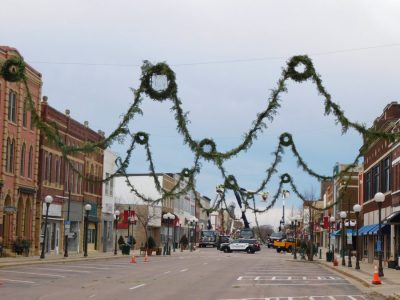
NEW ULM --The City of New Ulm will move forward with engineering services to look into designing new poles to support holiday garlands on downtown Minnesota Street.
In 2020, the holiday garlands were not strung across downtown Minnesota street because the anchor points on the buildings no longer support the holiday decorations.
To develop new decorating options, the city formed a garland committee. It was determined that if the city wanted to continue hanging the garlands, new poles will need to be installed at all intersections downtown. Before the poles can be manufactured, an engineering study must be conducted to determine where poles can be placed. Steam tunnels and utility lines run under the downtown area. Certain areas might not support new poles.
It is only after the engineering study that the city would be able to get an accurate quote on the poles.
Bolton & Menk is prepared to conduct the study. This service has a price range of $32,500 to $45,500. The cost of this service would be funded with the holiday decoration budget. The engineering service includes drawing anchors for the proposed 22 poles that give the city 11 strands of garland from 4th North to 1st South. The garland committee unanimously supported moving forward with the study.
The cost of the poles is unknown. The city has an estimate on the cost based on a similar project done in 2013. In 2013, a single anchor pole was $15,000. Assuming a 5% increase per year, each pole would now cost $21,106.50. For 22 poles, the price would be $464,200.
The potentially high cost of the project was previously a sticking point with the council. Authorization of this engineering study came before the council on Nov. 4 but was tabled because the council was evenly split. The council had only four members after the resignation of Lisa Fischer.
Councilor President Charlie Schmitz and Councilor David Christian were against the garlands based on cost. Councilor Les Schultz and Councilor Larry Mack were willing to move forward with the study, but the vote was tabled until after a new council took over.
Christian remained adamant against spending nearly $500,000 on garland poles. Christian said the people who have spoken to him on this issue think this is a ridiculous number to spend on poles downtown. He said he favored spending the decoration budget to create a holiday park in German Park.
Mack asked if instead of an engineering study for poles, the city could do a comprehensive study for downtown Minnesota Street.
City Manager Chris Dalton said a complete downtown master plan would take longer and could cost more later. The pole study would be quicker.
Schultz was on the garland committee and said after a year of discussion, the committee agrees New Ulm was the "city of charm and tradition," and the garland tradition was popular. A petition to keep the garlands received 5,000 signatures.
Schultz acknowledged that $500,000 for the poles was too much and he would not vote for that but said the city was only considering engineering services. Schultz said the only way to know the cost was to do the study. He said the poles could come in much lower at $300,000 or $350,000.
"We already said we are going to fundraise for this," Schultz said. "We were able to fundraise $300,000 for the amphitheater. You can't tell me we could not fundraise for this as well."
Garland committee member Heather Hammer said no matter what is done, a study is needed to determine if downtown can support this infrastructure. Other projects, like parklets, could benefit from this study.
Hammer said the garlands set New Ulm apart and bring in customers who support the downtown businesses.
Christian said he understood the passion for the garlands but did not know how this would be budgeted. He believes the city departments may be looking at significant cuts because of the pandemic.
Hammer said the committee was prepared to fundraise and she believes the community would support it. She said the city was not expected to cover the cost.
Christian believes there were other options. He had a hard time supporting the garlands when Sleepy Eye can receive 10,000 visitors for decorating a park.
"It's like we are stuck on the garlands. That's all we're going to do," Christian said. "For $40,000 I could do a Christmas City on Main Street. I got a hard time supporting it with the people who contacted me."
All the councilors admitted they received calls and letters from citizens supporting both sides. Council President Andrea Boettger said she received more calls and e-mails against spending money on the garlands, but would vote for the engineering service because she believes it was important to have this information. She did make it clear approving engineering services was not a promise the garland poles would happen. Boettger wanted to continue exploring other options for decorating. She said the garland committee was unanimous in its decision that this is how they should proceed and that should be taken into consideration.
Schultz made the motion to approve the engineering study, with a second from Councilor Eric Warmka. It was approved 4 to 1 with Christian voting against.
------
The council reversed its decision to demolish the building at 307 N. Minnesota St. and instead will look at repairing the structure.
The city has been dealing with maintenance issues associated with this property since July 2015. Currently, the north wall of the building is crumbling. The building owner has stated he did not have the money to fix the wall, leaving the city with two options, but both have potential hidden costs.
The cost of repairing the crumbling wall of the 307 N. Minnesota building is estimated at $108,000. The cost of demolition is estimated at $36,640. Demolition could be the lower-cost option, but 307 N. Minnesota abuts The New Ulm Journal building and the city does not know how big space is between the two.
The city is not sure if 307 N. Minnesota St. and The Journal have a common wall or separate walls. If this is not an exterior wall, the city would be responsible for covering it, potentially raising the cost. If the city is forced to fix the Journal north wall after the demo, the cost would go up to $60,000. Additional tuckpointing and hazard abatement would raise the cost further.
Building Inspector Ellwood Zabel said there were many unknowns on the numbers presented. He said the cost of fixing the building could be less than $108,000 or it could be more expensive, depending on how much of the wall needs to be fixed. He said whether the city went with a repair or demo it was difficult to know the final costs.
The greatest unknown is The Journal's northern wall. Historical documents on the properties were unclear about whether the buildings were attached. One map showed a space between buildings, another showed no space. Either way, he said the Journal's northern wall has not been exposed for over 100 years.
City Attorney Roger Hippert said the city had leaned toward demolition, but after discussions with staff, there are legitimate concerns with this option. Hippert said no bids had been accepted for the project and the city could still choose to repair the building. As city attorney, he warned the council the city could face further exposure by going through with demolition as The Journal was now a third involved party.
Christian said during the last meeting on the building he was willing to support either option as long as the city moved forward. In looking at the general costs he said the $108,000 to repair it left the city with a building that could be marketed and sold. If the building was demolished, it left the city with a parking lot. Christian said he believes repair might be the better option as the city might recoup some cost through tax assessments.
Warmka said he voted against the tear-down during the previous meeting because there were too many variables and risks to the Journal. The repair option gave the city a tangible structure to recoup the cost.
Boettger said the city has to move forward because the building is a safety hazard. She believes the city needs to take the option that puts the city at the least amount of risk. She said the repair option leaves the city with a possibly usable building and is the safest way to go.
Schultz made the motion to reverse the previous decision and direct staff to repair the wall of 307 N. Minnesota St. Warmka seconded the motion. It was approved by 4 to 1 vote with Mack voting against.
------
The council tabled an amendment to the City Attorney Service Agreement. The council wanted to review a possible service agreement with Brown County for criminal prosecutions amending the contract.
Nierengarten & Hippert Law Office has served as City Attorney for New Ulm since 1979. From 1986, until the retirement of Hugh Nierengarten in 2015, three or four attorneys were providing the legal services required to meet the City's needs, including all of the work involved in City criminal prosecutions, the civil matters involving the City and also the New Ulm Public Utilities.
Roger Hippert and Tom Borgen were able to cover these, but as of Jan. 4, Borgen has left the firm and Hippert is not in a position to provide all of the services as a solo practitioner. Hippert went into negotiations with the Blethen Berens Law Office to join. The addition of Blethen and Berens Law Office would require changes to the current retainer agreement. This new agreement would represent an increase in attorney fees for the city. Dalton said the increase was dependent on the number of billing hours, but the current increase is between $40,000 and $60,000.
Schultz made the motion to table. He said the council was still waiting for a second option and he could not support approving this amendment until seeing the county proposal. Schultz believes the other service agreement would be presented before the next council meeting.
Warmka seconded the motion to table. It was unanimously approved to table.
------
The council approved a resolution to enforce Minnesota statutes with local law enforcement in regards to vehicle noise.
City Engineer Joe Stadheim said the city received numerous complaints regarding loud noises caused by trucks jake braking at the Highway 14/Highway 15 interchange. The Minnesota Department of Transportation (MnDOT) has a process to authorize the installation of “Vehicle Noise Laws Enforced” signage along with state highway segments. This process requires the city to adopt a resolution stating that the City will enforce Minnesota Statutes, Sections 169.69 (muffler) and 169.693 (motor vehicle noise ordinance), with local law enforcement. The City would be responsible for the sign installation cost.
Sign installation cost, set by MnDOT, is $1,228.00 per sign. The City has three state highway entrances but would be credited one sign as there was a non-compliant sign removed in 2020 on Highway 14 near North Highland Avenue. MnDOT would credit the sign that was removed. The project cost is estimated at $2,456.
The councilors believe with further development on 7th North Street, the need to enforce these ordinances would rise. The council unanimously approved the resolution.
------
The council approved a parklet pilot program. A parklet is a small seating area or green space created as a public amenity along a sidewalk that would be placed in an existing parking space. This amenity would increase the outdoor seating area downtown.
The Downtown Action Team proposed a pilot program to allow the use of parklets in the downtown area. The team, along with input from city staff, developed standards to allow the installation of parklets. The requirements included: right of way use permit; a fee of $50 for the first year and $25 for each subsequent year; application deadline is March 15 of each year; cannot exceed three parklets total per block; parklets can be installed after May 1 and shall be removed before first significant snowfall or Nov. 1; written summary and sketch of the desired location; certificate of liability insurance ($1,000,000) for the permit calendar year and understanding that the parklets shall be open to all members of the public, regardless of the proximity to the storefront.
The application originally required 60% of property owners, business owners and residents within the same block to sign a petition approving the parklet. The council believes 60% would be a stumbling block for the project.
Hippert said it would be difficult to determine how many tenants were on the block.
Schultz believes 60% was too restrictive to fill a single parking spot.
Christian said this is the city's right-of-way. He asked the petition sign-off be simplified.
Boettger said the city only needed the buy-in from the businesses. She said tenants cannot typically park on Minnesota Street.
The council agreed to keep it simple and leave approval to the first-floor occupant.
Christian made the motion to approve, with a second from Warmka. It was unanimously approved.