Forum centers on land, water
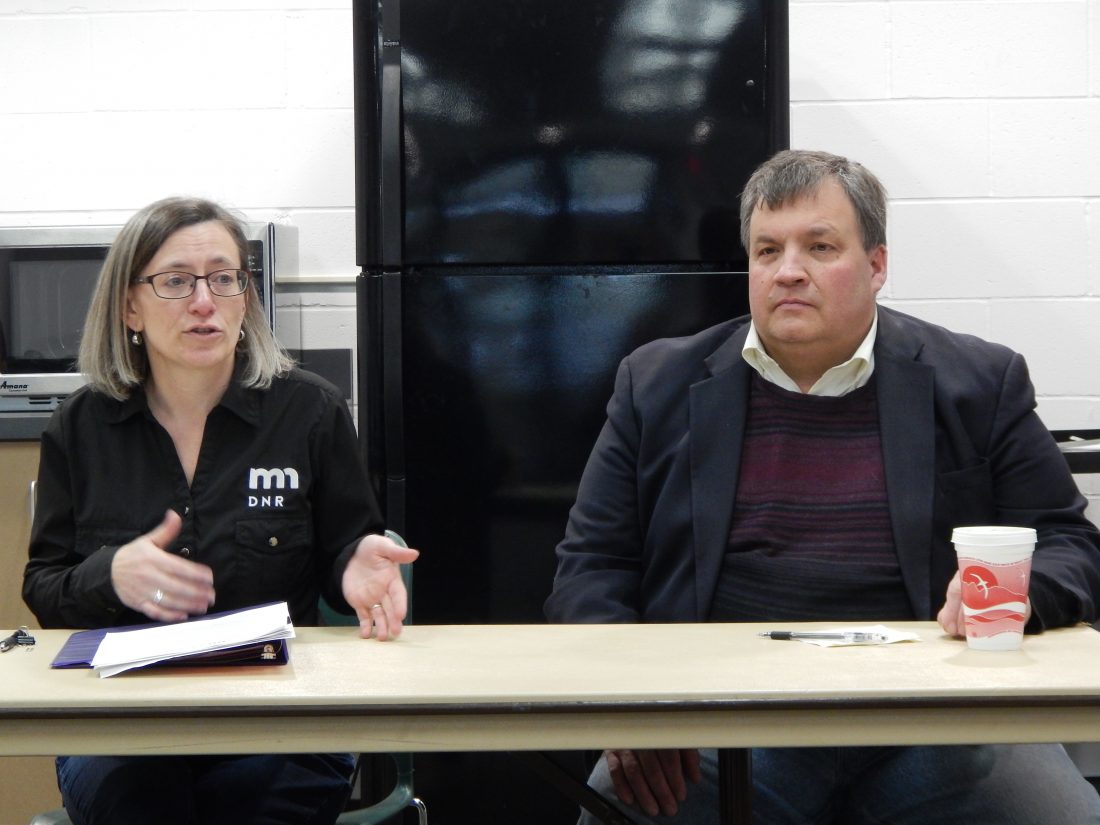
Staff photo by Fritz Busch Minnesota DNR Commissioner Sarah Strommen, left, talks and Minnesota Agriculture Commissioner Thom Peterson listens at a Commissioner’s Forum at the 39th annual New Ulm Farm-City Hub Club Farm Show at the New Ulm Civic Center Saturday.
NEW ULM — A Commissioner’s Forum at the New Ulm Farm-City Hub Club Farm Show centered on land and water issues.
Courtland farmer Tim Waibel said he recently bought farm land near his farm after getting in a bidding battle with a group he said planned to sit on the land until a land exchange by the lake was made.
“I struggle with it. The group raised the land cost by $400 an acre. I didn’t like how it happened,” Waibel said.
Minnesota Department of Natural Resources (DNR) Commissioner Sarah Strommen said she was intrigued by Waibel’s story about such a group that would trade land.
“We like to work with local organizations and people. Getting into a chess game is not in our interest,” Strommen said. “We reserve the right not to take land people offer us. We need to be aware of land purchases that don’t serve the public. We won’t accept land that doesn’t meet our strategic land goals.”
“I hope that’s an isolated incident,” said State Sen. Nick Frentz of North Mankato, who moderated the forum.
“I think the DNR has more land than it can properly manage. I often get calls about the DNR not property draining land,” said State Rep. Paul Torkelson of Hanska. “Land that is not properly managed is a burden.”
Strommen said the DNR accepts public plan input with public notices that can be found online.
Randy Wiltscheck of New Ulm said we’re spending millions of dollars repairing roads from flooding. He suggested holding ponds.
Torkelson said holding more water on the land is an answer. He suggested adding more water storage to the CRP (Conservation Reserve Program).
Greg Mickelson of Lake Crystal said he disagreed with more water storage.
Strommen said more lakes are not designed to handle the increased amount of rain that drains into them in recent years.
Vince Bock of Mankato called tax hikes of $50 to $60 an acre for retention ponds for 15 years an “outrageous number.”
Nicollet County farmer Warren Krohn said he eliminated washouts by tiling.
“It’s good for the land,” Krohn said.
Sleepy Eye farmer Greg Bartz said a lot of people blame farmers for water quality issues but that cities bear responsibility too.
“The City of Sleepy Eye dumps storm sewer water into Sleepy Eye Lake. The water winds up in a farm ditch not designed for it and it’s the farmer’s fault?” said Bartz.
Strommen said she felt Bartz “had a really good point.”
Sleepy Eye farmer Dennis Hillesheim said the recent State of Minnesota vulnerable ground water map shows his land is so vulnerable to nitrates, he can’t apply fertilizer this fall. He said testing showed very low nitrate levels on his land.
“They’re going by soil type rather than well tests,” Hillesheim said.
Peterson urged farmers to look at the Minnesota Department of Agriculture Groundwater Protection maps that can be found online.
Frentz said groundwater protection maps could be changed for land that doesn’t need protection.
Dean Schmitz of Springfield questioned using domestic wells as trigger points, calling it “bad science.”
Schmitz said dedicated monitoring wells are a better way to determine groundwater protection.
“We’re putting burdens on farmers due to domestic wells. I think it needs to be addressed,” Schmitz said.
A Redwood Falls radio broadcaster said guidance for cities would make sense because people can buy as much fertilizer as they want, put it on their lawns and a good share of it winds up in the street or gutter when they broadcast it beyond their lawn.
Another man said lawn fertilizer had many kinds of chemicals and asked if storm sewers can be checked for chemical pollution.
Fritz Busch can be emailed at fbusch@nujournal.com.