They bump, they hoot, they groan…
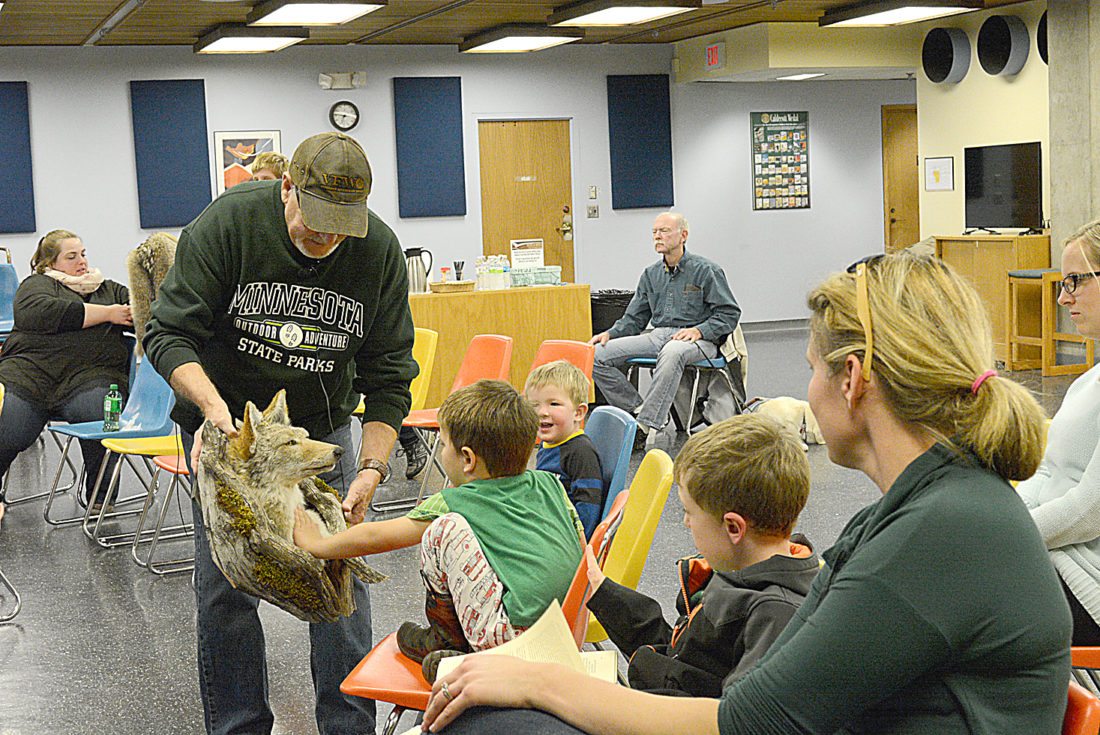
Staff photo by Connor Cummiskey Ron Bolduan, curator for the Nature Learning Center in Riverside Park, shows guests a coyote head during the presentation of creepy critters that he and naturalist Scott Kudelka gave at the New Ulm Public Library Wednesday evening.
NEW ULM — The first ever creepy critter presentation by local nature buffs was held in the New Ulm Public Library Wednesday night.
Department of Natural Resources naturalist Scott Kudelka and Ron Bolduan, curator at the Nature Learning Center in Riverside Park, presented “Scary Creatures: Things that Bump, Hoot, or Groan in the Night.”
In the program, they talked about why some animals might be considered scary and why they are important to our ecosystems. The first animal was the wolf.
“We think that it is something that we should be afraid of and in reality they are wild and unpredictable,” Kudelka said.
Along with being wild, wolves also can instill fear with their eerie howls. Kudelka played a grey wolf howl while summoning the image of being alone in a cabin in the woods.
A few other reasons humans fear wolves that Kudelka listed are their voracious appetites and the European association of wolves with the devil because they eat sheep — a symbol of holiness.
But wolves are important for the environment because they serve to control populations of other animals, Kudelka said. They are also social animals, akin to humans.
“Wolves are just like us, they run in packs, they take care of their family, they go out and get their food by killing other animals just like us,” Kudelka said. “They are very much just like us.”
Another animal the pair presented on was the bat. Kudelka theorized that bats are creepy mostly because they are flying mammals.
Bats serve as a pest control, Kudelka explained. A brown bat, which lives in Minnesota, can eat somewhere between 600 and 1,200 mosquitos an hour.
The fear of getting rabies from a bat is largely overblown, Bolduan explained. In the last 50 years, there have only been 10 deaths related to rabid bat bites in the United States, he said.
Bats are also useful pollinators because many species of bat that live in warmer climates eat fruit and spread the seed when they fly.
Unfortunately, bat species have been on the decline for the last decade thanks to disease and habitat destruction, Kudelka said.
After presenting on wolves, bats and many more animals, Kudelka revealed the most deadly animal in North America: the deer.
“1.1 million deer-vehicle crashes resulted in 150 human fatalities, 10,000 injuries and insurance payoffs of over $3.8 billion,” Kudelka said. “We think about grizzlies, we think about mountain lions, wolves, but really this is our most deadly animal.”
Connor Cummiskey can be emailed at ccummiskey@nujournal.com.
Local News

Hundreds hunt for Easter eggs
Wabasso water project delayed
WABASSO — A water treatment project in the city of Wabasso is temporarily on pause due to “unforeseen ...

NU native “Swede” Wagner joins MN Music Hall of Fame

Wabasso wrestling future bright, 6th-grade team wins state

Aqua‑Bunny makes big splash