‘Loyalty and Dissent’ recalls unique local WWI history
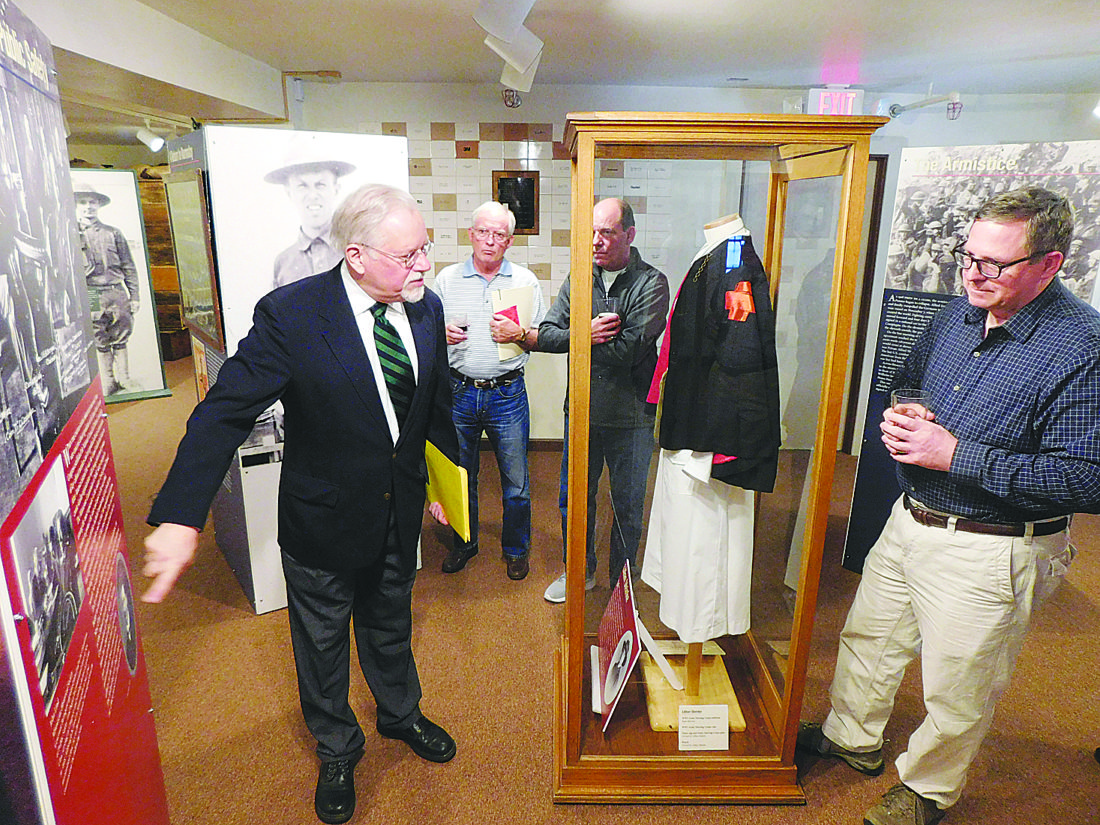
Staff photo by Clay Schuldt Historian Dan Hoisington leads VIPs on a tour of the “Loyalty and Dissent” exhibit at the Brown County Museum Thursday evening. Hoisington was able to give a detailed explanation of each display. This display describes the actions of the Public Safety Commission created in wake of the United States’ entry into the war.
NEW ULM –Historian Dan Hoisington led VIPs through a special guided tour Thursday night of the new Brown County Historical Society exhibit, “Loyalty and Dissent: Brown County and World War I.”
Hoisington began his research for the exhibit five years ago. The exhibit tells the story of the First World War and New Ulm’s unique reaction to the event.
Hoisington said the U.S. Dakota War is the first great story everyone associates with New Ulm but WWI is the next great story.
One hundred years ago to the month, the United States entered WWI but New Ulm remained conflicted. Then, as it is now, New Ulm was a German community. Hoisington said the citizens were German in their hearts.
Ten years before the U.S. entered the war, the U.S. received a signed portrait of Kaiser Wilhelm. The portrait was displayed at the Hermann Monument.
By 1914, the war started in Europe. The United States was committed to staying neutral. Hoisington said in New Ulm many residents supported the Germans. They viewed the conflict as the fault of wealthy capitalists in England.
U.S. neutrality ended in 1917. The Germans continued to sink American ships, and a decoded message known as the “Zimmerman note” was found. In the message, the Germans offered to help Mexico take back land from the United States if it joins the war. As a result, President Woodrow Wilson declared War in April 1917.
The war was extremely controversial in New Ulm. Citizens with German heritage did not wish to fight Germans overseas. The institution of a draft was a source of concern.
On July 25, 1917, a massive rally was held in Turner Hall Park as a response to the draft. Those at the rally wanted an option that would allow drafted citizens the option to not be sent overseas. The rally led to New Ulm being viewed as a place of dissent. Soon after, federal agents and secret service agents came to New Ulm to find evidence of enemy aliens and enemy sympathizers. The mayor and the city attorney of New Ulm were removed from office by the Minnesota Commission of Public Safety.
A section of the exhibit is dedicated to the freedom of speech and the right to speak out in the time of war. Hoisington said the limits of free speech are still important issues today, and 100 years ago New Ulm was at the center of the controversy.
The exhibit includes displays of WWI artifacts such as uniforms, weapons, gas masks and even a replica of a WWI-era trench.
The exhibit includes several interactive videos from locals, sharing memories of the era. The video include interviews with Dr. Kurt Bell, Dr. Ted Fritsche, Marion Pfaender Downs and Kathryn Doty.
Hoisington said WWI is often a confusing period of history. People do not understand it the way they do the Civil War or World War II. The exhibit attempts to clarify the conflict’s impact on New Ulm.
From 5 p.m. to 8 p.m. Friday, May 5, a special members-only reception for the exhibit will be held, including the Comrades of Valor and music by Molly Henig. The exhibit will be open free to the public from 10 a.m. to 3 p.m. Saturday, May 6.
Local News
Creativity Camp returns for 9th year at The Grand
Streich sentenced in embezzling case
NEW ULM - Jacquelynn Rae Streich was sentenced to pay $100,000 in restitution and serve a staggered jail sentence ...
New Ulm homeowners may qualify for property tax refunds
NEW ULM — New Ulm and Brown County homeowners who own and occupy their primary residence may qualify for ...
LEMA trains with the New Ulm Battery

Drafting customers’ dreams