What doesn’t kill you makes you stronger…
Speaker details painful journey after daughter’s terminal illness, death
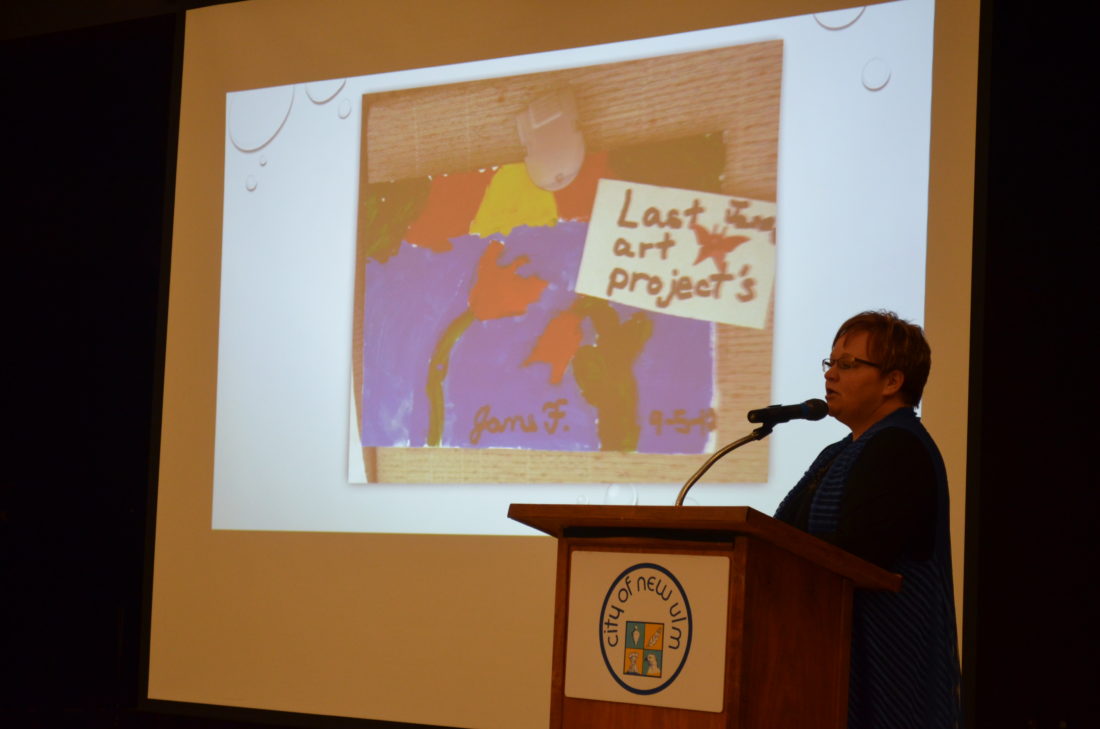
Staff photo by Connor Cummiskey Jil Fiemeyer stood behind a lecturn to deliver her speech in the New Ulm Community Center. Behind her is a photo of her daughter Jane’s last piece of art work, or her last masterpiece, as Fiemeyer called it.
NEW ULM — The final speech in the Life Living Series in New Ulm Monday was about a mother’s journey through the illness and death of her daughter, what came after and lessons learned along the way.
Jil Fiemeyer’s eldest daughter Jane was diagnosed with Acute Lymphoblastic Leukemia in 2011.
Fiemeyer described one of her most striking memories with Jane before she died. They went to an art therapy session, of which Fiemeyer was skeptical, until it taught her about her daughter.
Jane started with some clay, a box and feathers, making a park scene with beautiful flowers, pond, two women and a bench, Fiemeyer recalled.
“All of a sudden, she took her arm and she wiped it all out,” Fiemeyer said. “There were no more beautiful flowers, no more beautiful pond and no more park. It was all gone.”
After Jane destroyed the image, she decompressed by watching TV, and Fiemeyer sat down with a child psychologist to process what had just happened.
They concluded that Jane was probably worried about her legacy. The child was worried nobody would remember her.
So Fiemeyer talked with her daughter about her legacy. Two big pieces came from that: a duct tape wallet fundraiser and a princess warrior 5k.
The wallets raised $13,300.16 — $2,100.16 was raised by Jane herself. The princess warrior 5k was, at Jane’s behest, as inclusive as possible — welcoming everyone to run, walk, role, stroll or crawl.
The art room played a pivotal role in the story Fiemeyer told, as it appeared one more time just before Jane died.
The last time Fiemeyer took her daughter home from the hospital, Jane insisted on going to the art room first. Once there, she made what Fiemeyer described as her last masterpiece.
It was two flowers on a blue background. Above them is a yellow sunrise. One flower is blooming, while the other is wilted, facing the ground.
Before she finished, Jane asked for a white card and on it she wrote, “Jane’s last art project.”
Jane died the next day at home Sept. 6, 2012. She was surrounded by her mother, father and two siblings and her mother’s friend Christie who was singing the song “Give Me Jesus” as she passed away.
“I think that losing a child is one of the loneliest, most desolate journeys a person can take,” Fiemeyer said. “It is a club that no one wants to belong to.”
Even though the journey is lonely, most parents are not alone, Fiemeyer said.
She explained that 43 children are diagnosed with cancer every day and while many, like Jane, are afflicted by diseases with 90 percent survival rates, 90 percent is not always enough.
Partnered with every other reason a child might die, it is likely that everyone will at some point meet a parent who has lost a child. Fiemeyer shared some tips for supporting them:
Remember the child and do not shrink away; accept they cannot be fixed by you; birthdays, death anniversaries and mother’s and father’s days will all be very hard; realize they struggle every day with happiness and accept that their loss will likely make you uncomfortable.
But parents are not the only ones who deal with heartbreak and adversity, Fiemeyer said, using a metaphor that referred to manure and flowers. Everyone does. It is unavoidable, but, she argued, it is not inherently bad.
A person’s goal should not be avoiding the pain but recovering from it faster.
It is manure that makes plants grow stronger, more beautiful and faster.
Connor Cummiskey can be emailed at ccummiskey@nujournal.com.
Local News
Hundreds hunt for Easter eggs
Wabasso water project delayed
WABASSO — A water treatment project in the city of Wabasso is temporarily on pause due to “unforeseen ...
NU native “Swede” Wagner joins MN Music Hall of Fame
Wabasso wrestling future bright, 6th-grade team wins state

Aqua‑Bunny makes big splash