
News of New Ulm from 100 years ago
CO. A IS WELCOMED HOME SATURDAY EVE.
——–
Local Infantry Unit Returns from Fifteen-Day Annual Encampment at Fort Snelling.
——–
MET AT DEPOT BY BAND–RED FIRE ALONG STREET
——–
Marched Through Minnesota Street in Uniforms.-Made Excellent Appearance.
——–
The Home-Coming of Co. A, Saturday evening, following the annual encampment, was a joyous affair. The Pioneer band met the infantry unit at the M. & St. L. depot and headed by Sheriff W. J. Julius and Major Max. Sebald the “fighters” marched south on German street and then north up Minnesota street to Second North street and to the Armory.
Minnesota street was lined with spectators to welcome the boys home. Red fire was also placed along the thoroughfare, and made a brilliant spectacle.
The boys were in full uniform and made an imposing sight as they marched to the Armory.
They were all pleased to return home, but stated that the annual encampment was a most enjoyable affair and that the stay at Fort Snelling was a most pleasant one. The weather conditions were not all that could be expected at this time of the year, but a little thing like the weather is of small consequence in a guardman’s life.
Recalls Old Days.
The big welcome arranged for the boys Saturday evening recalled to many of the older citizens the welcome of former days, which was invariably arranged by the late Jos. A. Eckstein, who took keen delight in affairs of this kind.
Brown County Journal
Sept. 21, 1923
————————
WILL SEND
XMAS BOXES
TO EUROPE
——–
Local School Children Will Help to Spread Holiday Cheer Among Suffering Kiddies.
——–
ANNUAL MEETING RED CROSS CHAPTER OCT. 8
——–
Board of Directors Held Special Session at Commercial Club Rooms, Monday Evening.
——–
The school children of New Ulm will again contribute their share toward spreading holiday cheer among the suffering kiddies of Europe his year. Last year a large number of Christmas boxes were filled with articles of clothing, nick-knacks, candy, toys, etc., by pupils of the 1ocal schools and forwarded to New York City, where a shipment, consisting of 100,000 gift packages, was made up and sent to Europe. Great was the joy among the poor children there as the result of receiving presents from the children of the United States, and grateful letters are still being received by Red Cross head-quarters.
At a special meeting of the board of directors of the East Brown County Chapter, American Red Cross, held at the Commercial club rooms here, Monday evening, it was decided to continue the Christmas gift boxes, and Mrs. A. H. Besmehn and Martin L. F. Eyrich were appointed by President Chas. Stolz as a committee to ascertain the number of pupils in each of the various local public and parochial schools, who are willing to receive and fill these boxes. Treasurer A. L. Boock was empowered to order the necessary number of cartons from the Red Cross headquarters.
President Stolz reported that the officers had appropriated $150 out of the local chapter’s treasury toward the relief of the sufferers of the recent Japanese disaster. This action was approved by the other members of the board. The $5,000,000 fund fixed by the national Red Cross head-quarters was handsomely over-subscribed in a short time, demonstrating the readiness and willingness of the American people to contribute their share toward alleviating the sufferings of the victims of disasters in other parts of the world.
It was decided to hold the annual meeting of the East Brown County chapter on the evening of Monday, October 8, in the Commercial club rooms, and all members are urgently requested to keep this date open and attend the gathering.
Brown County Journal,
Sept. 21, 1923
————————
RURAL
SECTIONS IN MOVE FOR POWER
——–
Plan Marks First Step in
United States Toward Solving
Important National Problem.
——–
CONFERRED YESTERDAY WITH BIG POWER MEN
——–
Five-Mile Installation in
Dodge County Is Asked,
Northern States Interested.
——–
Five Minnesota farmers appointed by J. . Reed, head of the Minnesota Farm Bureau Federation to represent the farmers of the state, conferred with members of the Minneapolis General Electric company and the Northern States Power Company yesterday at Minneapolis on a plan of rural electrification which Mr. Reed said may have a revolutionary effect on farming in the northwest.
“The move to install a trial line in to a Minnesota farming community and for the first time make a scientific study of every aspect of rural electrification marks the initial step in the United States for the solution of a problem which in a few years will engross the nation,” Charles F. Stuart, assistant general manager of the electric and power company, said.
“To compete with the intensified farming of Europe, farmers will soon be looking for more economical methods, and labor shortages are increasing the demand for labor saving devices. If electrification will bring the farmer more money and better living conditions, and if it is proved practicable the greatest field of development since the radio will open up.”
The primary elements of the plan, according to Mr. Stuart are:
Installation of a five-mile line through a farming community near West Concord, Dodge county.
Providing 15 farms with electrical equipment, tapping power from the trial line.
Keeping an exact record of costs of line, operation and upkeep.
Computing output of farm before and after electrification.
Two propositions were to be presented at the conference. One is for the company to finance the line, the other is for the farmers to buy the equipment and turn the operation over to the company. The committee of five will have the final decision. The first plan requires no investments on the part of the farmer, but entails higher prices for service because of interest rates. The second plan calls for an investment from each customer at a cost below the price of individual electric systems now on the market, Mr. Stuart said.
“The farmer must realize actual profit before he can be expected to electrify his farm,” Mr. Reed said. “It must be more than a convenience. It must bring him added dollars.”
E. A. Steward, associate professor of agricultural physics, University of Minnesota, was to advise the conference on results of his experiments with individual cases where farmers used electricity to increase production.
“Farm experts are satisfied that aside from the better social aspect, relieving drudgery and improving conditions generally, bringing electricity to the farm means more money,” Mr. Stuart said. “Hens lay more eggs if longer feeding hours are made possible by electric lighting. Cows give more milk when provided with running water, and their milk, when strained by power separators, yields more cream. Milking machines, flat-irons, and hundreds of appliances, are waiting for a market in farm communities out of touch with electric lines.”
In Brown County.
If the trial line proves successful it is possible that farmers in Brown county will hook with the Northern States Power Co’s lines in this county.
Brown County Journal,
Sept. 21, 1923
————————
GUNS BANGED AND GAME
CAME DOWN
——–
Opening Day of Season, Sunday, Saw Hundreds of Hunters Out After Ducks and Chickens.
——–
BIG BRACES BROUGHT DOWN BY THE NIMRODS
——–
Bombardment Was Sufficient
to Wake the Dead at Sunrise
at Opening of Season.
——–
Hundreds of nimrods from New Ulm and all over this part of the state were at Swan lake and marshes Sunday morning, the opening of the hunting season. Ducks and prairie chickens were their quarry. The bombardment following sunrise was sufficient to wake old King Tut. Every person, who had the inclination and could shoulder a gun was afield early and ready to take a shot at either a juicy mallard or chicken.
Chickens Plentiful.
Chickens are plentiful and are found around marshes, especially if near corn fields. Hunters state that ducks are not so plentiful as in former years. But, nevertheless, big bags were reported as having been taken at Swan lake and other resorts in this part of the state.
The odd years are open years for chickens and therefore most of the nimrods were out after this class of game Sunday. One party composed of New Ulm hunters brought home fifty birds. This was a good bag. Other parties report that shooting was good and they secured big bags.
Wild Game All Week.
Many a family in New Ulm is enjoying wild game this week, especially if the head of the house was out Sunday.
The weather was not the best for the hunter upon the opening day, as the wind was heavy and made outdoor life disagreeable. Monday, however, was the proverbial hunting day. The sky was overcast, and the day was lowering.
Up And At It Early.
Sunday the local nimrods were up and at it early. Between two and four o’clock the noise of starting cars was terrific. The sound was not unlike a battery of machine guns getting in action. The Ole Barnsfields turned their engines loose and the staccato notes floating o’er the lea caused many a homestayer to cuss under his breath and above it, because his early Sunday morning slumber was spoiled. But if some friend happened to drop several mallards or chickens at his back door that evening he was well repaid.
Run Out of Licenses.
The county auditor’s office force were busy several days prior to the opening of the season, preparing licenses to those who called. There were 715 licenses issued and 560 of these were paid licenses. Miss Fannie Keal, obliging deputy in the auditor’s office, informs the Journal that the office ran out of licenses. Many of those, under age, and making application, simply filed their application and therefore the total number is not known, but Miss Kral expects that the total number of those applying total above 300.
Brown County Journal,
Sept. 21, 1923
————————
GANG LAYING NEW
RAILS WITHIN CITY
——–
Ninety-Pound Steel Will Be Placed Throughout the
Yards at This Point.
——–
EXPECT TO FINISH WORK TO SLEEPY EYE THIS FALL
——–
Heavier Engines Can Be Used on This Division.-Workmen Coming This Way from Milford.
——–
A steel gang of some forty men are now laying 90-pound rails from the Milford hill to New Ulm. Information that the work would be completed this season by the C.&N.W. was carried in these columns several months ago, and is now being vigorously prosecuted. It is expected the heavier rails will be laid into the city some time next week. The 90-pound steel is replacing that of the 72-pound variety.
New Rails in Local Yards.
The steel gang, when they have the steel laid from the Milford hill to the situation will then replace the rails throughout the local C. & N.W. yards.
Will Take Some Time.
The gang will be in New Ulm for some time as the work here will require a number of weeks. Following the completion of the work the big “J” type of engines can be accommodated. It is expected new steel will be laid as far as Sleepy Eye this fall and as Sleepy Eye also has yards of considerable extent this will increase the handling capacity of the line.
The big “J” engines will replace the “Z” type, which are now being employed on this division as freight movers. The new engines will accommodate far more freight and facilitate the handling of same more expeditiously. Longer trains will be hauled and this means, when crops are marketed in the fall, the grain will be moved to greater advantage.
Brown County Journal,
Sept. 21, 1923
————————
FIGHT OPENS TO TAX MOONERS, LEGGERS
——–
Civil Court to Be Convened
in Twin Cities by Minnesota Revenue Department.
——–
OLD CASES NOT TO BE
REOPENED, IT IS SAID
——–
Court Provides Process for Levying on Manufacturers
and Peddlers of Illicit Stuff.
——–
A fight to collect excise taxes from manufacturers and peddlers of illicit liquor in Minnesota will be started next Tuesday when a “civil court” will be opened by the Internal Revenue department in the Twin Cities.
The court will provide the process of law which is necessary before the revenue department can levy assessment against moonshiners and bootleggers. The Supreme court has ruled that the assessments are not really a tax, but rather an added penalty for violation of the prohibition laws, and that the only method of collection is through individual suits in United States district court.
Organized Year Ago.
In Minnesota the “civil court” was organized a year ago, but information regarding its existence was withheld until Monday. Raymond W. Johnston, chief of the legal division of the Internal Revenue department of Minnesota, has been appointed “judge” of the court and Jesse Steenson, attorney for the prohibition department in St. Paul, has been named “prosecuting attorney.”
The establishment of the new judiciary is interpreted to mean that the prohibition department does not intend to give up hope of collecting taxes on illicit liquor, despite the adverse rulings of the United States courts and the Supreme court of the state.
Judge Wilbur F. Booth, senior justice of the United States district bench, ruled that the tax was not a tax, but an added penalty and he issued nearly 500 temporary injunctions early in 1922 restricting collection of the tax. Later the injunctions were made permanent.
L. M. Willcuts, collector of internal revenue, said that the “civil court” will not reopen cases which have already been heard in Federal court. Only the new cases will be considered.
The excise tax fight, it was said, involves millions of dollars in Minnesota alone.
Local Man Interested.
An order to show cause why the recently established internal revenue civil court should not be enjoined from attempts to collect excise taxes on the manufacture and sale of liquor was signed Tuesday by Judge Wilbur F. Booth in United States District court. The order was filed in four separate suits brought before the court by New Ulm attorneys in the interests of four clients, one from New Ulm and three from Nicollet, who have been summoned to appear before the new court. The order was made returnable next Monday.
Brown County Journal,
Sept. 21, 1923
————————
VOLUME XXVI, No.1.
——–
With this issue of the Brown County Journal we celebrate its silver jubilee and this issue is Volume XXVI, No. 1. For twenty-five years it has appeared regularly each week without interruption and during that span of a quarter of a century it has had an eventful career. It has been a strenuous one from many aspects.
When the Journal was established October 15, 1898, it was the sixth newspaper in New Ulm, making three English and three German newspapers in a city of five thousand inhabitants, and it was but natural that its appearance several weeks prior to a general state and county election gave rise to considerable discussion that the Journal would succumb shortly after the election. It was a hazardous undertaking from a financial standpoint. We were spurred on in our adventure by some of the well-meaning republicans of those days, who promised a great deal, but who like all politicians, were short on performances. This was soon realized and all the energy and resourcefulness within our power was exerted to bring the Journal to the forefront as an A1 publication in the Minnesota field of journalism.
During that period two German and one English newspapers have been suspended or were merged with those remaining in the field, and the Journal today is the most widely circulated newspaper in Brown county. This success is due principally to a sincere effort to give the people a newsy and interesting paper and strict adherence to things which are American, first, last, and all the time. That the public appreciates the service is best reflected in its large family of readers and its recognition by advertisers, local and foreign, demonstrates that its advertising columns are indispensable to progressive businessmen.
It is with a great deal of pleasure that we look back over the twenty-five years of a strenuous and eventful career and we take this opportunity of extending hearty greetings to our readers, as well as our advertisers, in recognizing and being loyal to us in our efforts. It will be our aim to merit their confidence and esteem in the future.
Brown County Journal,
Sept. 21, 1923
History
RAID ON AT GAYLORD
Federal Officials Dig Up Some of the Staff That Kicks There. ———— Federal men working out of St Paul, ...
Nick Metzen Barn Is Destroyed By Fire
Origin Of Fire Unknown. Save All Livestock From Flame ———— Fire of mysterious origin destroyed the ...
GEOLOGISTS LIKELY TO INSPECT VALLEY
Comprehensive Investigation to Determine Commercial Possibilities of this Section ...
TOWNS APPROPRIATE $4,000 FOR ROAD
New Ulm Businessmen and Citizens Will Raise Substantial Fund, Approximating $2,500, for ...
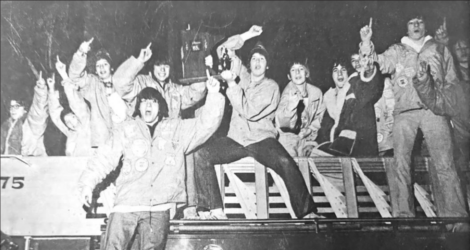
Welcoming ice champs
Highway 15 bypass option meets Lafayette resistance
LAFAYETTE — If Lafayette area residents would have their way, an improved Hwy. 15 wouldn’t by pass their ...