
Women reflect on World War I
Trending
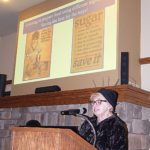
NEW ULM -- Reflections on World War I from women on the home front and in service abroad were shared following dinner at the New Ulm Country Club on Tuesday.
Excerpts of life a century ago were taken from a Brown County Historical Society (BCHS) exhibit. Presenters Carol Brennan, Brenda Nielsen, Vicki Pieser and Kathleen Backer followed a program researched by BCHS staffers Backer and Darla Gebhard.
The heatless, sweetless, meatless days in New Ulm featured maps of Europe and postcards of German soldiers as World War I rumbled on.
A delegation of New Ulm community leaders including Mayor Dr. Louis Fritsche and newspaper publisher Albert Steinhaus went to Washington, D.C. as the clouds of a very unpopular war gathered.
The newly-created Minnesota Commission on Public Safety (CPS), designed to deal with a large immigrant population, reported only to itself. The organization was so worried about how the country could protect itself at home that many civil liberties were restricted.
Members formed an armed militia and a spy network. Internment camps and alien registration became the norm. Property greater than 2 1/2 acres could be confiscated by the government. The commission acted on more than 700 disloyalty cases.
There were no more church services in German in New Ulm. Speaking German at all was discouraged, and German was not taught in the schools. German Street became Liberty Street.
But some New Ulm residents sent money to Germany to help feed starving children. Thousands of people attended a rally at Turner Hall, getting the attention of the CPS.
The government suspended New Ulm's civic leaders because they wanted German-Americans to serve in positions away from front-line combat. The oppression cut the community in two. More than two-thirds of Minnesota residents were German-Americans and many were upset.
Some people saw it as an attack on the City of New Ulm. Others felt the action was proper.
A military draft was created. Parades were held in all Brown County cities, bringing thousands of people together in an effort to demonstrate loyalty to America. Liberty bonds were sold to pay for the war. Residents were monitored to see if they bought war bonds.
Many nurses joined the military to care for soldiers. Lil Steinke of Sleepy Eye worked in a field hospital and ate, slept and danced in the same building in France. More than 10,000 Army nurses served overseas. More than 200 of them died, mostly due to influenza.
Solomon Isaacs of Sleepy Eye enlisted in the Marines, leaving his wife and two-year-old daughter at home. He was killed in action and buried in a French cemetery.
John Watson of Springfield was wounded, recovered, then was killed in action overseas.
Church groups sold food to raise money for local families that suffered war losses.
Alfred Mecklenburg died on Armistice Day, just hours before the war ended and was buried in France. His body wasn't shipped home until three years later.
Backer invited people to visit the World War I exhibit at the Brown County Historical Society and Museum. She urged people with books, CDs, DVDs and puzzles to donate them to the BCHS Book Sale for members in the annex on April 26 and for the public April 27-28.
Fritz Busch can be emailed at fbusch@nujournal.com.