
WWI series: The Home Guard
Trending
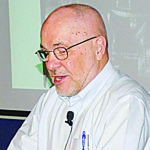
NEW ULM -- The Brown County Historical Society continued its speaker series on World War I (WWI) Thursday, with a presentation by Greg Gaut on the Minnesota Home Guard.
The presentation took place in the Library and was well attended by the public.
During the United States' entry into WWI, the efforts on the home front were contentious. The public was not unified in the decision to join the war. President Woodrow Wilson had campaigned and won re-election five months earlier on a promise he would keep the United States out of the war.
The institution of the draft made the choice even more unpopular. Because of continual disputes among labor organizations, suffragists, immigration, the fight for prohibition and the rising gap between the rich and poor, the United States was almost at war with itself.
Across the nation, individual states were creating groups to handle domestic security to replace the National Guard units that had been federalized.
Two weeks before the U.S. Declaration of War, Minnesota created the Public Safety Commission. Gaut said this group was given a vast amount of power, comparable to that of a dictatorship.
The Public Safety Commission had the power to seize or condemn property, remove elected officials, which they did in New Ulm, and create military units like the Home Guard.
The Home Guard was designed as a form of protection for the state, but few real crises occurred in Minnesota during the war years.
Gaut said two natural disaster occurred in Minnesota during those years. The first was cyclone in Tyler County and the second was forest fire in Moose Lake. The Home Guard assisted with these disasters, but were often used to enforced loyalty.
The Public Safety Commission was controlled by several powerful Republican Conservatives. The defacto leader of the group was a lawyer named John McGee.
McGee made statements that anyone with neutral opinions on the war was a traitor. Public Safety Commission and the Home Guard were used by McGee and other to push political causes, such as strike breaking.
Around the same time the Minnesota Home Guard was formed the American Protective League (APL) was formed. The group was an auxiliary organization to Federal Law Enforcement.
Gaut described the APL as a group of amateur detectives that were close to a vigilante organization. At the start of the war the APL began conducting investigations to find draft dodgers, but soon switched to hold massive raids called "Slacker Raids".
This first such raid was held in Minneapolis. At the time, men were required by law to carry proof they were register for selective service. One night the Home Guard raided a section of Minneapolis and arrested 21 men who were not carrying their draft papers. All 21 men later proved to have papers. Later a similar draft was conducted in Duluth in which 2,000 men were arrested, but almost none of the arrested were draft dodgers.
These raids continued in cities across the nation. In September 1918, the APL went to far with the arrests of 60,000 men in New York were arrested over the course of three days. This raid brought business to a stand still and less than 200 draft dodger were found.
Gaut said these raids were violations of civil liberty, but they were not as sever as the actions taken by the Minnesota Public Safety Commission and the Home Guard.
In Minnesota, the Home Guard was used to target the political party known as the Non-Partisans. n 1917, the Non-Partisan League had managed to gain political advantage in the Dakotas by uniting the farming organizations and had set its sights on Minnesota next. Many Republicans were nervous and used the Home Guard to block members of the Non-Partisan League from campaigning under the guise of preventing sedition in a time of war.
Despite the Home Guard's efforts and suppressing the Non-Partisans, their candidate for Governor received 150,000 votes in the primary. Gaut said this raised questions about how Minnesotans felt about the war. Even though Minnesotans were being told the Non-Partisans were traitors, many continued to vote for the party.
The Public Safety Commission and the Home Guard both disbanded after the end of the war.
Without the commission, McGee had lost his power and return to his law profession. He would eventually become a Federal Judge in Minnesota. He became famous for sentencing prohibition violators. Working as much as 45 hours a week, McGee sometimes sentence violators on average of one a minute. Unfortunately the stress of the work took a toll on McGee and in February 1925 he committed suicide.
The Minnesota Home Guard only lasted for two years, but left a significant mark. Gaut said no similar organization was ever formed during later American wars.
For more information on the Home Guard, Gaut recommended the book "Watchdog of Loyalty" by Carl Henry Chrislock.
The WWI speaker series will continue Noon, Thursday, June 15 at the Historical Society Annex. Doug Bekke will speak on the Military Uniforms of WWI.