
High school greenhouse functional
Trending
NEW ULM -- The new aquaponic and hydroponic systems at the New Ulm High School are almost fully functional.
The greenhouse at the high school contains the two types of systems that use water and fish to grow crops. The school has partnered with community groups like the Farm City Hub Club to raise money for the sustainable farming practices.
"You can pretty much grow virtually any vegetable crop you like, aside from a lot of the root crops that would be below the surface," agriculture teacher Jeff Nelson said. "So any leafy vegetables, a lot of greens."
The aquaponics system uses fish to supply nutrients to the plants, which in turn clean fish excrement from the water.
The fish will stay in a 100-gallon barrel that should be able to sustain around 50 full-grown tallapia, Nelson said.
The barrel is connected via piping to two large, plastic tubs. One tub contains clay pebbles that provide structure for root systems.
The second tub is empty, except a drain tube and styrofoam "floats" that will contain the plants. The floats have holes in which students will insert plugs with some pre-started plants.
"Students started some seeds, and so we will have plants hopefully ready to put in here by the time it is all running, because you do not want to put them in when they are just getting started," agriculture teacher Kelsey Brandt said. "You want to establish them first and then transplant them over."
The clay pebbles are good for plants like tomatoes and peppers that students can repeatedly harvest.
The float tub will be filled with water up to the top of the drain pipe. The floats full of plants will sit on the surface, with the plants' roots floating in the water.
"This type is for your short-term, quick-turnaround things like lettuce," Brandt, who is also an advisor for Future Farmers of America (FFA), said. "You harvest it once, that is all you are going to get."
Unlike the aquaponic system, the hydroponic systems in the green house are all independent of each other.
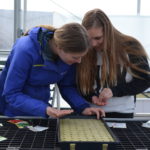
As of writing, the only system fully functional is the flood table. It consists of a white plastic tub suspended above a plastic box.
The two pieces are connected via some PVC pipes and four times per day, water with added nutrients is pumped from the box up to the flood table and allowed to drain back down.
The flood table is good for starting seedlings that go in the aquaponics and other hydroponics systems.
Still under construction are two other hydroponic systems. One consists of a series of planter boxes filled with the clay pebbles. They will be filled with water four times per day. The boxes sit on a bare metal frame and will be linked with plastic piping.
The second consists of four long, rectangular boxes on a frame of metal pipes. Each box has holes regularly placed along its top face.
Produce like lettuce will be placed in the holes. Its roots sit inside the boxes, which will have a constant flow of water feeding them.
"I think most of the work is getting them set up, because once it is up and going, there is very little you actually have to do," Brandt said.
Brandt and Nelson hope to have the systems up and running two weeks to a month from now.
They have yet to decide what to do with the fully grown fish and produce that the systems will be producing.
"We have kind of kicked around some ideas on where to take our product after we raise it," Nelson, also an FFA advisor, said. "I think a lot of the fish will probably be consumed here with students and faculty."
Other options discussed include selling at the food co-op, donating to the food shelf or selling it as a fundraiser, Nelson said.
While the systems operate largely without human interaction, the instructors are hoping to find a couple of students who want to volunteer to check water levels and nutrients over the summer.
Connor Cummiskey can be emailed at ccummiskey@nujournal.com.