US warns shipping firms over paying Iran to transit the Strait of Hormuz
AP
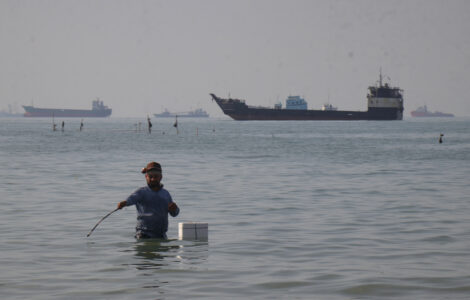
A man stands in the water, appearing to fish, as bulk carriers, cargo ships, and service vessels line the horizon in the Strait of Hormuz off Bandar Abbas, Iran, Monday, April 27, 2026.(Razieh Poudat/ISNA via AP)
Trending
By SARAH EL DEEB and ADAM SCHRECK Associated PressBEIRUT (AP) -- The United States is warning shipping companies they could face sanctions for paying Iran to pass safely through the Strait of Hormuz.
The U.S. Office of Foreign Assets Control alert on Friday adds pressure in the standoff over control of the strait at the mouth of the Persian Gulf, where about a fifth of the world's trade in oil and natural gas typically passes.Iran effectively closed the strait by attacking and threatening ships after the U.S. and Israel launched a war on Feb. 28. It later offered some ships safe passage via routes closer to its shore, charging fees at times.The U.S. warns against transfers not only in cash but also in "digital assets, offsets, informal swaps, or other in-kind payments," including charitable donations and payments at Iranian embassies.The U.S. has responded with a naval blockade of Iranian ports since April 13, depriving Tehran of oil revenue it needs to shore up its ailing economy. The U.S. Central Command on Saturday said 48 commercial ships have been told to turn back.Nobel laureate Mohammadi's health at 'very high risk'
Imprisoned Nobel Peace Prize laureate Narges Mohammadi remained hospitalized in Zanjan in northwestern Iran after being transferred from prison late Friday. Her foundation described the condition of the rights lawyer as "very high risk," with fluctuating blood pressure and severe nausea.But medical teams in Zanjan have requested her medical records before performing any treatment, while recommending that she be transferred to Tehran for treatment by her own doctors, the foundation said.However, "the Intelligence (Ministry) is still opposing the transfer of Narges to a hospital in Tehran for angiography," or imaging of blood vessels, said her Paris-based husband, Taghi Rahmani. He spoke in a voice message shared with The Associated Press by the foundation.The Norwegian Nobel Committee in a statement Saturday urged Iranian authorities to immediately transfer Mohammadi to her medical team, saying her condition "has deteriorated seriously" and her life is in their hands.Her legal team is pursuing the matter with the General Prosecutor's office, the foundation said.
Trump rejects the latest Iranian proposalU.S. President Donald Trump has rejected Iran's latest proposal to end the war, saying on Friday that "I'm not satisfied with it, so we'll see what happens," without giving details.Iran's state-run IRNA news agency said Tehran handed over its plan to mediators in Pakistan on Thursday night.The shaky three-week ceasefire appears to be holding. Negotiations continued by phone after Trump called off his envoys' trip to Pakistan last weekend, the president said.Trump also has floated a new plan to reopen the Strait of Hormuz.Iran hangs two men convicted of spying for IsraelIran on Saturday said it hanged two men convicted of spying for Israel.The Iranian judiciary's news outlet, Mizanonline, said Yaghoub Karimpour and Nasser Bekrzadeh were hanged after the Supreme Court upheld death sentences.The outlet said Karimpour was accused of sending "sensitive information" to an officer in Israel's Mossad intelligence agency, while Bekrzadeh allegedly sent details about government and religious leaders as well as information about Natanz. The city is home to a nuclear enrichment facility bombed by Israel and the U.S. last year.Iran has hanged more than a dozen people over alleged espionage and terrorist activities in recent weeks. Rights groups say Iran routinely holds closed-door trials in which defendants are unable to challenge the accusations they face.___Associated Press writers Collin Binkley in Washington and Nasser Karimi in Tehran contributed to this report.

 AP
AP