
‘The most important training I hope you never use’
Chief Borchert gives domestic terrorism presentation
Trending
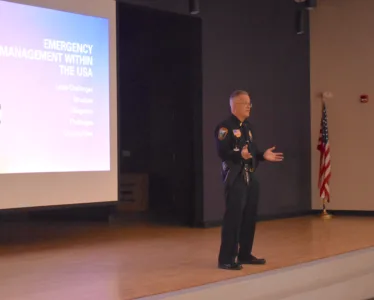
NEW ULM - Community members gathered for a domestic terrorism active shooter presentation given by Police Chief David Borchert, Sgt. Brady Murphy and Emergency Preparedness Coordinator at Brown County Public Health Michelle Steinbeisser Saturday morning at the Community Center.
Borchert began the presentation by urging community members to consider consultation. New Ulm Police Department can work with schools, churches and private businesses to create plans unique to respective buildings and situations relevant to each group.
Borchert then spoke of the growth of domestic terrorism.
"It's important to come together and talk, even if it's a little difficult to talk about," Borchert said. "In the ’80s I never thought of active shooters and domestic terrorism, but it’s a real thing that happens nationwide and statewide and we've seen things locally."
Bomb threats and shooter threats happen in New Ulm every year.
For example, Borchert said that a church in New Ulm had a man behaving unusually. When the individual began approaching clergy, ushers and other members physically escorted him to the back of the church and deescalated the situation.
"The ushers, I believe, saved the day," Borchert said. "They responded appropriately to the situation."
To prepare for threats, Borchert shared the four phases of emergency management.
The first step is to be prepared. Borchert said those attending already took the first step of preparing. By thinking about exits, escape plans and monitoring surroundings, community members can make their communities safer.
Another step to being prepared is knowing warning signs to mental health struggles. Change in behaviors, giving away possessions and referring to people in past tense are all examples. Since most attackers are familiar with the places they are targeting, fellow community members involved with those places are the ones who will notice these warning signs. Borchert encouraged everyone to reach out to police if there are safety concerns.
Response is the second phrase. Borchert said that the domestic terrorist has an upper hand because they decide when and how they are going to attack. However, by practicing for active shooter and other threats, individuals can make intentional decisions rather than freezing in the event of a situation.
"Prevention is like studying for the test, response is the test," Borchert said.
Murphy said that during a domestic terrorism situation, the three options are to run, fight or hide. All three are acceptable, and by practicing for situations they can be achieved more effectively.
He also talked about officer response to emergencies.
"We don't wait for anybody. If something’s happening at Jefferson Elementary and I’m the first officer on the scene. I grab whatever equipment I need and I go in, I don't wait for anyone else," Murphy said.
He also encouraged people in these situations not to flee using vehicles because it can create backups for emergency response vehicles trying to enter the area.
Mitigation is the third phase. By drawing shades, locking doors and securing the door, mitigation is occurring. Once an act of domestic terrorism is occurring, action can be taken to decrease the amount of harm done.
Utilizing ushers, security and technological advancements can help with all stages. Cameras and motion alarms are cheap resources that can have significant beneficial impacts.
The last phase is recovery. This involves providing resources for people after the event has occurred.
"The event generally happens in a short period of time but has long-lasting effects," Borchert said.
During recovery, assessments of missing individuals and setting up call centers are necessary. Providing psychological first-aid and grief counseling and also needed to help individuals recover from the event.
Steinbeisser said this is where Brown County Public Health comes into play.
They are responsible for coordinating Friends and Family Reception Centers (FRCs) and Family Assistance Centers (FACs) following events of domestic terrorism.
FRCs are created for families looking for unaccounted for individuals. They are set up 1-3 hours after notification of a situation with assistance from law enforcement and hospitals.
FACs differ from FRCs. FACs are set up if there are confirmed fatalities, missing individuals, hospitalizations or separations. They serve as a safe and secure facility where families can receive specialized services.
"It is a one-stop shop," Steinbeisser said.
Community collaboration is essential for all four steps in emergency management.