
Hands-on learning about the brain
The world of neuroscience comes to River Bend
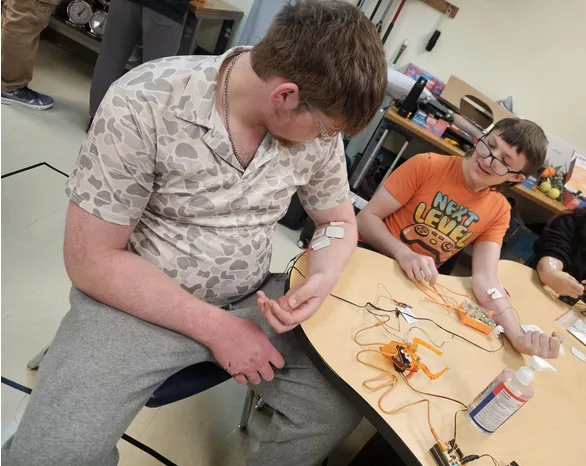
Ethan Wegner and Enrich Knaack using the Human-Human simulator. Submitted photo
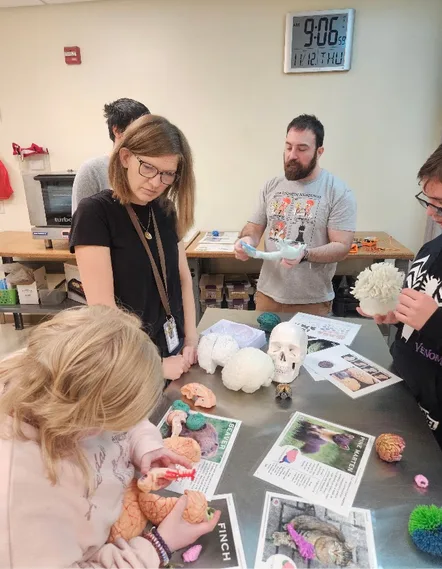
Front left to right: Josie Ulrich working on a brain puzzle as River Bend teacher Elise Cronin supervises. (Back) Adam Stiner shows a stuffed neuron to River Bend Student (right) Shawn Hacker inspects the brain nerves. Submitted photo
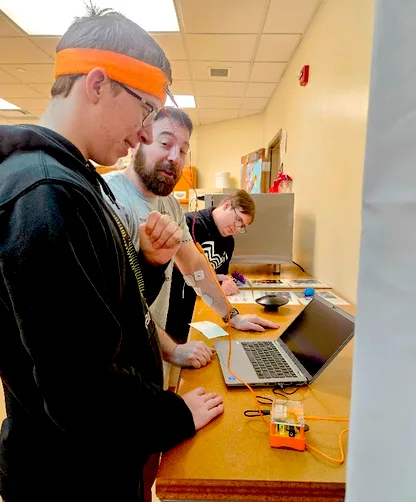
Ethan Lund seeing his brain activity through brain waves using an electroencephalogram (EEG). Submitted photo
Ethan Wegner and Enrich Knaack using the Human-Human simulator. Submitted photo
Front left to right: Josie Ulrich working on a brain puzzle as River Bend teacher Elise Cronin supervises. (Back) Adam Stiner shows a stuffed neuron to River Bend Student (right) Shawn Hacker inspects the brain nerves. Submitted photo
Ethan Lund seeing his brain activity through brain waves using an electroencephalogram (EEG). Submitted photo
Trending
NEW ULM - Students at River Bend Education District recently had the opportunity to explore the world of neuroscience.
Dr. Adam Steiner from Minnesota State University, Mankato, visited the school with interactive activities and equipment from the Backyard Brains curriculum.
Dr. Steiner, who is associated with the N3 Lab in the Department of Psychology at Minnesota State University, Mankato, brought science to life by allowing students to investigate how the brain, nerves, and muscles communicate with one another.
Throughout the visit, students participated in hands-on demonstrations that allowed them to see electrical signals produced by their own bodies, experiment with muscle-controlled technology, and explore how science is used to develop prosthetic devices.
The visit included a variety of activities to accommodate students of all ages and ability levels. From simple, hands-on activities such as matching exercises, sensory fidgets, and a three-dimensional puzzle of the brain to more advanced demonstrations involving nerve stimulation and muscle-controlled technology, there was something for everyone to explore.
One of the most memorable activities involved the Human-Human Interface, a device that uses electrical signals from one person’s muscles to stimulate movement in another person’s arm. Students saw how electrical signals could be used to produce movement.
“It was fun. My favorite part was being able to control someone else’s movements,” said student Ehrich Knaack.
Another popular activity involved using muscle signals to operate a robotic claw, demonstrating technology similar to that used in modern prosthetic hands. Students experienced firsthand how challenging it can be to control movements using this type of technology.
Alex McKay reflected on the experience, saying, “It was fun! I just wish I hadn’t been shaking so much while trying to stack the cups with the prosthetic simulator.”
Students also had the opportunity to observe electrical activity produced by their bodies, including brain waves. The demonstrations helped them better understand how the nervous system works and how scientists use technology to study it.
“It was a really cool experience,” Logan Watson said. “I got to see my brain waves, and that was amazing.”
Beyond the excitement, the visit introduced students to real-world applications of neuroscience, engineering, robotics, and medical technology. The activities demonstrated how concepts learned in the classroom connect to careers in scientific research, healthcare, and technology.
The experience also encouraged curiosity, problem-solving, and a willingness to try something new. Students were not simply learning about how the brain works; they were actively investigating it.
Steiner’s outreach program provides hands-on neuroscience learning opportunities to schools throughout southern Minnesota. The lessons incorporate activities adapted from Backyard Brains and BrainU, helping make complex scientific concepts accessible and engaging for students.