
MnDOT District 7 reports safety gains from roundabouts
Trending
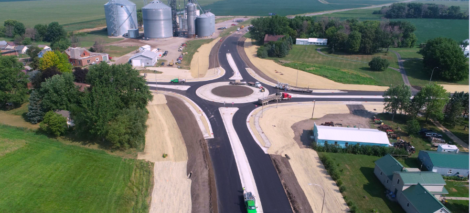
NEW ULM – Roundabouts across south-central Minnesota have reduced fatal and serious injury crashes by more than 80 percent, according to Minnesota Department of Transportation District 7 Engineer Zachary Tess.
District 7 oversees more than 1,200 miles of state and federal highways, 470 state-owned bridges and 10 public rest areas stretching from Sibley County in south-central Minnesota to Rock County in the southwest corner of the state. Tess said local intersections in and around New Ulm reflect broader statewide safety trends following roundabout installations.
At the roundabout at U.S. Highway 14 and Highland Avenue in New Ulm, built a few years ago in response to concerning crash patterns, MnDOT recorded two property-damage-only crashes over the past year.
A second roundabout on the north side of New Ulm at Palmer Avenue, constructed near Menards through a public-private partnership with the city, was installed proactively to manage traffic growth before crash patterns developed.
In the broader region, MnDOT completed three new roundabouts during the 2026 construction season using funding from the state legislature’s 2023 Rural High Risk Roads program. Those intersections include Highway 15 and County Road 5 near Klossner, Highway 111 and County Road 5 north of Nicollet, and at Highways 13 and 99 south of Montgomery.
Modern roundabouts have been used in Minnesota for more than two decades in various forms, including compact mini roundabouts with fully paved center islands along Highway 4 in downtown St. James.
Even so, Tess said public misconceptions persist whenever circular intersections are proposed.
One of the most common concerns involves whether large farm machinery and commercial semis can navigate the tighter turning radius.
While state highways across Minnesota typically carry 8 to 9 percent heavy commercial traffic, District 7 routes average 12 to 13 percent due to the region’s agricultural economy.
“We design our roundabouts to accommodate that level of traffic,” Tess said. “We have those center truck aprons where trailers are allowed to track on that. We get combines through the intersections, and in fact, we actually have a larger vehicle, a 115-foot-long vehicle that will commonly move large construction excavation equipment through our intersections.”
Tess said engineers have refined curb profiles and turning clearances over the years to prevent load shifts and accommodate low-clearance trailers, known as lowboys, that haul heavy machinery.
Multi-lane roundabouts, such as those on Highway 22 in Mankato at Adams Street and Madison Avenue, are engineered with turning geometry that allow passenger vehicles and heavy commercial trucks to navigate simultaneously.
In New Ulm, urban roundabouts also incorporate separated pedestrian crossings set back one car length from the yield line to give motorists and pedestrians additional reaction space.
When engineers evaluate high-volume intersections where a state highway meets a busy city street or county road, Tess said studies consistently show roundabouts are safer for pedestrians than traditional signalized intersections because vehicles move at slower speeds and cross only one direction of traffic at a time.
In rural areas, such as north of Nicollet, engineers evaluate approaching roadway conditions and whether pedestrians or cyclists are traveling along high-speed shoulders before determining the appropriate crossings to create.
Locally, the city of New Ulm is also exploring a future roundabout near the base of Hermann Heights Park. Tess said that questions regarding municipal roundabout projects fall under the jurisdiction of New Ulm City Engineer Joe Stadheim.
With winter weather arriving across southern Minnesota, District 7 maintenance crews are shifting from construction oversight to snow and ice operations.
MnDOT operates snowplows out of 20 truck stations across District 7 to pre-treat pavement and clear snow across Minnesota’s transportation network, which ranks as the fourth-largest in the nation.
Crews also maintain roadsides during warmer months, patching pavement and mowing grass to improve wildlife visibility.
Ahead of incoming snow earlier this week, crews were out as early as 3 a.m. Wednesday in the Windom and Worthington areas to pre-treat pavement and keep freight and commuter corridors moving safely.
Tess also urged drivers to stay alert around snowplows and highway work zones, due to an increase in distracted-driving crashes and worksite intrusions over the past year. Unlike motorists protected by vehicle frames and airbags, highway maintenance workers operate directly on the roadway without physical barriers.
Law enforcement and the Minnesota State Patrol have partnered with MnDOT to curb speeding and distracted driving in active work areas.
“We really want to encourage people to go to www.511mn.org,” Tess said, pointing motorists to the state’s live plow cameras and color-coded road reports before traveling. He advised that drivers should give snowplows plenty of room, maintain slow, safe speeds during winter storms and delay travel when no-travel advisories are issued.
State transportation officials encourage motorists to monitor weather forecasts before heading out during winter storms and allow extra travel time as road crews work to clear highways across south-central Minnesota.