
‘Funerals are for the living’
MVFH walks the public through end of life planning
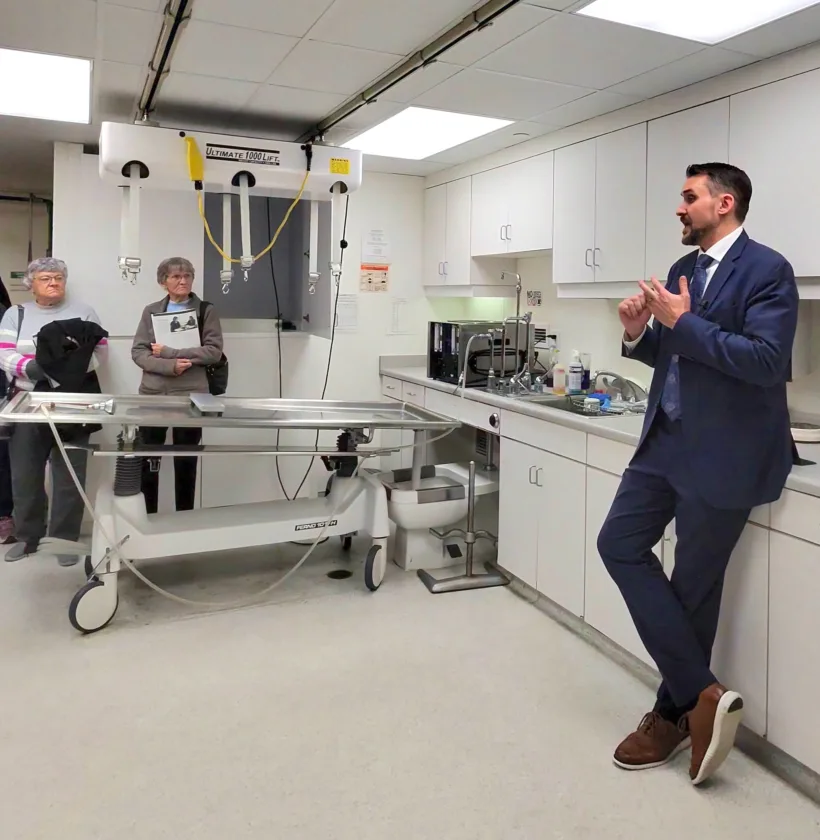
Eric Warmka talks with guests in the prep room during a tour after the Nov. 4 seminar at Minnesota Valley Funeral Homes in New Ulm. (Photo by Amy Zents)
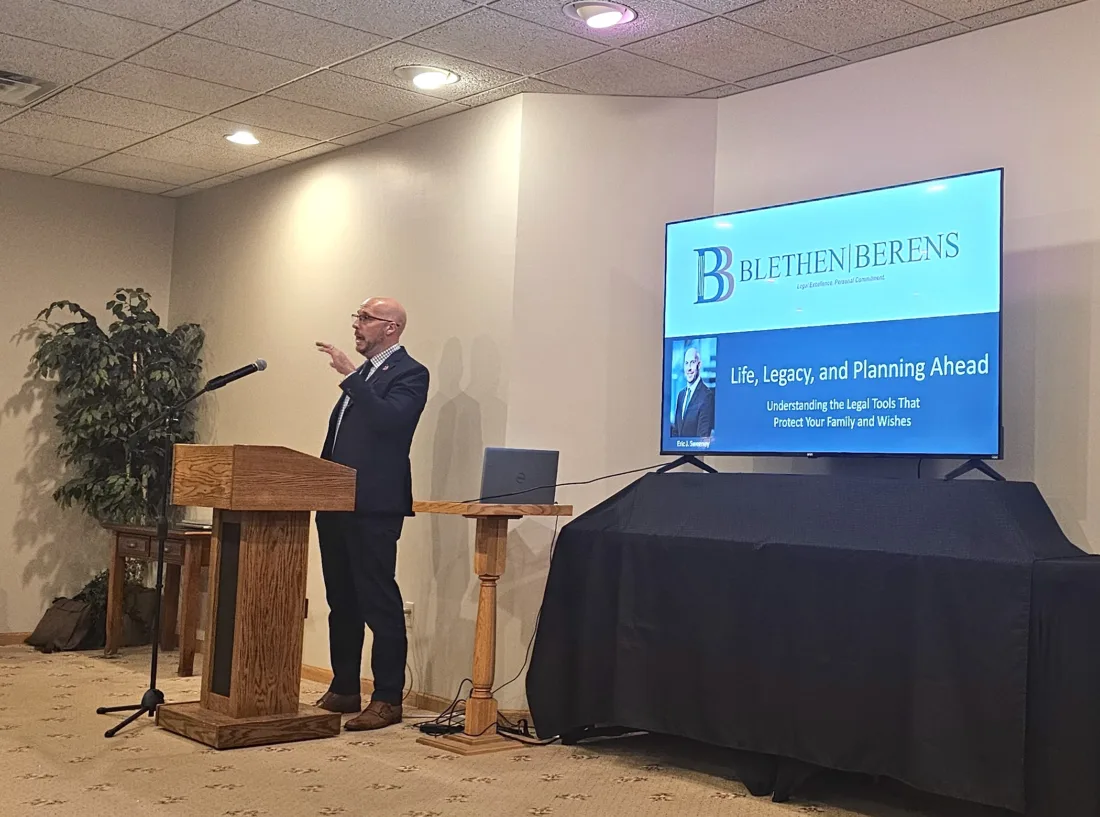
Eric Sweeney, an attorney at Blethen Berens, talks about estate planning during the Nov. 4 seminar at Minnesota Valley Funeral Homes in New Ulm. (Photo by Amy Zents)
Eric Warmka talks with guests in the prep room during a tour after the Nov. 4 seminar at Minnesota Valley Funeral Homes in New Ulm. (Photo by Amy Zents)
Eric Sweeney, an attorney at Blethen Berens, talks about estate planning during the Nov. 4 seminar at Minnesota Valley Funeral Homes in New Ulm. (Photo by Amy Zents)
Trending
NEW ULM -- About 125 people gathered at the Minnesota Valley Funeral Home (MVHF) North Chapel for two talks on estate planning and funeral planning last Wednesday.
Eric Sweeney, an estate planning and real estate attorney for Blethen Berens, said most people know they should get their affairs in order, but they put it off.
“Life doesn’t always give us the best timing,” Sweeney said.
He said families feel the most stress when decisions are left until after a loved one has died.
To ease this stress, Sweeney explained the differences between different types of estate planning.
Sweeney said a financial power of attorney lets a person act for someone else regarding their money matters. The power of attorney goes into effect the moment it is signed.
If no power of attorney exists and a person loses capacity, the family must ask a court for a conservatorship, which costs more money and takes more time.
Sweeney said a healthcare directive is something altogether separate. It covers only medical decisions and goes into effect when a person cannot make informed medical choices.
It names a health care agent and can list medical wishes, end-of-life instructions, organ donation choices and plans for the deceased’s remains.
Sweeney said a will is for probate assets (items that do not already have a beneficiary or transfer-on-death designation).
A will names a personal representative, also called an executor. He said in Minnesota, the state estate tax exemption is $3 million. The federal exemption is $15 million for one person and $30 million for a married couple.
Sweeney said a trust is different from a will. A revocable living trust can be changed during a person’s life and becomes irrevocable after death. A trust only controls assets placed inside it. A trust does not go through probate and is private.
A will goes through probate and probate records are public in Minnesota. Trusts work well for farm succession, blended families and out of state property.
Sweeney said transfer on death deeds, payable on death accounts and beneficiary designations are the simplest tools.
A transfer on death deed for a house is recorded with the county, does nothing while the owner is alive, and after death the named person can take ownership with a death certificate and no court case.
MVFH Director Eric Warmka spoke on funeral planning.
Warmka said becoming a funeral director was never on his list of jobs as a young man. He started as a maintenance man at a funeral home. Working with a good funeral director showed him what one person could do to help someone through one of the hardest situations they might ever face.
Warmka said his approach changed when his grandfather died during COVID. He said all his family knew was that his grandpa wanted cremation. Many details had been left for another day.
He said people in this part of Minnesota are humble. They work hard and do not want to make themselves the center of attention.
He said he often hears, “Don’t make a big fuss over me,” or “Just cremate me and scatter my ashes in the wind.”
He said funerals are not for the person who died. They are for the spouse, children, grandchildren, friends, neighbors and coworkers who must figure out how to move forward without that person.
“Funerals are for the living,” Warmka said.
Warmka said telling family members not to have a funeral for them can make things harder. Avoiding a funeral can also prolong grief.
“A person does not need a parade down Minnesota Street, a packed church or an expensive casket,” Warmka said. “A simple gathering can be as meaningful as a large funeral.”
Warmka said planning ahead gives direction and prevents disagreements. He reminded attendees that unexpected deaths can happen at 40, 60 or 85.
The most common forms of disposition are burial and cremation. Warmka explained a family can still have a visitation with a rental casket even if they decide on a cremation later.
He said about 60% of the 300 calls MVHF handles are for cremations.
Warmka said planning and paying are two separate decisions. A person can write down wishes without paying in advance. If a funeral costs less than the amount saved, the extra money goes back to the family.
“You do not have to plan that elaborate funeral," Warmka said. "You do not have to spend a fortune."
Warmka said Minnesota Valley is a co-op, one of the last in the country. If the co-op makes a profit, money goes back to families it served. The funeral home does not charge for infant funerals.
Planning does take the uncertainty away, but will not necessarily take the grief away.
After the talks, guests toured the prep room, casket room and crematory.