
BCHS honors Capt. Bianchi in Veterans Day program
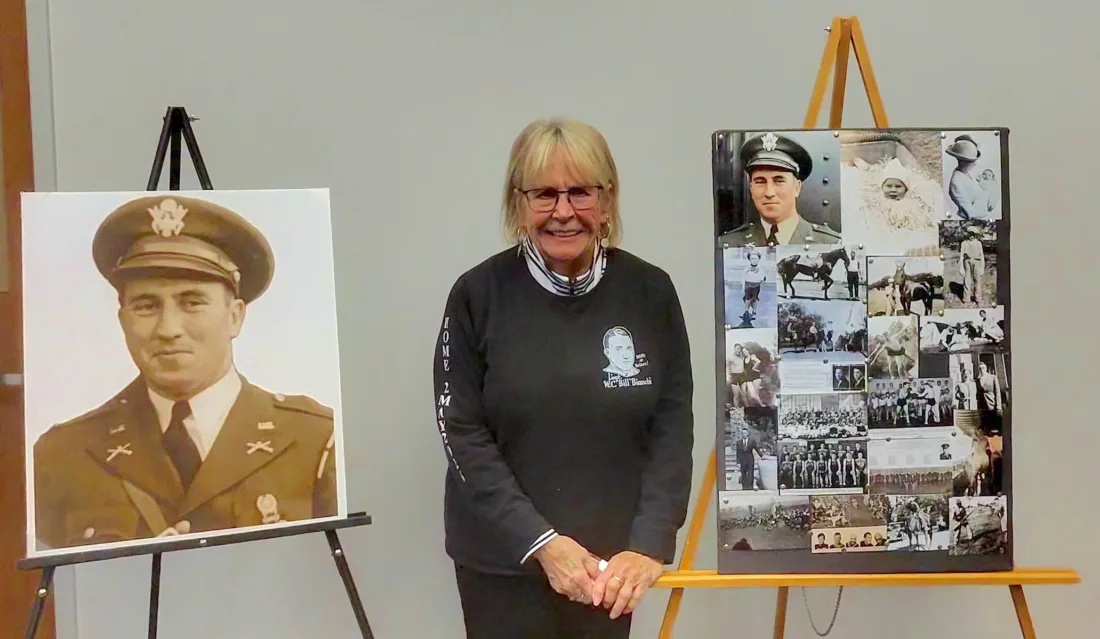
Carolyn Marti Smith stands between a portrait of her uncle, Capt. Willibald “Bill” Bianchi, and a collage of family and military photographs during a Veterans Day program at the Brown County Historical Society on Wednesday evening. (Photo by Amy Zents)
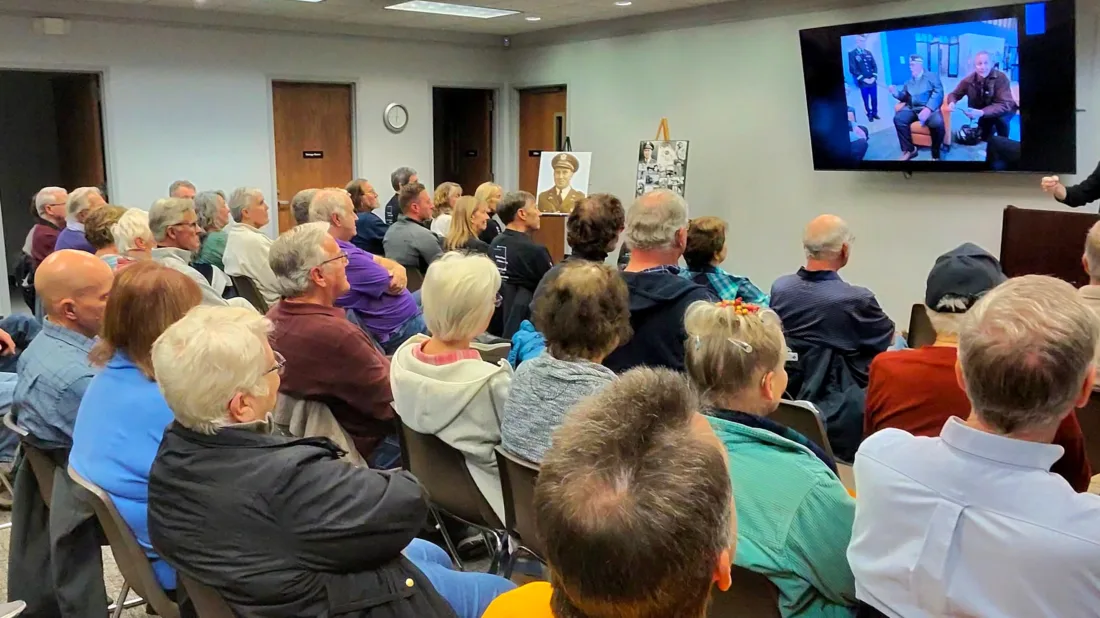
Attendees fill the Annex meeting room at the Brown County Historical Society on Wednesday evening for a Veterans Day program honoring Medal of Honor recipient Capt. Willibald “Bill” Bianchi. (Photo by Amy Zents)
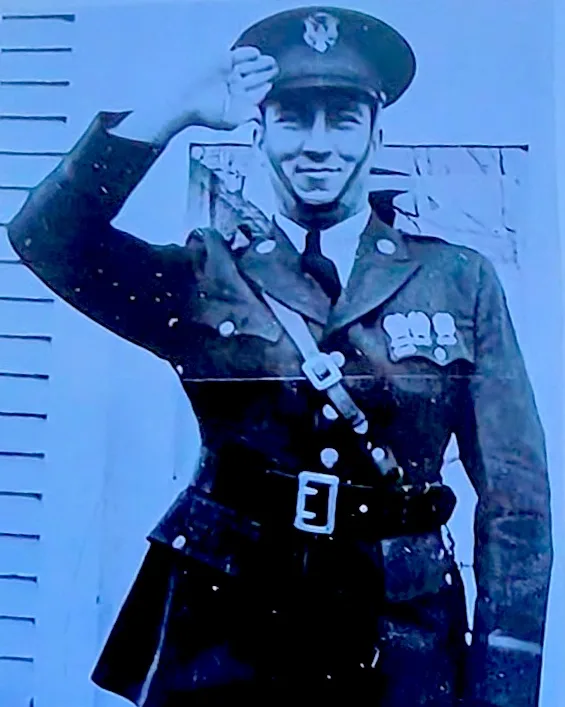
An archival photograph displayed during the Veterans Day program at the Brown County Historical Society shows Capt. Willibald “Bill” Bianchi in uniform saluting. (Photo courtesy of the Brown County Historical Society)
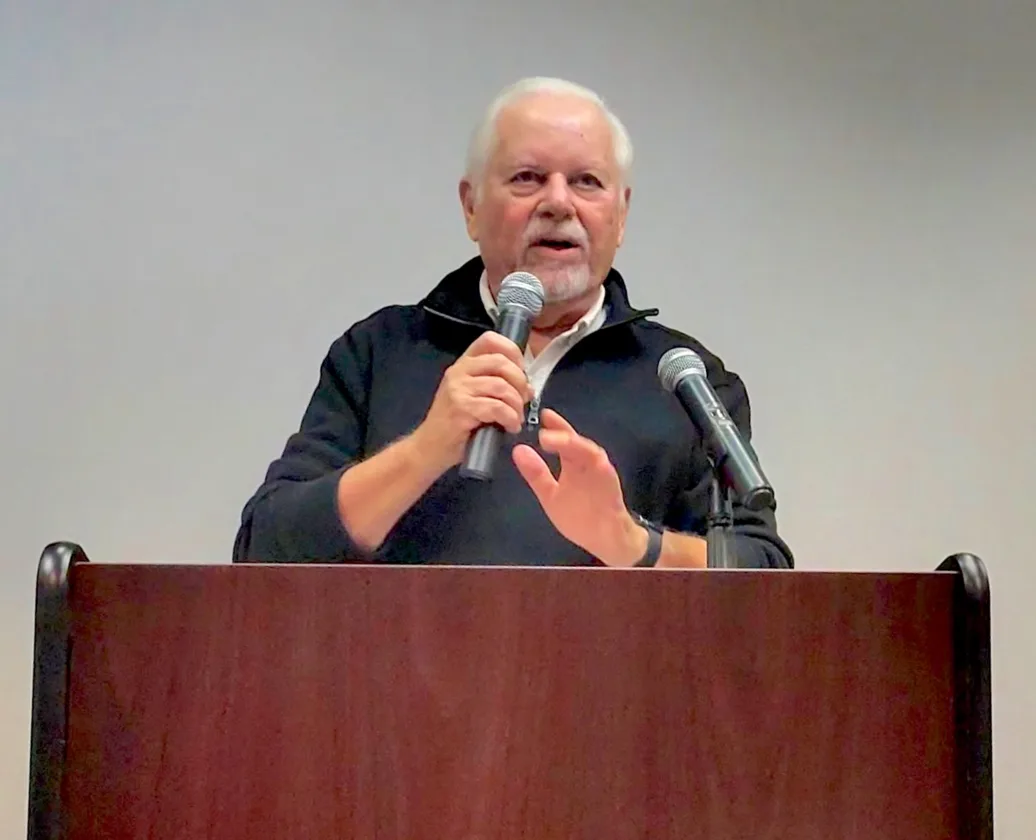
Curator Dan Hoisington opens the Brown County Historical Society’s Veterans Day program introducing the history of Medal of Honor recipient Capt. Willibald “Bill” Bianchi. (Photo by Amy Zents)
Carolyn Marti Smith stands between a portrait of her uncle, Capt. Willibald “Bill” Bianchi, and a collage of family and military photographs during a Veterans Day program at the Brown County Historical Society on Wednesday evening. (Photo by Amy Zents)
Attendees fill the Annex meeting room at the Brown County Historical Society on Wednesday evening for a Veterans Day program honoring Medal of Honor recipient Capt. Willibald “Bill” Bianchi. (Photo by Amy Zents)
An archival photograph displayed during the Veterans Day program at the Brown County Historical Society shows Capt. Willibald “Bill” Bianchi in uniform saluting. (Photo courtesy of the Brown County Historical Society)
Curator Dan Hoisington opens the Brown County Historical Society’s Veterans Day program introducing the history of Medal of Honor recipient Capt. Willibald “Bill” Bianchi. (Photo by Amy Zents)
Trending
NEW ULM - The Brown County Historical Society hosted a Veterans Day program Wednesday evening in the Annex building to honor Medal of Honor recipient Capt. Willibald "Bill" Bianchi of New Ulm, featuring stories from his family and the world premiere of a choral piece set to his mother's wedding poem.
Dan Hoisington, curator of the museum exhibit "A New Ulm Hero: Captain Willibald Bianchi," opened the program by telling attendees that preserving history requires active effort.
"Remembering is a choice," Hoisington said. "This is what we do."
He said names fade on the backs of photographs and stories disappear unless people choose to keep them alive, a responsibility taken up first by the soldiers who served with Bianchi and later by his family.
Hoisington traced Bianchi's service from the fall of Bataan to the Cabanatuan prison camp on Luzon, where up to 20 prisoners died daily of disease and malnutrition in the summer of 1942.
On Aug. 3, 1942, Bianchi took charge of the camp's grave-digging detail. Although a severed ulnar nerve from a combat wound left him unable to write his name for two years, he organized burials and placed dog tags in the men's mouths so their remains could be identified later. By the end of that month, Japanese camp administrators permitted chaplains to pray over the graves and allowed grave markers.
Other prisoners continued that record-keeping. Maj. Robert Cone of Minneapolis assumed responsibility for documenting camp deaths from November 1942 until October 1944, later helping the War Department identify Bianchi in a mass grave on Taiwan.
Before prisoners were shipped out in October 1944, Bianchi gave an uncensored letter addressed to his mother to fellow prisoner Hans Hornbostel, who buried it for safekeeping and delivered it to Carrie Bianchi two days before Mother's Day in 1946.
Hoisington read the letter aloud during the program.
"You have to excuse this writing, but for two years I couldn't write at all," Bianchi wrote. "The food here has been very scarce. Very little meat. Most of the time, none at all. No flour, grease or medicine. Thousands have died."
He told his mother to use his back pay and insurance money to keep herself secure in her old age if he did not return.
Carrie Bianchi preserved her son's story for decades after her husband, Joseph, died in a 1932 farming accident. She worked in the bakery at Eibner's, (her father Willibald Eibner's restaurant and bakery in downtown New Ulm), moved to Minneapolis in 1951, taught cake decorating and joined a daily bowling league at age 70.
When the Diocesan Council of Catholic Women honored her in 1942, she spoke of every family remembering a service member.
"I am proud, but tell me of a mother who was not proud of her son," she said at the time, before reciting an anonymous poem from her wedding that served as the text for Wednesday's choral premiere: "Life is a book of volumes three / The past, the present and the yet to be / The past we have written and laid away / The present we are writing day by day / The last and best of volumes three / Is locked from sight, God holds the Key."
Bianchi's niece, Carolyn Marti Smith, then described the effort to bring her uncle's remains back to Minnesota.
"It was an ordinary Saturday in September when my sister Sue came to me and said, 'They found Uncle Bill,'" Smith said.
Using DNA samples submitted by family members in 2018, the Defense POW/MIA Accounting Agency officially identified Bianchi on Aug. 11, 2025. His return from Takao Harbor, Taiwan, to Soldier's Rest in New Ulm covered 7,316 miles more than 81 years after his death.
Smith spoke about Bianchi's early life on a New Ulm farm, his boxing days at the University of Minnesota Farm School in St. Paul and his 1939 animal husbandry degree from South Dakota State University. In a recently discovered college textbook, he had underlined a single sentence about "why men behave as they do and how men can be encouraged to do as they should."
Assigned to the 45th Infantry of the Philippine Scouts, Bianchi earned the Medal of Honor on Feb. 3, 1942, near Bagac, Bataan. After taking two bullets to his left hand, he silenced an enemy machine-gun nest with grenades. Shot twice through the chest, he climbed onto an American tank and fired its anti-aircraft machine gun until another wound knocked him off the vehicle.
Bianchi survived the Bataan Death March and spent 32 months in three Japanese POW camps, where he managed food rations and bartered with guards for extra supplies and medicine.
As Allied forces closed in, guards loaded prisoners onto transport ships bound for Japan. Bianchi survived the initial bombing of the first ship (The Oryoku Maru), in Subic Bay and was transferred to a second ship (The Enoura Maru), where an American bomb struck the hold on Jan. 9, 1945, in Taiwan, killing Bianchi and 421 other prisoners.
For decades, relatives believed Bianchi was buried in an "Unknowns" grave at the National Memorial Cemetery of the Pacific in Hawaii called The Punch Bowl.
"I thought he was buried there," Smith said. "My family, who also went, thought he was buried there. Even Gov. Tim Walz told me he visited that grave marker. He wasn't there. We just didn't know it."
After forensic anthropologist Carrie LeGarde and her team at Offutt Air Force Base in Nebraska identified his remains, Bianchi returned to Minnesota aboard a Medal of Honor flight, where airport fire trucks greeted the plane with a water-cannon salute.
Despite a two-hour bus delay on the tarmac, residents lined highway overpasses, farms and Main Street businesses with flags as a 62-vehicle motorcade escorted the hearse to New Ulm.
"I spent 27 years with the military, teaching students in Wiesbaden, Germany, and Okinawa, Japan," Smith said. "Yet that day, looking at all of this at the bus window, I cried. I didn't know saluting could make me cry, but I guess it does now."
On May 2, which Walz proclaimed Captain Bill Bianchi Day, Bianchi was buried with full military honors, a 21-gun salute and a flyover by three Black Hawk helicopters.
Speakers at the memorial service included New Ulm Mayor Kathleen Backer, Maj. Gen. Shawn Manke, Minnesota Veterans Affairs Commissioner Brad Lindsay, Congressional Medal of Honor Society Chief of Staff Kim Mitchell, New Ulm native Joe Hoelz and U.S. Sen. Amy Klobuchar.
Wednesday, Veterans Day program concluded in the museum with the world premiere of "Life Is a Book of Volumes Three," composed by Grace Hennig and directed by Tom Andrews. Singers Gregory Derrickson, Michael Koester, Anna Kate Busch and Bethany Derrickson performed from the balcony alongside trumpeter Joe Schotzko, whose solo echoed taps.
Afterward guests enjoyed coffee and cookies baked by Becky Waibel of Becky Bakes, daughter of Bianchi's cousin Frederick Bianchi, before touring the exhibit.
Hoisington said Bianchi's actions showed courage in combat, kindness in captivity and devotion to his family, qualities people can still practice today.
"In some ways, Bill Bianchi has not left us," he said.