
Reading runestones
Hanska Historical Society hosts presentation on Kensington Stone
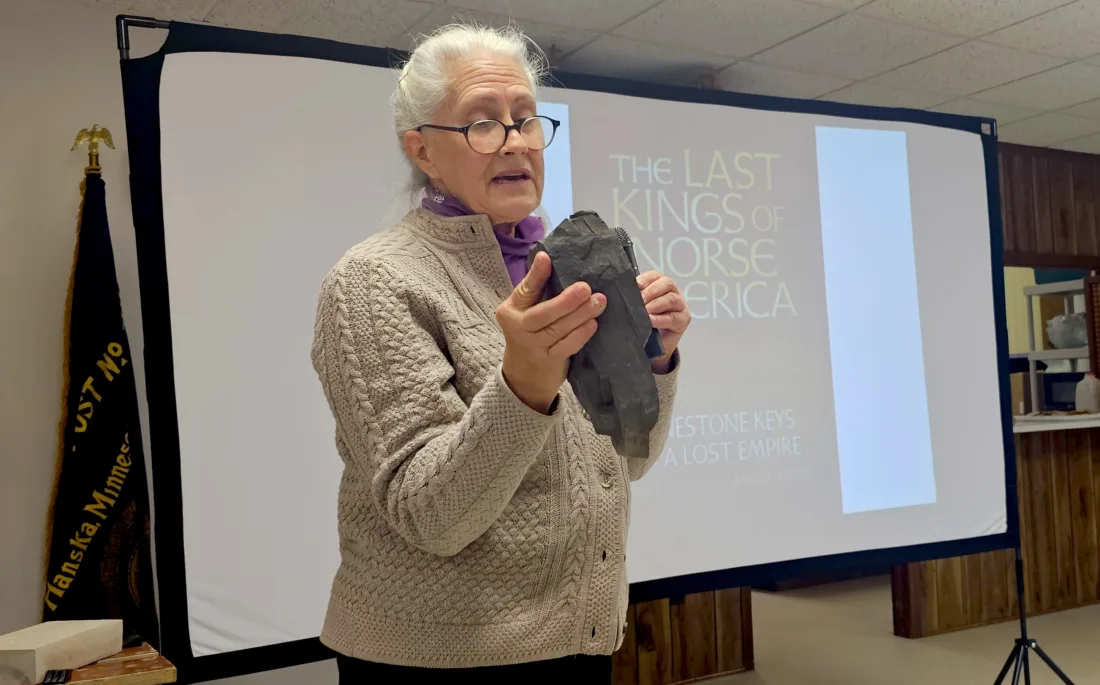
Janey Westin holds up a piece of graywacke rock to explain its dense properties and natural right-angle fracture lines during her talk on medieval Norse exploration. (Photo by Amy Zents)
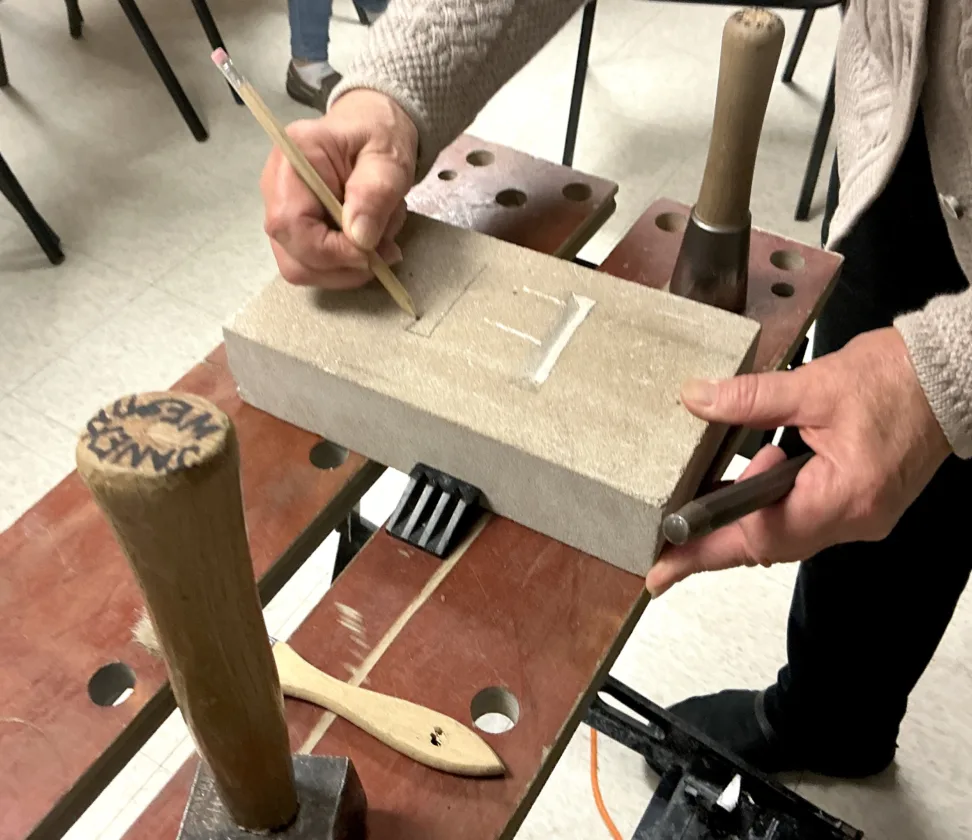
A close-up view of Janey Westin using a pencil to lay out V-shaped runic lettering on limestone before carving. (Photo by Amy Zents)
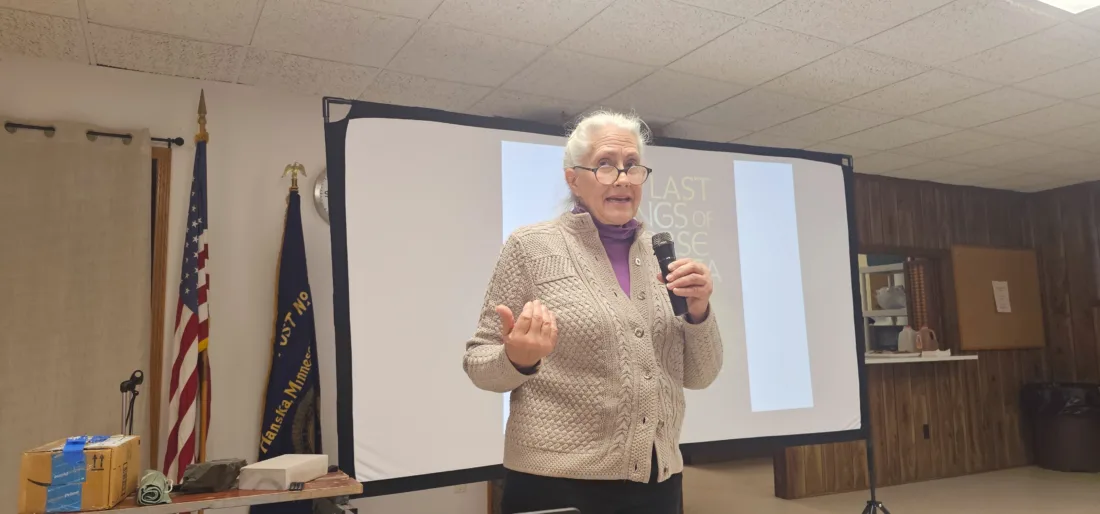
Janey Westin presents evidence supporting the authenticity of the Kensington Runestone during a presentation at the Hanska Community Center on Sunday. (Photo by Amy Zents)
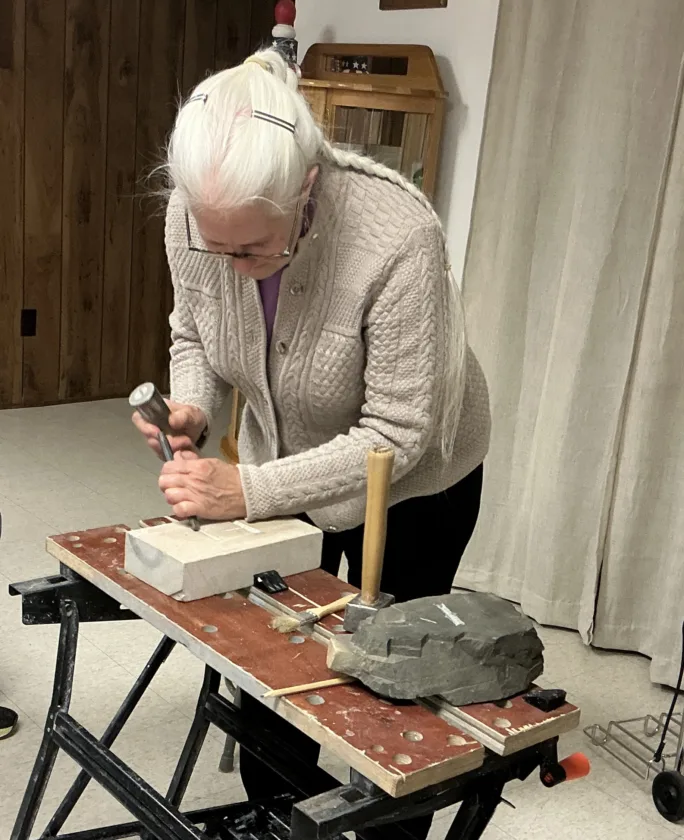
Janey Westin demonstrates medieval stone-carving techniques on Indiana limestone using a flat iron chisel and wooden mallet following her presentation. (Photo by Amy Zents)
Janey Westin holds up a piece of graywacke rock to explain its dense properties and natural right-angle fracture lines during her talk on medieval Norse exploration. (Photo by Amy Zents)
A close-up view of Janey Westin using a pencil to lay out V-shaped runic lettering on limestone before carving. (Photo by Amy Zents)
Janey Westin presents evidence supporting the authenticity of the Kensington Runestone during a presentation at the Hanska Community Center on Sunday. (Photo by Amy Zents)
Janey Westin demonstrates medieval stone-carving techniques on Indiana limestone using a flat iron chisel and wooden mallet following her presentation. (Photo by Amy Zents)
Trending
HANSKA -- Did the Vikings reach Minnesota before Columbus landed in the Americas?
That was the subject of a special of a special presentation held at the Hanksa Community Center, Sunday.
The presentation was part of the Hanska Historical Societies ongoing "Time Capsule Series."
Janey Westin presented a comprehensive, two-hour presentation on the 14th-century Norse population’s motives and experiences coming to America.
Janie Westin, a professional calligrapher and stone carver, co-authored the 2012 book "The Last Kings of Norse America: Runestone Keys to a Lost Empire" alongside her late father, Robert Johnson.
Westin presented evidence supporting the Kensington Runestone’s authenticity.
The Kensington Runestone was reportedly discovered in western Minnesota in 1898.
Olof Ohman, a Swedish immigrant, reported that he unearthed a rune stone from a field in the largely rural township of Solem, in Douglas County. It was later named after the nearest settlement, Kensington.
The stone is currently on display at The Runestone Museum in Alexandria.
Westin's father, Robert Johnson, a physicist at Honeywell, and an adjunct professor at the University of Minnesota, died a little over three years ago at age 100. His research on glacial history, geology and ocean currents provided the scientific foundation for their work together.
During her presentation, Westin focused on the Kensington Runestone, a 202-pound slab of graywacke featuring a runic text dated 1362.
“Graywacke is a dense, tough, and hefty type of rock," Westin said. "It begins as sandstone, but through geological heat and pressure, its silica grains become densely packed and fused together. This process makes the stone exceptionally hard and prone to fracturing in distinct, often right-angled lines."
To test the stone’s authenticity, Westin described how she and her father studied the artifact for four and a half hours in January 2001 after museum staff removed it from its display case for examination in Alexandria, Minnesota.
Their analysis relied on a primary discovery from 1909, when Newton Horace Winchell, then head of the Geology Department at the University of Minnesota, examined the stone for the Minnesota Historical Society.
During that earlier investigation, Winchell tapped a chisel against the front of the stone to chip off a 1-by-2-inch flake, exposing fresh, unweathered rock underneath, for testing.
Decades after Winchell’s test, Westin and her father used a portable microscope and high-intensity lighting to conduct a comparative physical analysis of three distinct surfaces on the stone.
They examined the fresh patch exposed by Winchell, the weathered grooves inside the runes carved in 1362, and the original 7,800-year-old glacially scratched surface.
Westin said the physical degradation inside the runes matched what would naturally occur over more than six centuries.
“We had to conclude that it could not be fake,” Westin said. “It had to be real. You can’t fake something like that.”
Westin translated the front of the artifact as documenting eight Gotlanders, referring to inhabitants of western Sweden near Gothenburg, and 22 Norsemen on a “taking-back journey” from West Vinland to reclaim lost trade.
According to the inscription, the party was anchored by two skerries (small rocky islets,) a day’s journey north of the stone, where they camped and fished.
Upon returning, they discovered 10 companions “reddened with blood and dead.”
The face inscription concludes with the Roman letters “AVM” for Ave Virgo Maria (Hail Virgin Mary) as a plea for salvation from an evil fate.
The side inscription adds, that a troop of 10 men remained in a large winter house to guard their ship, located 14 daghrise (an Old Norse measurement for a day’s travel, or roughly 75 miles) beyond the island in the year 1362.
Westin said that rather than functioning as a grave marker, the stone served as an authentic memorial to the slain men.
Following the presentation, Westin demonstrated medieval carving techniques, using a flat iron chisel and a sandstone whetstone to cut V-shaped grooves into Indiana limestone.
She said, “I always start my students working on the letter I.”
She explained that flat chisels and whetstones have remained virtually unchanged for centuries and that carving runes required significant technical planning and craftsmanship.
Hanska Historical Society member, Dave Nelson, was also present to assist with the event.
“The event was awesome. I had a good time," he said.
New Ulm local historian Terry Sveine also attended.
He said he had visited the Kensington Runestone four times previously, always viewing it as a contested artifact, but left Sunday’s presentation convinced of its authenticity.
“Yes, it’s real,” Sveine said.
Westin said she is currently preparing a second book focusing on medieval Scandinavian history in Denmark, and was traveling to Newport, Rhode Island, the following week for a historical conference.
She emphasized that Norse populations inhabited North America long before Columbus and that contact ended only when the Little Ice Age made North Atlantic ocean crossings too dangerous to sustain.
“As masters of sea travel and trade, the Norse people were able to live on the North American continent a long time before Columbus and the colonists arrived,” Westin said.