
The music comes home
Fezz Fritsche’s library returns to New Ulm
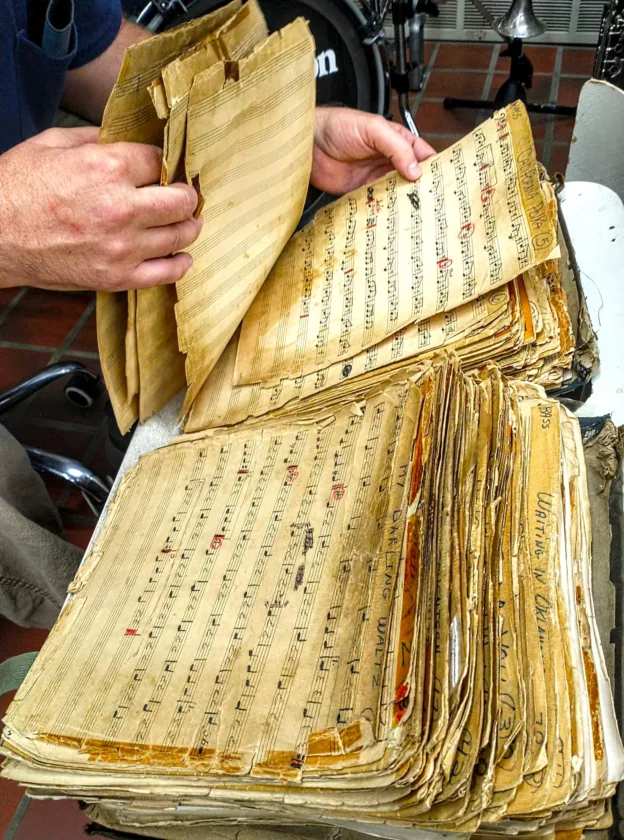
• Close-up of Fezz Fritsche's handwritten library, "California Polka" and "My Darling Waltz" with red markings; part of the five to six boxes donated to the Hall of Fame after being held by Jay Patterson. (Photo by Joel King.)
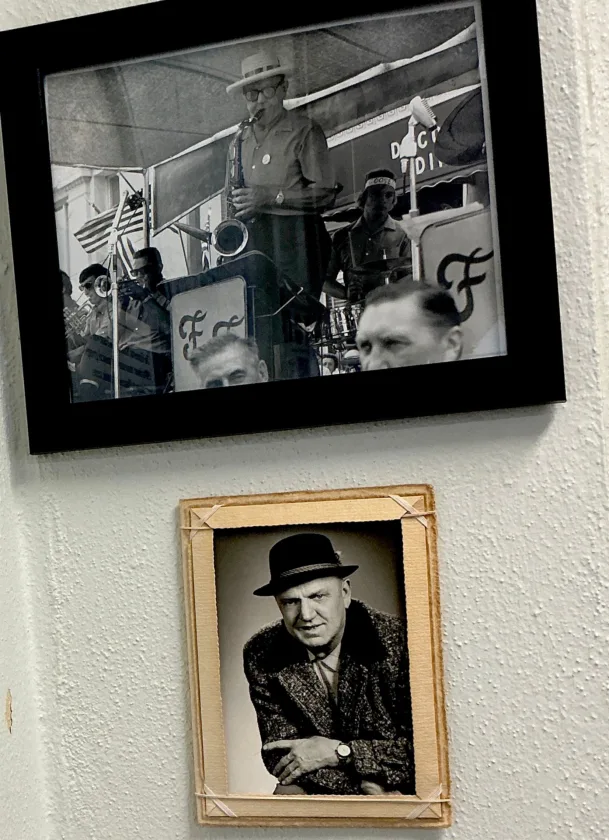
Fezz Fritsche on stage with his Goosetown Band (top) and a portrait of Fezz (bottom) on display at the Minnesota Music Hall of Fame during the Legacy Series honoring his music. (Photo courtesy of the Minnesota Music Hall of Fame)
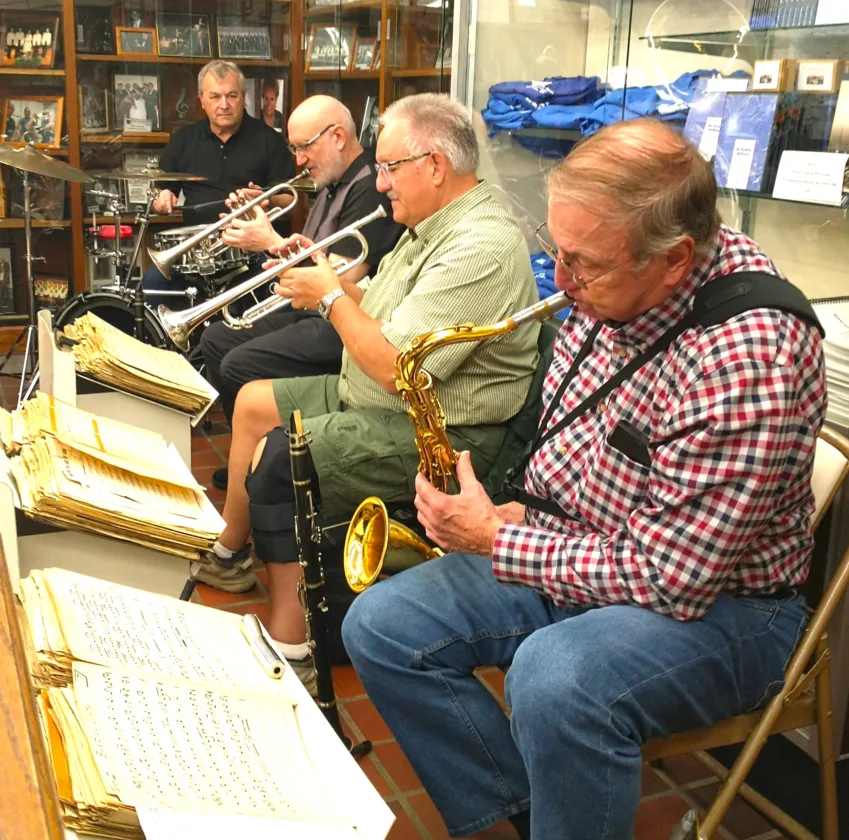
From left: drummer Mike Wendolek, trumpet players Richard Keane and Marty Nachreiner, and saxophonist Jerry Kahle (foreground, plaid) reading from Fezz Fritsche's handwritten charts. Photo by Joel King.
• Close-up of Fezz Fritsche's handwritten library, "California Polka" and "My Darling Waltz" with red markings; part of the five to six boxes donated to the Hall of Fame after being held by Jay Patterson. (Photo by Joel King.)
Fezz Fritsche on stage with his Goosetown Band (top) and a portrait of Fezz (bottom) on display at the Minnesota Music Hall of Fame during the Legacy Series honoring his music. (Photo courtesy of the Minnesota Music Hall of Fame)
From left: drummer Mike Wendolek, trumpet players Richard Keane and Marty Nachreiner, and saxophonist Jerry Kahle (foreground, plaid) reading from Fezz Fritsche's handwritten charts. Photo by Joel King.
Trending
NEW ULM -- A large group of people gathered at the Minnesota Music Hall of Fame (MMHF) museum on Friday, October 30 October Legacy Month.
The programming was headlined by a special event titled, “The Hall Travels to Goosetown and Salutes Fezz Fritsche and the Goosetown Band: A Special Live Practice Session”.
With band stands and original band signage on display, guests enjoyed a unique live practice session where an all-star replica band sight-read original handwritten arrangements of Fritsche’s music that had been buried for decades, some players even transposed the music into the right key on the fly.
The event opened with a special showing of the MMHF legacy film, "The Music Lives On," a tribute to those now gone who have contributed much to Minnesota's music scene.
The replica Goosetown Band came to the museum, in New Ulm, MN to bring Fezz’s music back to life.
What went up on the music stands made the day historic: not reprints, but the originals, yellowed paper taped at the corners, red pencil markings, and titles handwritten in ink such as California Polka and My Darling Waltz.
“Handwritten sheet music. That’s what they’re playing,” John Kass, Hall of Fame volunteer said.
The music’s return followed a remarkable 50-year detour.
Fifty years ago, when Fritsche died, he gave his extensive musical library to St. Cloud tuba player Jay Patterson. Patterson maintained five to six boxes of arrangements sorted by instrument sections, clarinets, saxophones, trumpets, and accordions, for five decades without public performance.
Following Patterson’s and his wife’s death, Albany radio broadcaster Cy Pfannenstein contacted the Patterson family to inquire about donating the collection. The family was happy to see it go to a good cause and donated the entire archive to the MMHF.
Pfannenstein picked up the collection, after which Myron Muehlbauer and Rick Keane traveled to St. Cloud to retrieve the boxes. Rick Keane took the music home to Pine Island and brought it along when playing in Wanamingo on July 3rd; subsequently, Peter Wendinger brought the materials back to New Ulm.
Wendinger, who grew up knowing Fritsche well, said that Fritsche was out at their place often.
Of the band members playing on Friday, Jerry Kahle, Myron Muehlbauer, and Richard (Rick) Keane are all proud inductees into the Hall of Fame.
The session culminated with a much-anticipated performance of “Tante Anna”. As the announcement from Dodie Wendinger rang out, “Make sure you stay long enough to hear when they play Tante Anna, ’cause Tante is coming out. That’s the big hit."
The traditional red shoes sat atop the cabinet alongside the green dress, peach apron, and flower-trimmed hat with red beads.
Local musician Adam Munsterman took on the vocal role as he stood beside the traditional costume, recreating the beloved presentation originally made famous by Eddie Willinger. (“Tante” is the German word for aunt, making Tante Anna mean Aunt Anna.)
For Peter Wendinger, the day carried deep personal significance rooted in childhood memories. He recalled when Fritsche took him and his brother Paul to Minneapolis Millers baseball games before the Minnesota Twins were established.
When Wendinger was seven and his brother Paul was five, Fritsche took them to a Millers game without their parents. It was an exciting outing that Paul was too young to fully remember, but one Wendinger recalled vividly.
“Fezz took Paul and I without our folks to a Miller’s game there.” Peter Wendinger said.
Friday’s event went full circle.
“After spending fifty years away, the music has come back home where it belongs: right here at the Minnesota Music Hall of Fame in New Ulm.,” Wendinger said.
Though the museum is now closed for the season until April, this historic homecoming ensures that Fezz Fritsche’s timeless compositions are safely preserved in their rightful home.