
Still Here
Exhibition explores Indigenous history and culture at The Grand
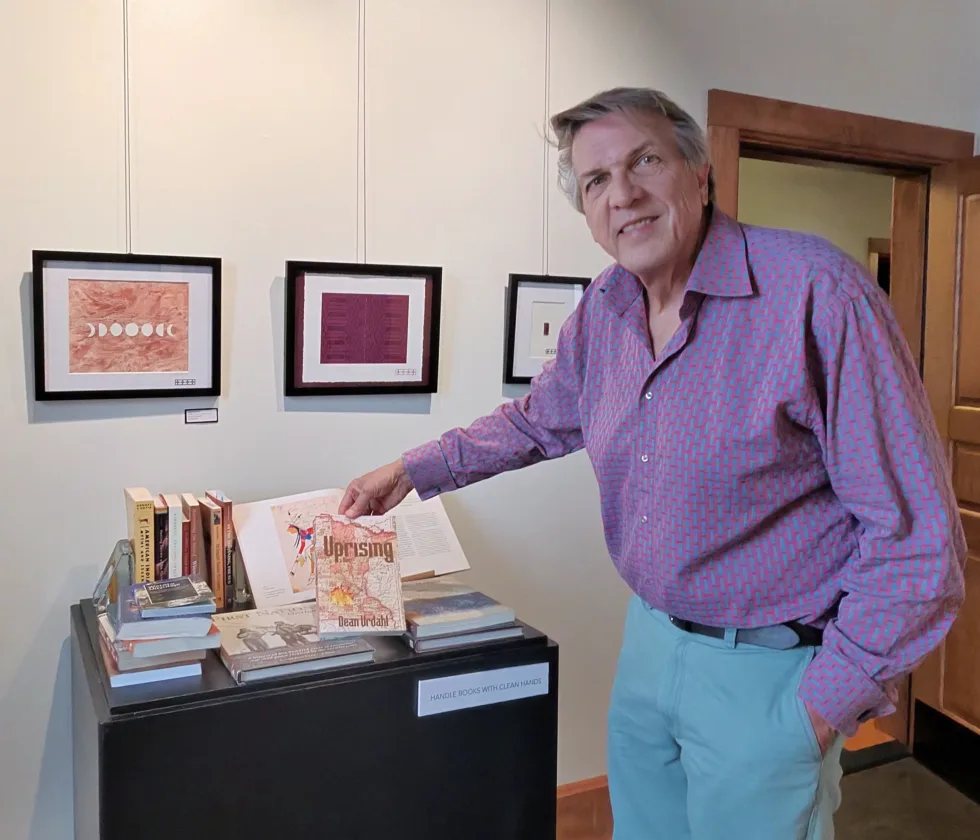
John Kellen with the book "Uprising," part of a book display that shaped his "We Are Still Here" exhibit. (Photo by Amy Zents)
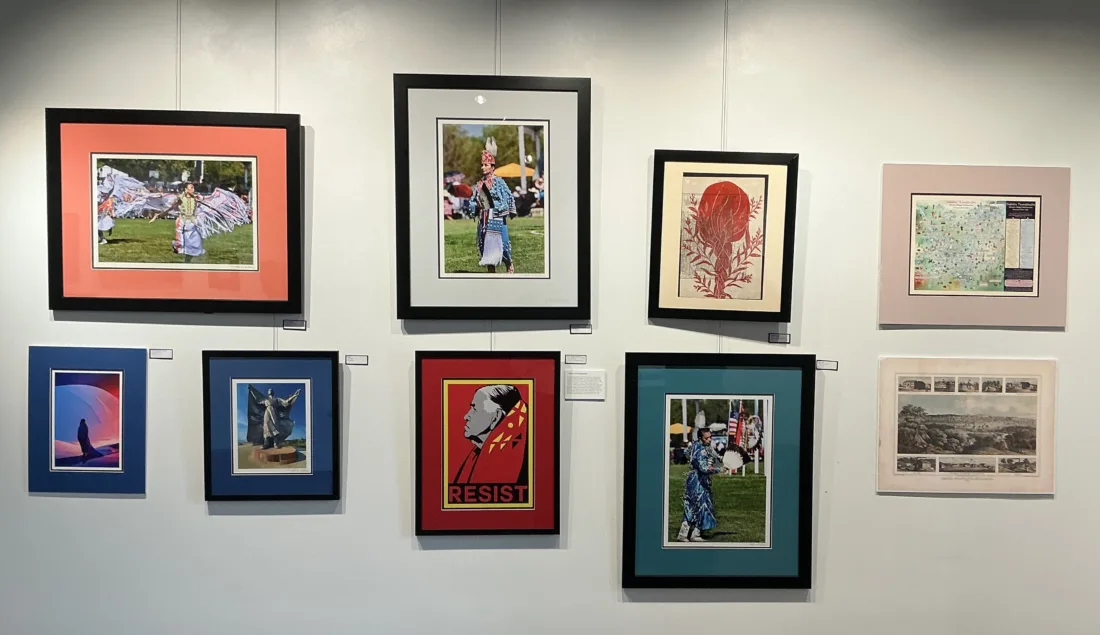
Mixed media wall with powwow regalia photos, Dakota land maps, ledger art and the "RESIST" print. (Photo by Amy Zents)
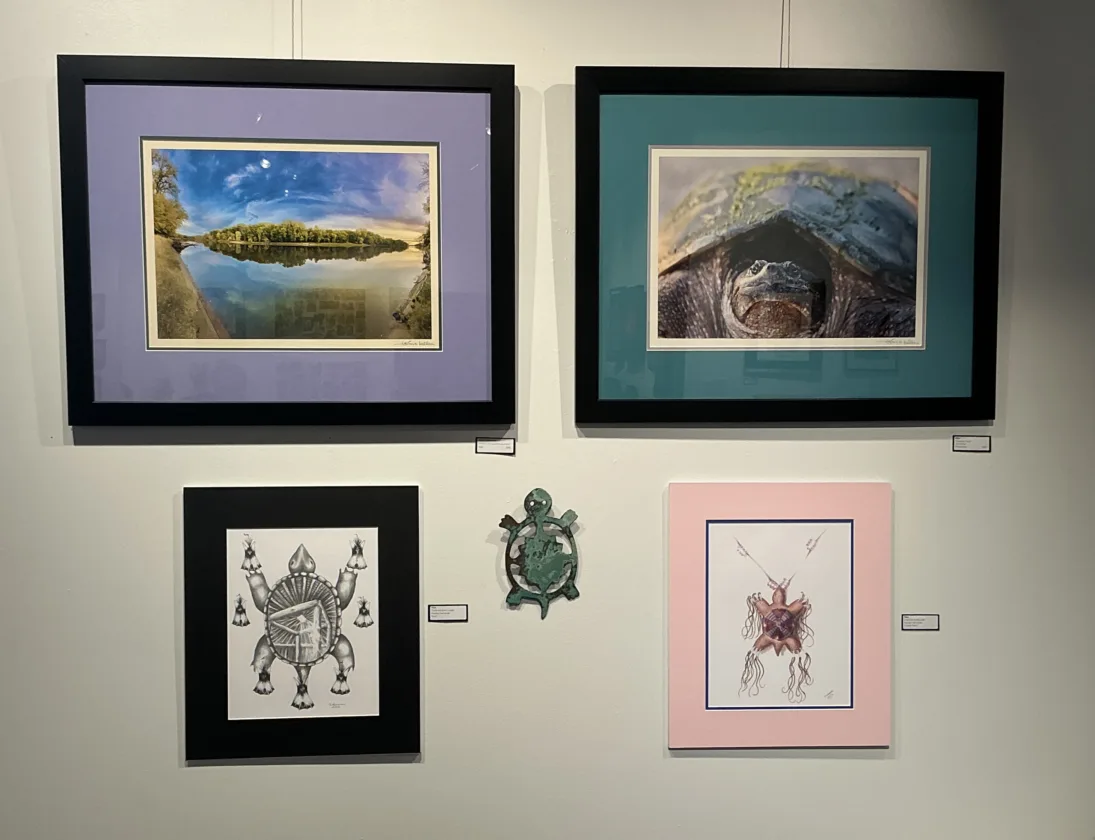
Turtle-themed works. "Keya" means turtle in Dakota. Includes art tied to 13 moons and earth lodges. (Photo by Amy Zents)
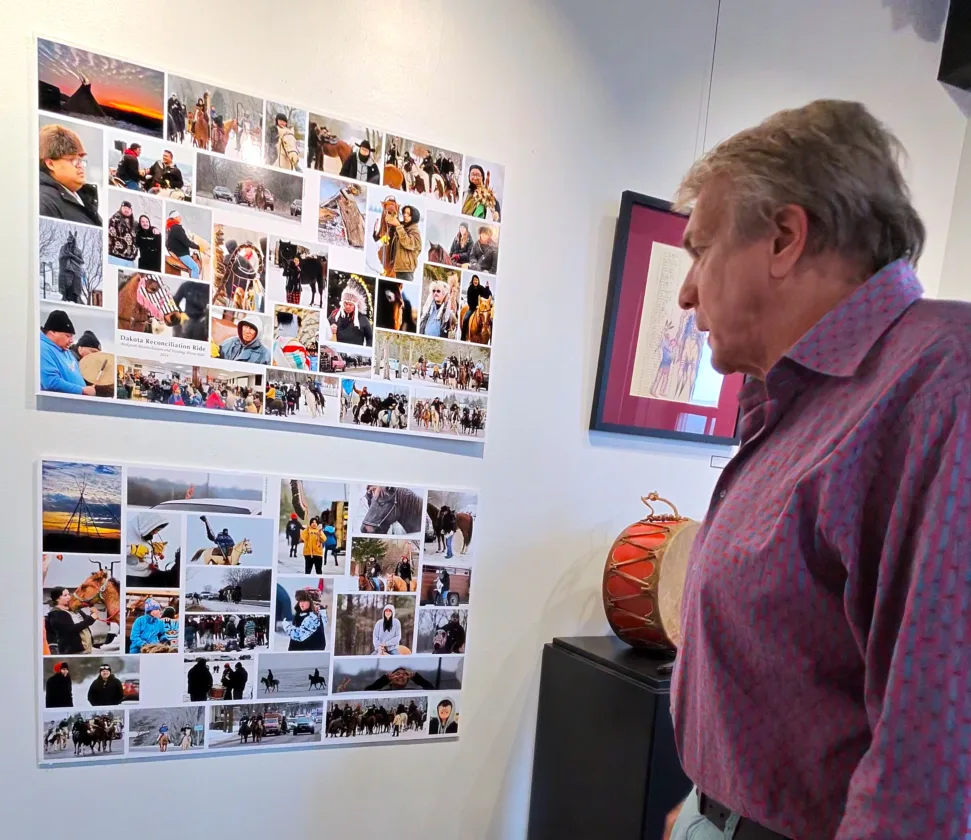
John Kellen with his photo collages of the Dakota Reconciliation and Healing Ride at the Grand. From his 40-year private collection. (Photo by Amy Zents)
John Kellen with the book "Uprising," part of a book display that shaped his "We Are Still Here" exhibit. (Photo by Amy Zents)
Mixed media wall with powwow regalia photos, Dakota land maps, ledger art and the "RESIST" print. (Photo by Amy Zents)
Turtle-themed works. "Keya" means turtle in Dakota. Includes art tied to 13 moons and earth lodges. (Photo by Amy Zents)
John Kellen with his photo collages of the Dakota Reconciliation and Healing Ride at the Grand. From his 40-year private collection. (Photo by Amy Zents)
Trending
NEW ULM – The Grand Center for Arts & Culture in New Ulm is presenting “Still Here: Cultural Reflections of the First Nations,” an exhibition curated by John Kellen that runs through November 27.
The collection, displayed in the 4 Pillars Gallery, coincides with National Native American Heritage Month, an annual November observance recognizing the history and contributions of Native American and Alaska Native communities.
The exhibition features a private collection of contemporary and historical Native art.
Kellen, the executive director of The Grand, said the title addresses a common misconception regarding Indigenous history.
“These indigenous people are still here,” Kellen said. “They have been treated as if they are in the past and history, and that they’re extinct. They still have very vibrant cultures that are existing today.”
Kellen said the art utilizes Indigenous motifs, patterns of symbols that hold deep cultural and spiritual significance. Rather than acting as simple decorations, these motifs serve as a visual language to share stories and record history.
Kellen began collecting this art 40 years ago while working in Yellowstone National Park.
His interest grew through friendships with Diné (Navajo) coworkers and later expanded as he lived in Arizona. He said the collection is intended to encourage public curiosity and foster deeper community reflection.
“My intention is to inform people, to have them be curious, to have them learn more on their own, and to really contemplate what is possible in a place like New Ulm that has such history and trauma on both sides,” Kellen said.
The exhibit addresses the trauma of the U.S.-Dakota War.
Kellen said that while New Ulm has extensive documentation of the settler experience through monuments and museums, he believes that account is often one-sided.
To illustrate, Kellen highlights the story of Taoyateduta, known as Little Crow, who was involved in the 1851 Treaty of Mendota.
As a leader, Little Crow saw the massive scale of settlers moving west and realized the Dakota were vastly outnumbered. When the war began, he helped people escape to Canada and the Dakotas, yet a $500 bounty was later placed on his head.
The history of Little Crow's remains is also part of the broader history.
His remains were displayed by the Minnesota Historical Society at the State Capitol starting in 1879 until removed in 1915 at the request of his grandson, Jesse Wakeman, before being returned for burial in 1971.
Kellen said he is learning to be a worthy ally by listening to Indigenous people.
He emphasized that the goal is not to induce guilt, which he views as an unproductive emotion, but to foster compassion and understanding across the broader community.
This focus on healing is central to the Makatoh Reconciliation and Healing Horse Ride, which honors the 38 Dakota warriors executed in Mankato in 1862. Kellen said modern riders maintain a spiritual focus.
“They’re in prayer every step of the way, and the horse is part of that prayer,” Kellen said. “While modern society calls this equine therapy, the Dakota have practiced this for centuries as a spiritual method to heal from historical trauma, reconnect with their ancestors, and remain grounded in prayer.”
The exhibit also includes work by contemporary artists such as Autumn Cavender, who combines traditional beadwork with recorded songs of incarcerated Indigenous women, and Marlena Myles, who created maps reclaiming Indigenous place names.
The collection features ledger art, a practice from the 1800s where artists used pages from ledger books to paint when paper was scarce. Another artist featured in the exhibit builds earth lodges, which are designed in relation to the stars and a calendar of thirteen moons.
Kellen is continuing his work as a filmmaker, currently developing an updated documentary on the Dakota 38+2 Ride.
He pointed to a free language-learning app called Dakhód Iápi Wičhóie Wówapi. Developed by the Dakhóta Iápi Okhódakičhiye in conjunction with Augsburg College and the University of Minnesota, the app serves as an electronic multimedia Dakota-English dictionary.
Kellen said language reclamation remains difficult because Indigenous children were punished for speaking their languages in boarding schools, and it was illegal to practice Indigenous religion and ceremonies until 1978.
The exhibition also features sacred sites like Bdote, the confluence of the Mississippi and Minnesota rivers, which is the site of Dakota origin story and where women historically traveled long distances to give birth because of the medicinal plants found in the area.
Kellen said Dakota philosophy emphasizes interconnectedness.
“The Dakota have a saying called Mitakuye Oyasin, which means we’re all related,” Kellen said. “Not just the human people, but also the four-leggeds, the winged relatives, the crawlers, the swimmers, and the plant nations.”
The exhibition is open to the public during gallery hours.