
Deer are on the move
Trending
Deer crashes peak in October and November in Minnesota.
Deer are most active at dawn and dusk, the Minnesota Department of Natural Resources said. The increase is tied to mating season and hunting season.
“Fall is an extremely active time for wildlife, especially deer,” said Col. Ken Soring, enforcement director for the Minnesota Department of Natural Resources. “Drivers need to remain alert and drive with particular caution this time of year.”
Soring said white-tailed deer become increasingly mobile during the October and November breeding season. Deer population numbers are at a peak in the fall.
“When you see deer along the roadside, reduce your speed and be wary of any sudden movement,” Soring said. “If a deer crosses the road, others may follow in its path.”
Soring said deer may cross at any time of day, but they are most active at dawn and dusk. Those are the same hours most people travel to and from work.
The Minnesota Department of Public Safety said 6,218 deer crashes were reported from 2016 to 2020. The crashes resulted in 18 deaths and 124 serious injuries. DPS said an estimated two-thirds of deer crashes go unreported.
Minnesota consistently ranks among the top states for animal-vehicle collisions, with odds well above the national average.
The DNR gathered safety measures for drivers.
Drivers should watch at dawn and dusk. The DNR said the majority of crashes happen between 5 and 8 a.m. and between 5 p.m. and midnight from October through January. The peak is 6 to 9 p.m.
Drivers should use high beams when there is no oncoming traffic. Soring said high beams provide extra time to see deer near the road. Drivers should slow down in areas marked by deer crossing signs. The signs mark known crossing areas.
Drivers should remember where there is one, there are more. Deer often travel in groups.
“If one crosses, others may follow,” Soring said.
Drivers should brake firmly and not swerve.
“Don’t swerve or veer to avoid a deer,” Soring said. “This can cause you to lose control and travel off the road or into oncoming traffic.”
DPS said a vehicle can be unforgiving if a driver jerks too hard, and the maneuver can cause a rollover. DPS said the deer strike is far less serious than a rollover.
If a driver hits a deer, Soring said to move the vehicle to the side of the road if it is drivable and turn on hazard lights.
“Move your vehicle to the side of the road if it’s drivable and turn on your hazard lights,” Soring said.
The DNR said drivers should call law enforcement, take photos of damage and the roadway, and keep a safe distance from the animal.
“If a deer is struck but not killed by a vehicle, keep your distance as deer may recover and move on,” Soring said. “If a deer does not move on, or poses a public safety risk, report the incident to a DNR conservation officer or other local law enforcement agency.”
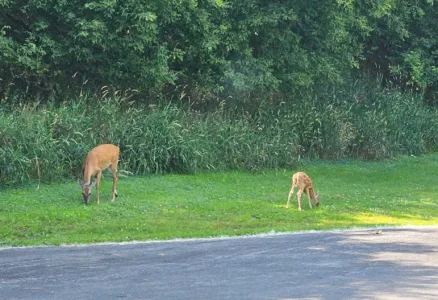
A doe and fawn graze near a road in New Ulm. The Minnesota Department of Natural Resources says deer are most active at dawn and dusk in October and November, and often travel in groups.
Photo by Amy Zents
Any Minnesota resident may claim a road-killed deer by contacting law enforcement for an authorization permit under Minnesota Statutes § 97A.502. The law says the driver who struck the deer has priority for the permit if the facts indicate the deer was not taken illegally.