
Backer presents how primary sources humanize historical figures
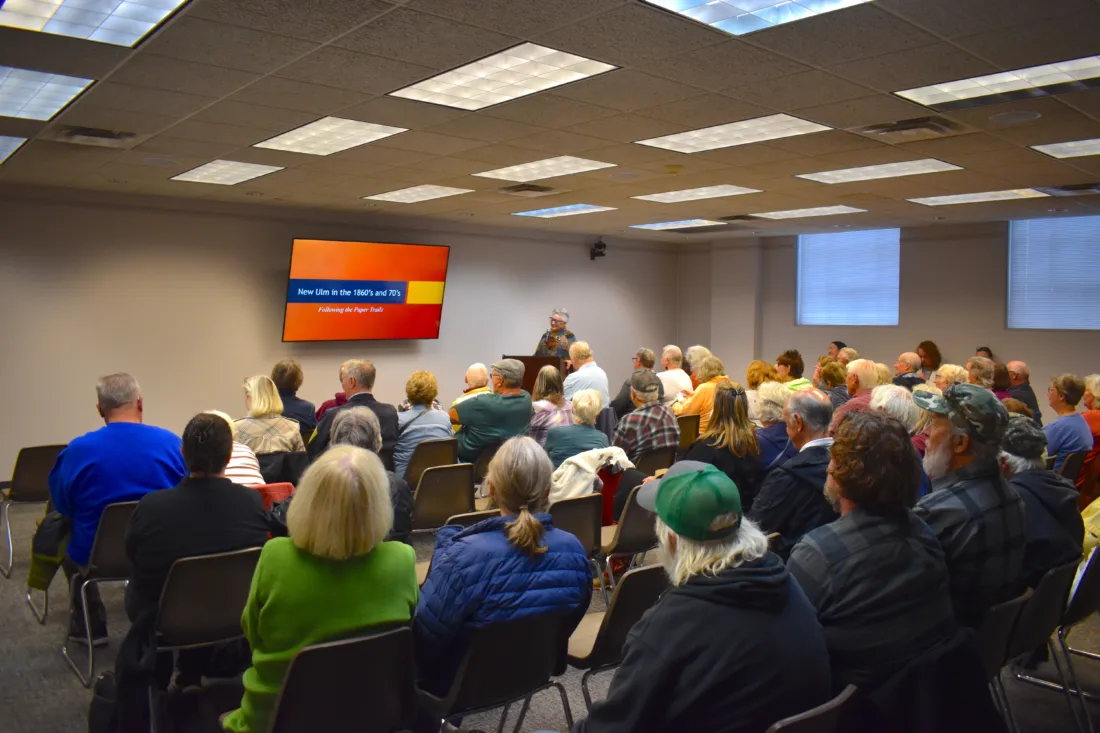
The BCHS Annex reaches full capacity for Kathleen Backer's presentation: “New Ulm in the 1860s and 70s: Following the Paper Trail” Photo by Dylan Jackson
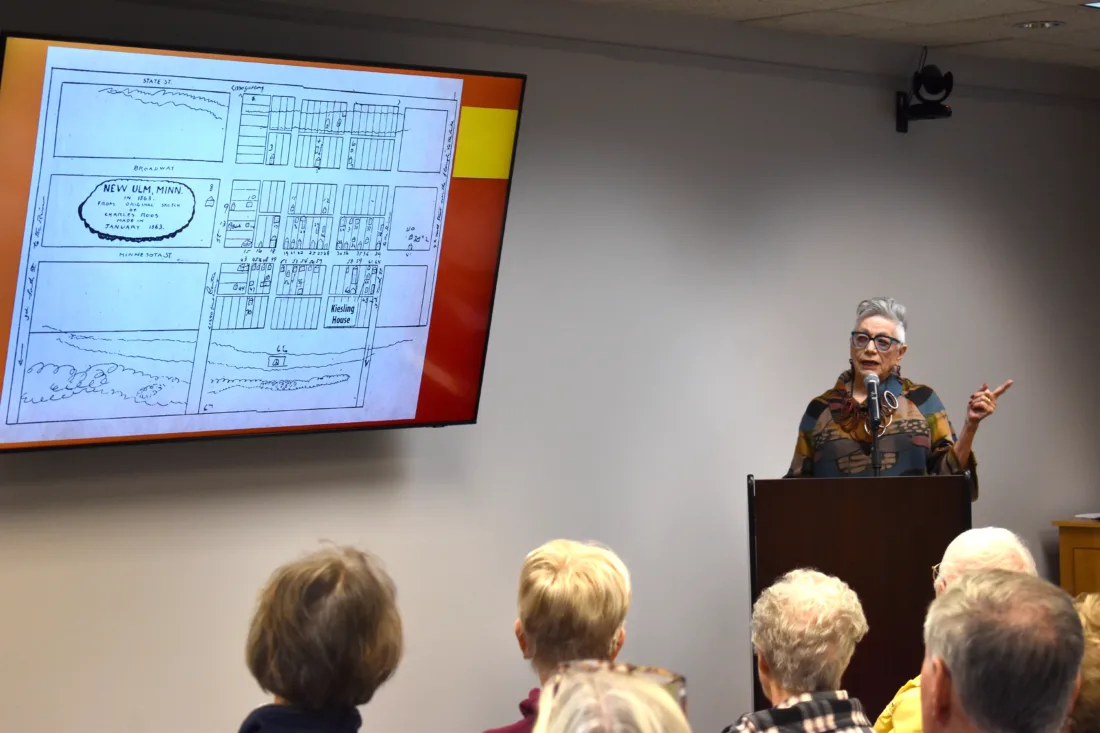
The BCHS Annex reaches full capacity for Kathleen Backer's presentation: “New Ulm in the 1860s and 70s: Following the Paper Trail” Photo by Dylan Jackson
Trending
NEW ULM -- Mayor Kathleen Backer explored how a range of items can serve as primary documents that humanize historical figures during her full capacity presentation "New Ulm in the 1860s and 70s: Following the Paper Trail" at the Brown County Historical Society (BCHS) Annex.
Backer's presentation wrapped up the season for BCHS's Lunch and a Bite of History series.
She opened by talking about all the new tools that assist with research. Backer, who worked as executive director at the BCHS museum in the 1980s, said back then it was just artifacts, photographs, and following the paper trail.
As technology has advanced, so has access to historical leads. Backer used the example of the Juni family. When researching, she had read that one of the Juni daughters was killed by Native Americans and another who was unable to be located following the Dakota War.
Backer said that this accepted truth became challenged with the development of the website Ancestry.
"The reason we probably couldn't find her on census records was because her name was spelled four different ways," Backer said. "And so how do you find her? Lucky for me someone else did."
With developments like Ancestry, in the case of the Juni family, the understanding of history is altered. For other developments, the understanding of history is sped up.
Backer pointed out a primary document written in German.
"[Before,] I would have to find somebody that could read German to share these with me," Backer said. "New tool. Take your phone on Google Translate."
After talking about the technological developments of research, Backer moved to discussing a 2012 paper trail development that humanized New Ulm historical figures like Frederick Keisling.
When working on the exhibit "Never Shall I Forget," the BCHS found depredation claims that were stored in the adjutant general's office records with the state.
Following the U.S.-Dakota War, Abraham Lincoln passed the Dakota Depredation Act to provide settlers funds to recover losses that occurred during the war.
Claims would include the ages and names of all the family members, where their home was located, and what businesses or services they offered to the town. Along with this information, a list of losses was included.
"It was quite involved, but it was a terrific vehicle or tool for people to recruit and start reclaiming their lives," Backer said.
More than 150 years later, the claims serve as incredible primary documents that paint a picture of what home life was like for the people of New Ulm in the 1860-1870s.
Backer used the depredation claim of Frederick Kiesling, who worked as a blacksmith, as an example. His claim sought $299.99. Later on he updated his list, citing that he had recovered ten hammers. Backer said that by clarifying his claim, Kiesling's claim would have more merit.
Fraud was common with those seeking depredation claims. For example, Backer said that one individual claimed $12,000. They ended up receiving $1,400.
Kiesling was awarded $190 of his claim.
For New Ulm residents like Kiesling, the loss of their items were commonly at the hands of the military that moved into the area following the initial attack.
"Maybe they saw it as a form of payment," Backer said.
Backer empathized with the settlers who fled their homes and returned to find them rummaged through.
"How would you feel? Violated?" Backer said.
Alongside lost personal items, such as a gold breast pin, Kiesling's depredation claim included emotions regarding the situation.
"He expressed anger at what the United States Army did with his equipment and his blackship shop and his house," Backer said.
She stressed the importance of primary sources like the depredation claims that gave insight into Kiesling.
"Until you find the primary sources, don't believe everything you read," Backer said. "Go to primary resources to find all the facts."
BCHS will be holding a Custom jewelry fundraising sale at the BCHS Annex from 10 a.m. to 3 p.m. Saturday.