
Building an ethical toolbox
NU students take part in Rotary ethics workshop
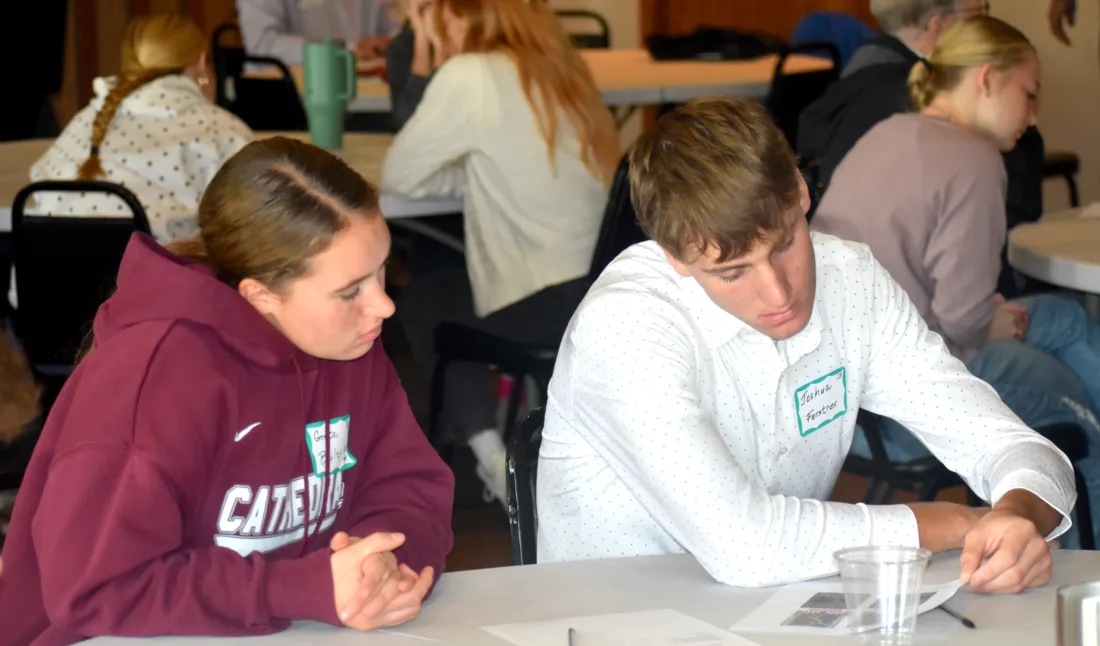
Cathedral High School students Greta Bailey and Joshua Forstner review an ethical dilemma involving autonomous driving cars during Tuesday’s Rotary Club ethics workshop. Photo by Clay Schuldt
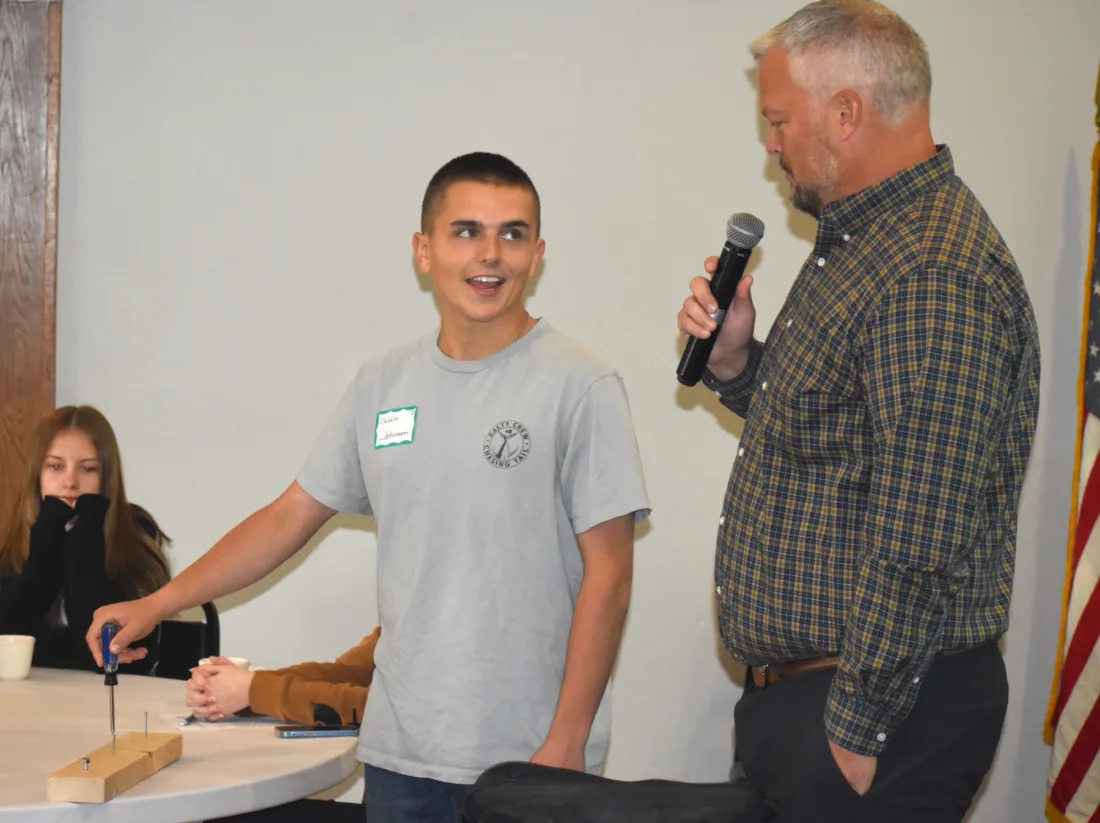
New Ulm High School student Cohlin Johnson assists Rotary Club member Steven Friese with demonstration during Tuesday’s ethics workshop. Johnson tells Friese that it is important to use the correct tool for each project. The same is true for ethical decision making. Johnson later said he appreciated the ethics workshop teaching the importance of discipline and integrity. Photo by Clay Schuldt
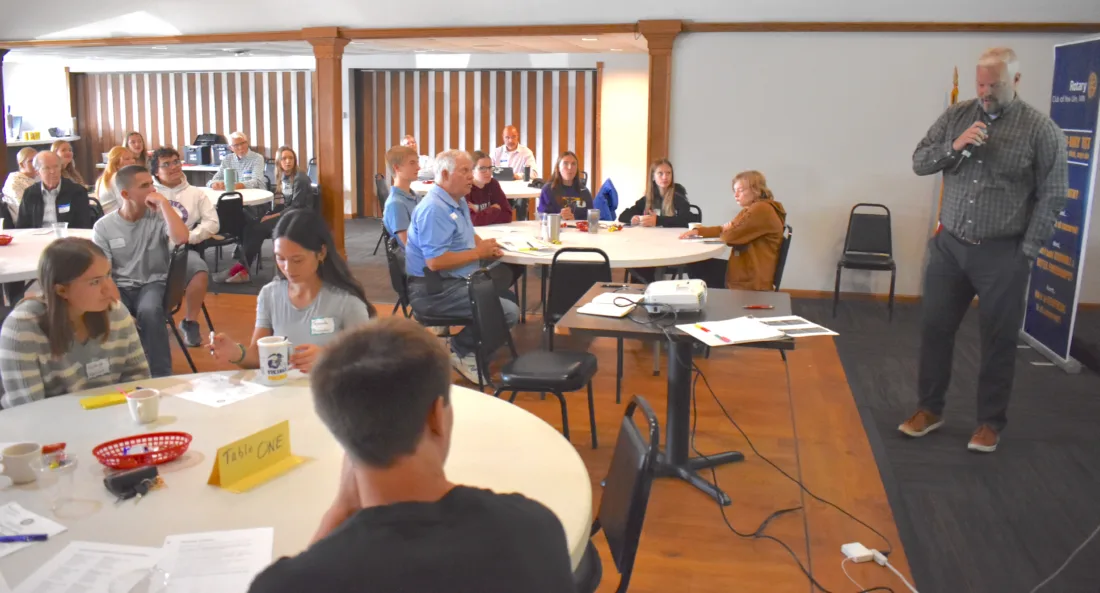
Rotary member Steve Friese talks about the different tool of ethical decision making during the Rotary Club’s Ethics Workshop at the New Ulm Country Club. Photo by Clay Schuldt
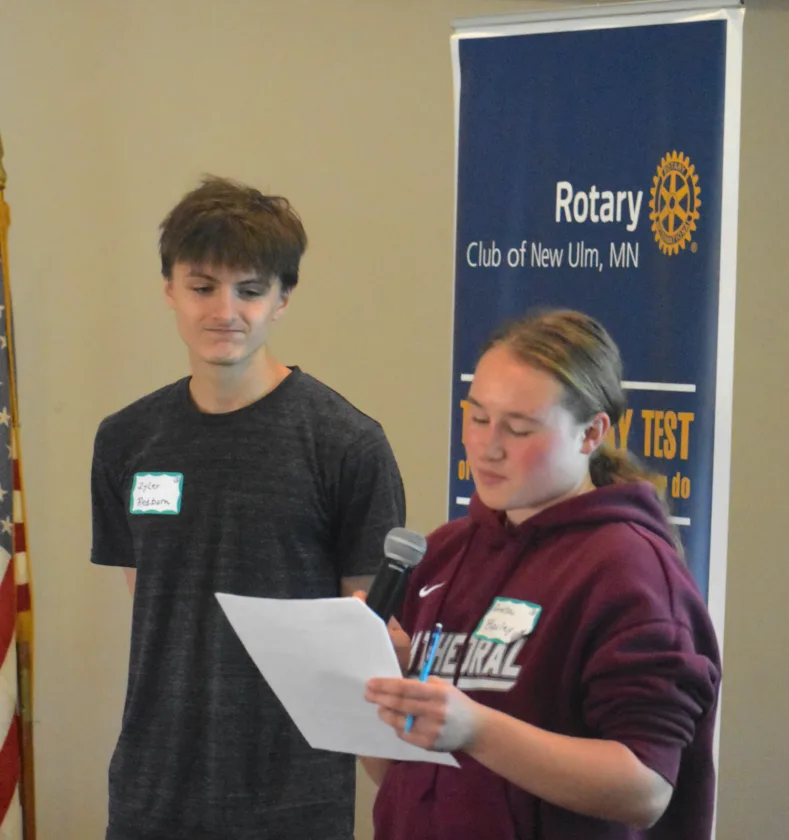
Cathedral Student Greta Bailey (right) and New Ulm High School student Zyler Redburn (left) give a prepared statement on how their company would ethically respond to the allegations presented in the Rotary Club’s simulation. Photo by Clay Schuldt
Cathedral High School students Greta Bailey and Joshua Forstner review an ethical dilemma involving autonomous driving cars during Tuesday’s Rotary Club ethics workshop. Photo by Clay Schuldt
New Ulm High School student Cohlin Johnson assists Rotary Club member Steven Friese with demonstration during Tuesday’s ethics workshop. Johnson tells Friese that it is important to use the correct tool for each project. The same is true for ethical decision making. Johnson later said he appreciated the ethics workshop teaching the importance of discipline and integrity. Photo by Clay Schuldt
Rotary member Steve Friese talks about the different tool of ethical decision making during the Rotary Club’s Ethics Workshop at the New Ulm Country Club. Photo by Clay Schuldt
Cathedral Student Greta Bailey (right) and New Ulm High School student Zyler Redburn (left) give a prepared statement on how their company would ethically respond to the allegations presented in the Rotary Club’s simulation. Photo by Clay Schuldt
Trending
NEW ULM - Students from New Ulm High School, Cathedral High School (CHS), Minnesota Valley Lutheran (MVL) and River Bend Alternative Learning Center came together at the New Ulm Country Club to tackle ethical questions.
This was part of the New Ulm Rotary Club's annual Ethics Workshop. The purpose of the workshop is to emphasize ethical behavior in everyday life. Throughout the day, the students listened to Rotary Club members discuss different aspects of ethics as well as presenting tools for thinking ethically.
Rotary member Steve Friese led a session on using tools to make ethical decisions. He started with a demonstration. He showed the students a board with a screw, nail and bolt attached to it. He asked New Ulm High School senior Cohlin Johnson which tools were the best for removing each item. Johnson correctly identified that a screwdriver was needed for the screw, a wrench for the bolt and a claw hammer for the nail.
Friese said for every job the right tool was needed and the same was true for ethical decision making. He said there were several tools for making ethical decisions, but in the workshop they presented four methods: The Golden Rule, conscience, moral point of view and the Rotary Four-way Test.
The Golden Rule states: "treat others as you would like others to treat you." Friese said the variations of this rule appear in several religions and comes down to reciprocity.
He described conscience as inner awareness, while the moral point of view was an attempt to look outside of oneself.
The Rotary Four-Way test asked four questions. Is it the truth? Is it fair to all concerned? Will it build goodwill and better friendships? Will it benefit all concerned?
As an exercise, Friese led the students through a scenario involving artificial intelligence (AI) and how it is programmed to behave ethically. The students were given a scenario of how to ethically program an AI-driven car. If an AI-driven vehicle experiences brake failure near a pedestrian crosswalk, does it continue in its current lane or swerve into another lane? Each decision could result in injury or death for a pedestrian, but which is the ethical choice?
Friese said there was no perfect outcome. All options were flawed, but it showed the complexity of making ethical decisions.
The AI scenario is a recent addition to the ethics workshop. It was introduced last year. Friese said AI was becoming a bigger part of students’ lives. It is something that is already impacting their lives.
The workshop closed with the students dividing into seven groups, each with a New Ulm Rotarian to provide guidance. In the groups, the students are given presented ethical scenarios to practice decision-making. The program ended with students participating in business simulations. In the scenario, the students take on the roles of different executives in an apparel company facing many ethical dilemmas.
In the scenario, the company was caught using child labor overseas, company data was hacked in a cyberattack, and the vice president of manufacturing was allegedly misusing company funds.
Each group needed to file a report on how they would handle the decision and give a report to the workshop. The other groups were encouraged to ask follow-up questions to critique the merits of their decisions.
Most of the students resolved the scenario by terminating their corrupt vice-president and moving manufacturing out of nations with questionable labor laws.
The exercise was facilitated by St. Thomas Professor David Rodburne. He said the scenario he created was fictional, but everything in the scenario had happened to a real-world business.
Rodburne said for some companies this ethical crisis was a bad day at the office, but not necessarily a unique problem because many businesses struggle with these issues.
He complimented the students for identifying a key ethical issue. Each of the groups commented on the need to have proper oversight on supply chain.
Rodburne said that when a company supplies a product from overseas using an outside contractor, it is difficult to verify things are being done ethically, especially if that company uses another subcontractor.
Student feedback on the workshop was positive. Several students said they learned a lot from the experience.
CHS student Emmett Gaalswyk asked the most questions during the reporting part of the program. Gaalswyk said he enjoyed the process of picking apart group plans. His takeaway from the workshop was the importance of having a moral framework.
"The decisions you make should always be morally right," Gaalswyk said. "You can see the problem from an economic or political viewpoint, but it all needs to lead back to a moral decision."
River Bend student Elise Lentz said she realized there were a lot of things to take in when discussing ethical decisions. With the business simulation, she tried to approach the problem from a logical perspective. In her group, Lentz had the role of the shady vice-president. Her group ultimately decided to fire their VP. Even though it was her role, she admitted it was the correct decision.
CHS student Greta Bailey said that going into the workshop she did not know a lot about the Rotary Club, but she appreciated the business simulator exercise and the opportunity to juggle the different ethical issues.
One of the hardest parts of the exercise was reporting back to the group on their decision-making process. Bailey served as the spokesperson in her group and was able to handle the role well.
Bailey credited her role in 4H as helping her become comfortable with public speaking. She gave special thanks to Michelle Schrader for getting her involved in speech classes.
Rotary member Harold Remme said this was the 11th year the club hosted the ethics program. He said it continues to remain popular with the local students. He praised this year's students for their participation.
"Their concentration on the program was wonderful," he said.