
Morgan Creek Vineyards holds final public Oktoberfest celebration
Vineyard shifts to private events

Ben Marti (left) and co-owner George Marti pose on the patio during the final public Oktoberfest celebration at Morgan Creek Vineyards on Saturday afternoon. (Photo by Amy Zents)
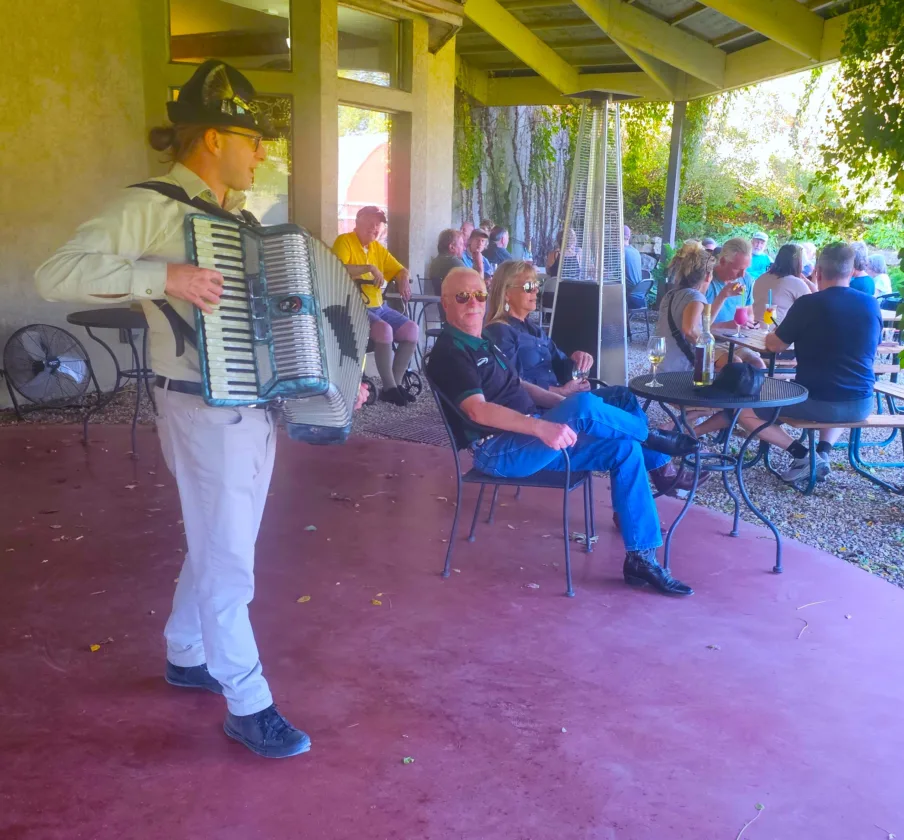
Ben Marti strolls the outdoor patio playing traditional Oktoberfest selections to entertain guests during the final public event at Morgan Creek Vineyards. (Photo by Amy Zents)
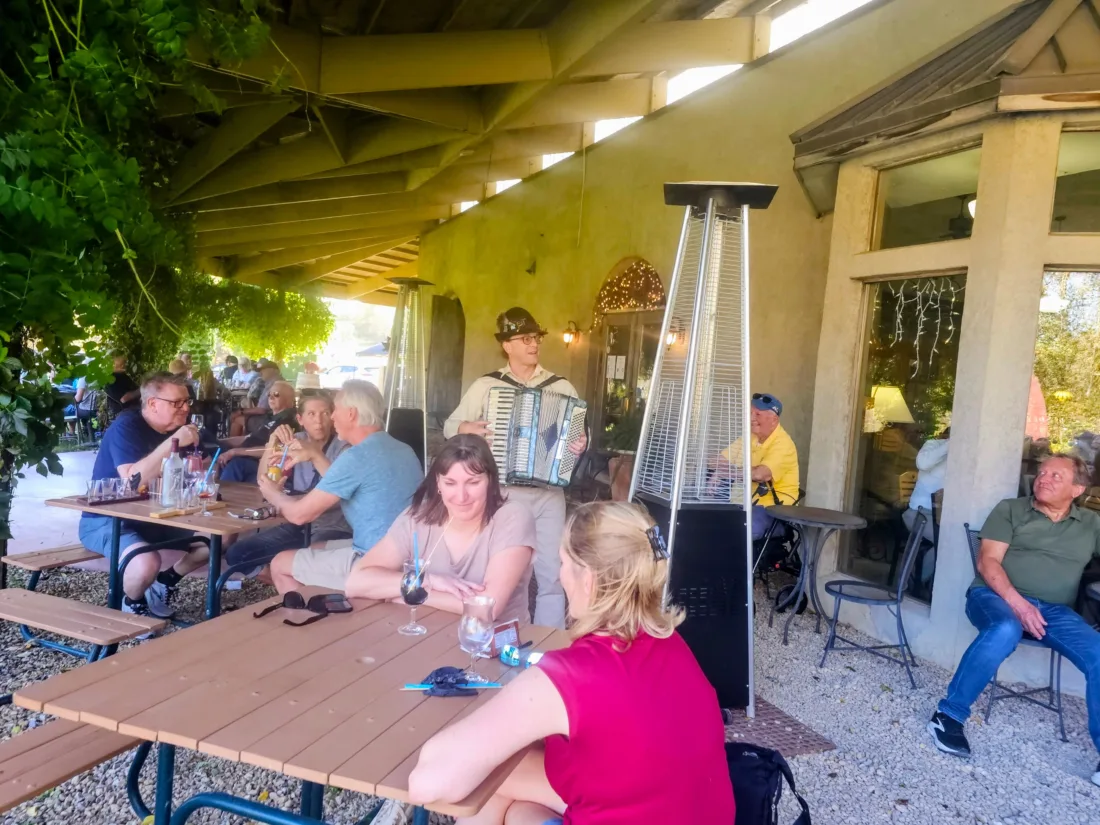
Patrons enjoy the final public Oktoberfest celebration on the outdoor patio at Morgan Creek Vineyards, marking the conclusion of the venue's regular retail operations. (Photo by Amy Zents)
Ben Marti (left) and co-owner George Marti pose on the patio during the final public Oktoberfest celebration at Morgan Creek Vineyards on Saturday afternoon. (Photo by Amy Zents)
Ben Marti strolls the outdoor patio playing traditional Oktoberfest selections to entertain guests during the final public event at Morgan Creek Vineyards. (Photo by Amy Zents)
Patrons enjoy the final public Oktoberfest celebration on the outdoor patio at Morgan Creek Vineyards, marking the conclusion of the venue's regular retail operations. (Photo by Amy Zents)
Trending
NEW ULM -- Morgan Creek Vineyards hosted its final public Oktoberfest celebration Saturday, closing its public festival schedule as owners George and Paula Marti shift the business exclusively to private events.
The Vineyard shifts to private events operated on a reduced schedule this year, with three public events, and is now ending regular retail operations. It will no longer operate as a public restaurant and bar and will no longer be listed in regional tourism guides for retail service.
George Marti outlined the change during the event Saturday, citing economic and demographic shifts affecting the wine industry and the long-term viability of retail hospitality in southern Minnesota. He said the decision followed careful consideration of market conditions, customer habits and operational demands in recent years.
“We decided we’ll try switching over to that,” George Marti said regarding the shift to private functions. “We’ve been doing it every year at some certain level, but now we’ll just be an event place. We’re just going to stop with our food service here, or the pizza there and all that.”
Under the new model, in-house food service, including pizza, will end. The business plans to work with outside caterers, including Lola’s and Gutes Essen, for private bookings. Gutes Essen provides custom catering, including pulled pork items served during Saturday’s event. Lola’s offers other catering options.
Marti said Aron Bode of Lola’s in New Ulm knows how to use the venue’s outdoor brick pizza oven and even has his own pizza paddle.
George Marti said age-related constraints and Paula Marti’s difficulty maintaining a full-time work schedule were primary factors in scaling back daily retail operations. Family members have helped over the years, he said, but the current retail model is no longer financially viable for long-term, full-scale operation.
Customer demographics and marketing strategy also shaped the outcome. George Marti said the business deliberately avoided marketing to younger customers, choosing instead to cultivate an older clientele that preferred classical music and jazz.
“We really avoided moving into a young crowd type of place,” George Marti said, “we just didn’t market to the young people, and we liked having just an older crowd.”
Financial data shared by George Marti showed revenue peaked in 2017 and declined steadily through 2020. The COVID-19 pandemic temporarily masked the downward trend, he said, but data from 2022 confirmed retail traffic would not return to prior levels. Wholesale operations previously provided a partial offset to retail losses, but overall retail viability continued to decline.
“COVID covered up the fact that we were already on a downhill slide,” George Marti said. “When we look back, 2017 was the best year money-wise, but it was declining in ’18, ’19, ’20. Then 21 came, and we just assumed, ‘Oh, this is going to take at least two years to go back.’ It wasn’t until 22 that we realized, ‘Oh gee, we didn’t really come back very much.'”
As the customer base aged, consumer habits shifted alongside the owners’ age-related constraints. Patrons moved away from multiple-bottle purchases toward single glasses.
“Patrons used to come out and they have one, two, three, sometimes they have four bottles with a little group, you know, in one night. Now they come out and they just order one glass,” George Marti said. “So not only are we not getting new people coming, the old people can’t keep up anymore.”
External expenses, including tariffs on glass bottles sourced from Canada or Mexico and higher costs for ingredients such as sugar and grapes, affected operations, though George Marti said those factors were secondary to the broader decline in alcohol demand.
He attributed the long-term societal decline in alcohol consumption to historical shifts in sanitation. In medieval Europe, he said, wine served as a safe beverage because water sources were contaminated.
“In the Middle Ages, they got densely populated, but there’s no sanitation system. So what happens? The water gets infected,” George Marti explained. “One of the reasons [for wine] was that was a safe beverage. No human pathogen can survive in wine. The pH is low, so you could make that a daily beverage.”
Saturday’s final public gathering brought together community members and longtime supporters. Among them were Dave and Janet Rieke of Chaska, who farmed in Fairfax for 53 years before relocating.
Dave Rieke said, "We're from Chaska, but we go way back."
The Riekes shared a family background in music, recalling that George taught piano to their daughters and that their son was involved in string instruments and the Suzuki program.
Marti's son, musician Ben Marti strolled among the guests playing his accordion, featuring traditional selections including the “Beer Barrel Polka."
Recalling the first week's 2026 New Ulm Oktoberfest at Morgan Creek, Marti said, "Last Saturday we had music from The Nintentones, and today we have Ben strolling with his accordion."