
MMHF celebrates the legacy of Whoopee John Whilfahrt
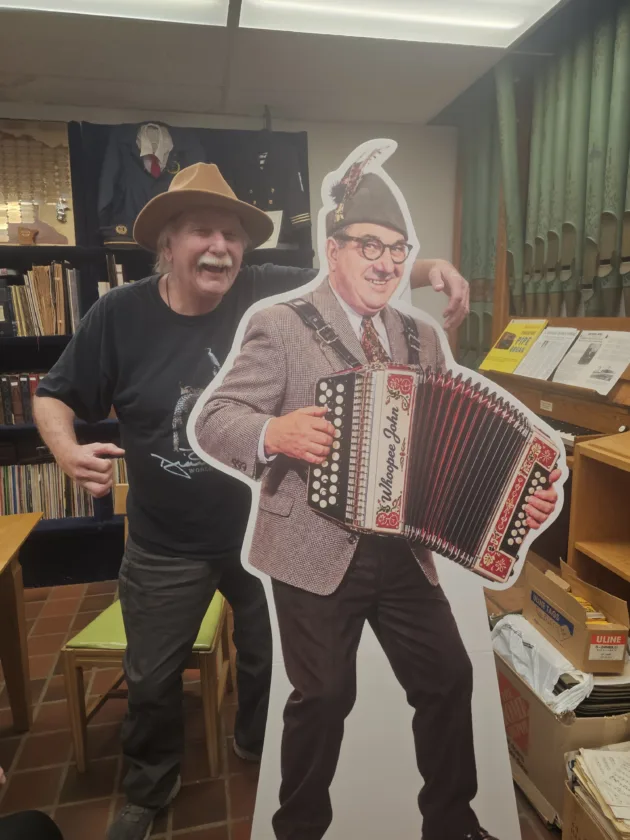
Neal Bond, board member of the Minnesota Music Hall of Fame, beside the life-size cutout of Whoopee John Wilfahrt. (Photo courtesy of Minnesota Music Hall of Fame)
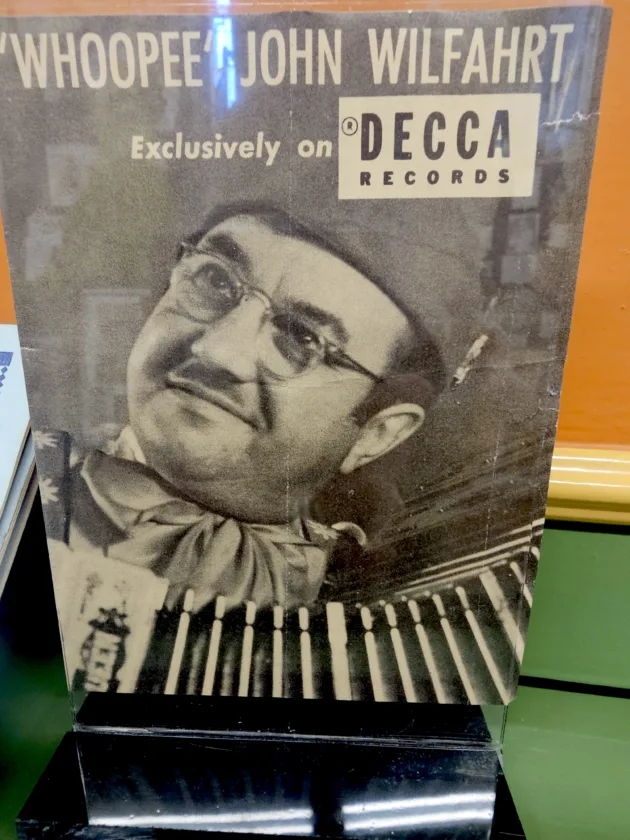
A display at the Minnesota Music Hall of Fame shows Whoopee John Wilfahrt billed as "Exclusively on Decca Records." Wilfahrt signed with Decca in 1934 as the label's second artist after Bing Crosby. (Photo courtesy of Minnesota Music Hall of Fame)
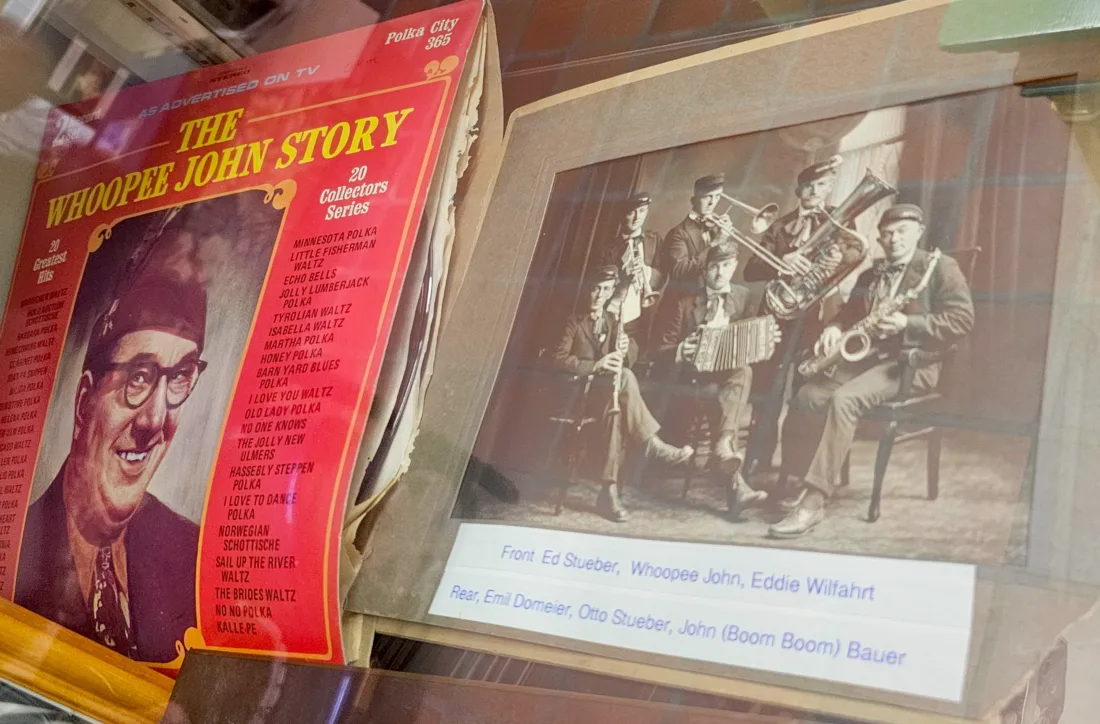
A display case holds "The Whoopee John Story — 20 Collectors Selection" album next to a historic band portrait. A label identifies front row, left to right: Ed Stueber, Whoopee John, Eddie Wilfahrt; rear row: Emil Domeier, Otto Stueber, John (Boom Boom) Bauer. (Photo courtesy of Minnesota Music Hall of Fame)
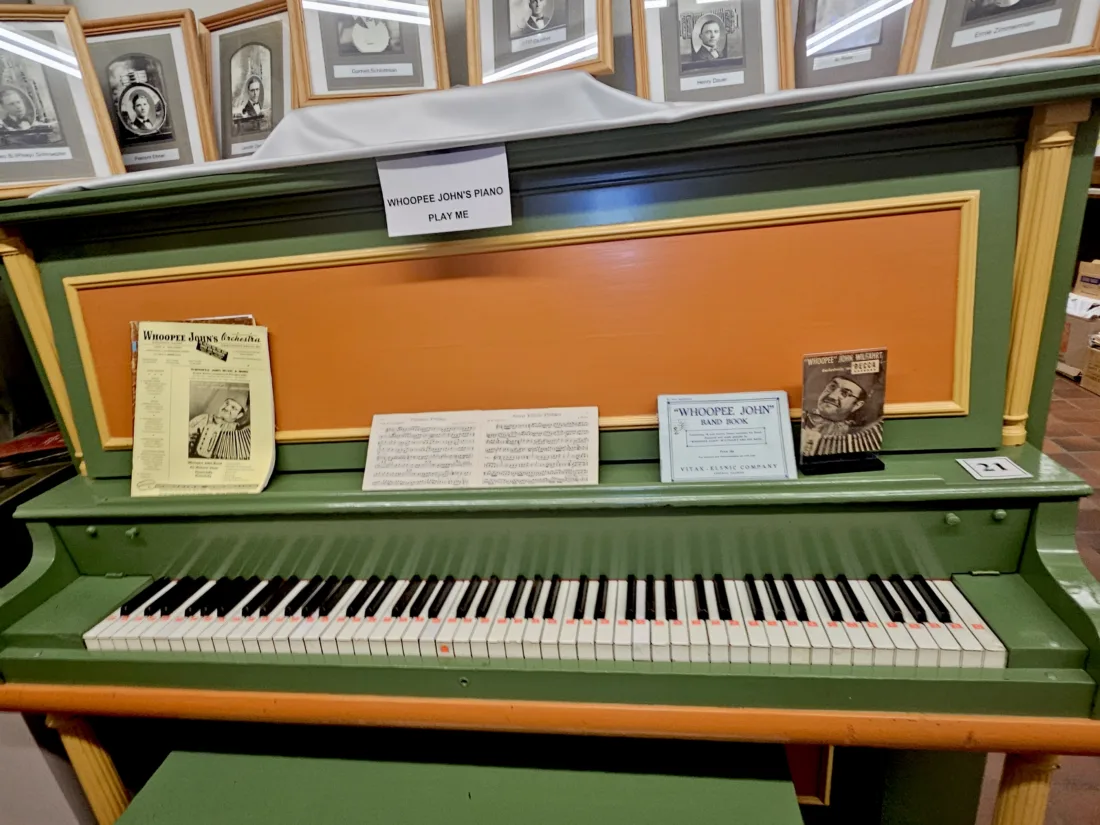
Whoopee John's personal upright piano on display at the Minnesota Music Hall of Fame. A sign reads "WHOOPEE JOHN'S PIANO PLAY ME." Band folios and sheet music are displayed on the music rack. (Photo courtesy of Minnesota Music Hall of Fame)
Neal Bond, board member of the Minnesota Music Hall of Fame, beside the life-size cutout of Whoopee John Wilfahrt. (Photo courtesy of Minnesota Music Hall of Fame)
A display at the Minnesota Music Hall of Fame shows Whoopee John Wilfahrt billed as "Exclusively on Decca Records." Wilfahrt signed with Decca in 1934 as the label's second artist after Bing Crosby. (Photo courtesy of Minnesota Music Hall of Fame)
A display case holds "The Whoopee John Story — 20 Collectors Selection" album next to a historic band portrait. A label identifies front row, left to right: Ed Stueber, Whoopee John, Eddie Wilfahrt; rear row: Emil Domeier, Otto Stueber, John (Boom Boom) Bauer. (Photo courtesy of Minnesota Music Hall of Fame)
Whoopee John's personal upright piano on display at the Minnesota Music Hall of Fame. A sign reads "WHOOPEE JOHN'S PIANO PLAY ME." Band folios and sheet music are displayed on the music rack. (Photo courtesy of Minnesota Music Hall of Fame)
Trending
NEW ULM -- The Minnesota Music Hall of Fame (MMHF) marked Oct. 2 as Whoopee John Wilfahrt Day.
The event was part of the museum’s October legacy month programming.
The day included a screening of Chapter One of the Hall’s Legacy film series, a display of original ballroom posters and a showing of Wilfahrt’s personal upright piano. Neal Bond, board member, said, “I think it’s going to be a lot of fun.”
John Anthony Wilfahrt was born May 11, 1893, on a farm southwest of New Ulm.
He was the eldest of 11 children of Barbara Portner and John Wilfahrt Sr., descendants of German immigrants.
He began playing concertina at local gatherings in and around New Ulm. In 1925, the band relocated to St. Paul, where they became regulars at live shows and on radio broadcasts on WCCO, KSTP and WNAX. Wilfahrt went by the moniker “Whoopee John.”
He became a concertina player, bandleader and pioneer of “Dutchman” or “New Ulm” style polka music, a German-American old-time style that developed in the late 1920s and early 1930s.
The Minnesota Music Hall of Fame lists him as a 1989 inductee in its first class. He was inducted posthumously into the International Polka Association Hall of Fame in 1976.
"Wilfahrt signed with Decca Records as the label’s second-contracted artist, positioned directly behind Bing Crosby," MMHF volunteer John Kass said.
Wilfahrt did not work alone. Discogs credits members of The “Whoopee” John Wilfahrt Orchestra as Christy Hengel, Dave Marvin, Der Cammack, Jerome Kadlec, Jerry Kadlec, LeRoy Dewanz, Ron Nadherny and Whoopee John Wilfahrt.
Those names appear on Decca releases, on tour posters and in the Hall’s photo archive. Band books and ledger pages on display at the Hall list instrumentation for E-flat clarinet, B-flat cornet, trombones and piano accordion, showing a full dance orchestra that could fill a ballroom.
For much of the 20th century, nearly every Minnesota town had a dance hall where families gathered on weekends. The Hall’s Legacy film said the bands didn’t simply provide entertainment; they became part of the community.
The film said, “They played the music of life’s greatest moments: first dates, wedding anniversaries, homecoming, graduations and countless evenings where memories were made one song at a time.”
Wilfahrt’s orchestra performed thousands of engagements.
Historical documentation and memorabilia identify the ensemble with a 75-year span from 1908 to 1983, promoted as the “Oldest Band in America.”
Posters on display during Wilfahrt Day documented the circuit. One advertised the Orchid Ballroom on Wednesday, Feb. 24, billed as 35 consecutive years on air and “The Oldest, Largest and Finest Old Time Band in the World.”
Another advertised the Gibbon Pavilion on Saturday evening, Oct. 19, as a “Big Carnival Dance” with WCCO and WNAX. A third advertised the Orpha Theatre in Henderson and Le Sueur on Tuesday, Jan. 10.
A yellowed folio page advertised the Annual K.C. Hall dance in New Ulm on Tuesday, Nov. 22 as “The Popular Whoopee and His Orchestra.”
Wilfahrt began making records in the 1920s for Brunswick, Vocalion, Okeh and Columbia. In 1934, he was signed to Decca.
During his career, he recorded approximately 1,000 tracks, including “Clarinet Polka” and “Mariechen Waltz.” Side one of Decca Presents an Album of Polkas lists “Whoopee” John Wilfahrt and his Concertina Orchestra performing Clarinet Polka, originally recorded in 1938.
The Hall displayed two published arrangements that show distribution beyond records.
The V-E Polka Book for Band and Orchestra, compiled by Joseph P. Elsnic, and the “Whoopee John” Band Book, containing 16 well-known dance numbers featured by Wilfahrt’s band, were both published by Vitak-Elsnic Co. in Chicago.
Contents included Baritone Polka, Coquette Polka, Doughboy Polka, Bubble Bath Polka, Whoop It Up Polka, Sunflower Polka and My Beautiful Rhine Polka. The books gave small-town bands the parts to play Wilfahrt’s hits.
Through radio, touring and record releases, the orchestra introduced German-American old-time music to listeners beyond state borders.
The band’s recordings continued to be pressed and reissued after Wilfahrt’s death June 15, 1961, in St. Paul.
Long before polka gained national recognition, Wilfahrt helped establish it as the musical heartbeat of southern Minnesota through his joyful personality and high-energy performances.
Whether performing on live radio broadcasts, commercial recordings, festival grounds, or crowded ballrooms, he shared music that celebrated family, friendship and community connection.
Through countless radio broadcasts, extensive touring across the regional ballroom circuit and high-profile record releases, Wilfahrt ensured that the musical spirit of New Ulm reached Through countless radio broadcasts, extensive touring across the regional ballroom circuit and high-profile record releases.
Wilfahrt ensured that the musical spirit of New Ulm reached listeners far beyond state borders. Rather than chasing fame, Wilfahrt and his fellow musicians chased the next dance, the next smiling crowd and the next town waiting for music.
Visitors viewed permanent and temporary exhibits detailing Wilfahrt’s career, including his personal green and orange upright piano used at home and during public performances. A sign on the piano said, “WHOOPEE JOHN’S PIANO -- PLAY ME.”
Bond said the piano gave an intimate glimpse into the band leader’s daily life. The piano’s music rack held original folios, yellowed songbooks and sheet music.
Cases nearby held Decca 78rpm records, family photographs and the Hall’s archival ledger pages documenting numerous tour dates and recording numbers.
Out-of-town visitors attended during Oktoberfest weekend. Rosie and Glen Schroers, visitors from Watertown, Minnesota, toured the Hall and said they were looking for Jerry and Ivan Kahle in the exhibits.
Rosie said she had worked with Jerry at Rosemont Inc. “We were looking for Jerry and Ivan Kahle, and they were there,” Rosie said.
As for the MMHOF, Rosie said, “We loved it. Amazing, and you know you need to take a lot of time to go through it. We’ll come again, of course.”
The museum’s exhibits and archival collections also highlight Minnesota rock and pop artists, not just polka greats. Prince Day is Oct. 24, with band members and Prince’s cousin Sammy G. expected, according to volunteer John Cass.
The MMHF continues to archive audio recordings, instruments and photographs to document musical history of southern Minnesota and regional band leaders.
The museum’s legacy month programming will conclude Saturday, Oct. 31, with a screening of The Complete Legacy Series.
Beginning at 11 a.m., all four episodes will be shown to honor more than 100 Minnesota music legends, encompassing traditional folk, jazz, rock and the historians and educators behind the state’s musical heritage. Admission is $7, with free entry for Hall members.