
Affordability, farming, fraud and healthcare
Senate District 15 candidates discuss the issues in LWV forum
Trending
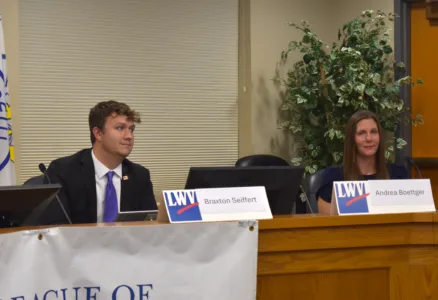
NEW ULM - Senate District 15 candidates Braxton Seifert (GOP) and Andrea Boettger (DFL) made their pitch to voters during Wednesday's New Ulm League of Women Voters (LWV) candidate forum.
The forum was designed to provide voters information on the different candidates. The forum began with opening statements from the candidates.
Boettger currently serves as the New Ulm City Council President. In her day job, she works as the executive director of New Ulm's Turner Hall.
Boettger said her work in local government includes serving on the Board of Directors for the Coalition of Greater Minnesota Cities (CGMC) where she represents Local Government Aid (LGA) and taxation as a co-chair. She is also the board chair for Region 9 Development Commission.
She said her time on these boards and commissioners made her realize how many communities were being impacted by the same issues; such as, lack of affordable housing, lack child care, rural hospitals on the brink of closing and rural EMS becoming unreliable without enough of a workforce to improve it.
Boettger said New Ulm was finding ways to address these problems, but as senator she hoped to help the state on wider level.
Seifert lives north of Marshall and is a sixth-generation resident of Senate District 15 and his family has been farming for six-generations. His day job includes working as a loan officer at Midwest Bank in Marshall. He writes loans for families, farmers and small business owners. Seifert said meeting with these people gave him the drive to run for senate.
"I understand our people, I understand our way of life and I understand our values," Seifert said. "I am running for state senate because I believe we can do better," he said. He highlighted the need to improve education in the state while eliminating high taxes and fraud.
Affordability was a reoccurring theme during the forum with several questions related to state budgets and finances.
The candidates were asked what policy measures they would push forward to assist residents struggling with increasing costs of basic needs, such as housing, food, gas and child care.
Seifert called for a decrease in licensing tab fees, which he said are higher than neighboring states. He also called out unfunded mandates, like the 2038 Green Energy Plan that will increase the cost of building a new home.
Seifert said these unnecessary mandates are driving people into the neighboring states that do not have as many regulations and higher taxes.
"We need to look at what other states are doing to drive people into their communities and make things affordable," he said. "We need to bring costs down to deliver for Minnesota."
Boettger said the legislators need to review how taxes impact cost of living. She specifically opposed a potential 1% wealth tax that will negatively effect farmers if they cannot exclude some of their assets.
Boettger also addressed state fraud claims. She said steps were being taken to combat it, but she recommended looking to consolidate state programs to prevent duplication of efforts and overspending taxes.
She did support improving programs that helped lower the cost of living for families, such as child care tax credits.
"I believe our rural communities are doing the best job they can to limit increases to tax levies, but it simple needs to be done," Boettger said. "Our district is suffering from aging infrastructure. We need our lead pipes replaced, we need to keep our roads maintained and the cost of all those things are going up and they need a way to pay for it."
At the same time, she believed income needed to keep pace with inflation, which was not the case for many Minnesota workers.
The candidates were asked what could be done to prevent Minnesota businesses from moving to lower income tax state.
Boettger argued that businesses leaving Minnesota was not a major problem in the state.
"There is a reason Minnesota is home to so many Fortune 500 companies that have been here and have stayed here," she said.
She cited the high quality of life in Minnesota as the reason many businesses stay. In speaking with business owners who had relocated to South Dakota, she said most don't stay there.
"You're going to get taxed one way or another," she said. "Taxes are an issue, but I don't think its stopping many businesses from starting or moving.
Boettger believed the District 15 was fortunate to have many entrepreneurs who were able to take advantage of state program that provide resources to new businesses.
Seifert disagreed, saying red tap was major hinderance for starting a business in Minnesota.
"We live in a state where it is easier to defraud the state than start a business," he said.
He cited Paid Family Medical Leave (PFML) as big issue for businesses, including Marshall's hospital which had to pay hundred of thousands of dollars for this one mandate.
Boettger pushed back on Seifert's red tap claim. She said in her years of running the nonprofit Turner Hall, running the for profit restaurant bar as well as starting her own 501c3, she never face significant red tape from the state.
Seifert argued that while not all businesses have red tap, there are others that are struggling with regulations, like child care.
On the topic of the state budget and financial challenges, Boettger believed the state needed to prioritize technology infrastructure. She said many state departments were using decades old equipment that ran on outdated operating systems, which some fraudsters exploited.
"That's not acceptable," she said. "We're going to need to swallow that pill and make those investment in technology to cut down on that fraud loophole."
Seifert agreed that the state should update antiquated technology and pointed to a bill Rep. Paul Torkelson wrote that addressed that last session.
He believed the main issues were fraud. He wanted to see it eliminated from the budget. Seifert recommended looking for state programs that work and fund those rather than put money into failing programs.
On the topic of rural healthcare, Seifert said the EMS program in Minnesota was broken due to worker shortage and high equipment costs. He is in favor of adding funding for rural healthcare to prevent further closures. He also wanted to end unfunded mandates and regulations that put extra burden on healthcare.
Boettger said healthcare costs in rural areas were significant problem, with many farmers unable to afford health insurance. For many other Minnesota workers insurance is either unaffordable or provides minimal coverage.
"I think something needs to be looked at in terms of how much insurance companies can make," Boettger said. She believed without restrictions on the insurance companies, cost would only go up.
"We need to find a way to insure everyone," she said.
Later the candidates were asked how they would help struggling farmers.
"Farmers want to be paid at the market, not the mailbox," Seifert said. "We need to take politics out of farming [and] get back to what is best for farmers."
Boettger criticized the federal government for failing to pass a farm bill and cuts to the SNAP program.
She said there were many families that depended on SNAP and the cuts trickled down to farmers.
Boettger also cited the tariffs that cut off markets to some farmers. She was concerned some markets could be lost for a generation or more.
On how to prevent and respond to domestic violence, Seifert supported implementing a domestic abuser database similar to the one in Tennessee. He also wanted mandatory minimums for abusers and care and programs for those who have been through abuse.
"We need to take a look at how these weapons can getting into the hands of people who should not have them," Boettger said.
She also want see legislation that deepens the penalty for domestic crimes and increases the consequences for each offense.
The general election is Tuesday Nov. 3 and early voting is already underway. For more information on elections, voting and voter registration visit https://www.vote411.org/
The Journal's article on the Minnesota House 15B forum between Geri Theis and Keith Klawitter will run in Saturday's edition.