
Officer’s best friend renews certification
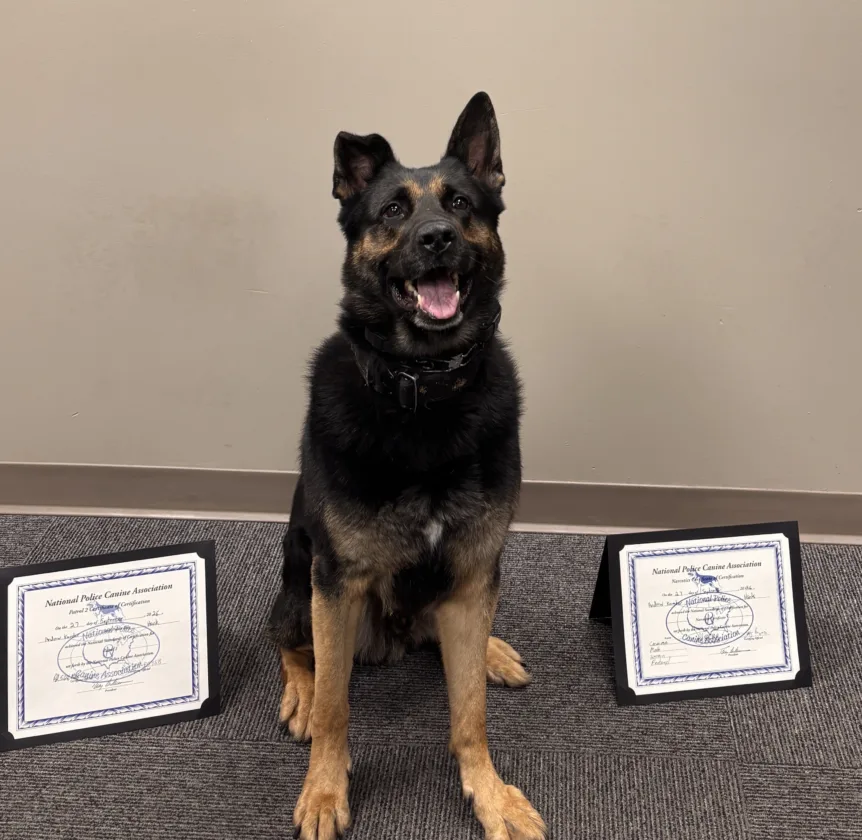
K9 Hank sits with his National Police Canine Association Patrol and Narcotics Detection certifications. The dual certification is required each year for a police K9 to remain operational in Minnesota. (Photos courtesy of the New Ulm Police Department)
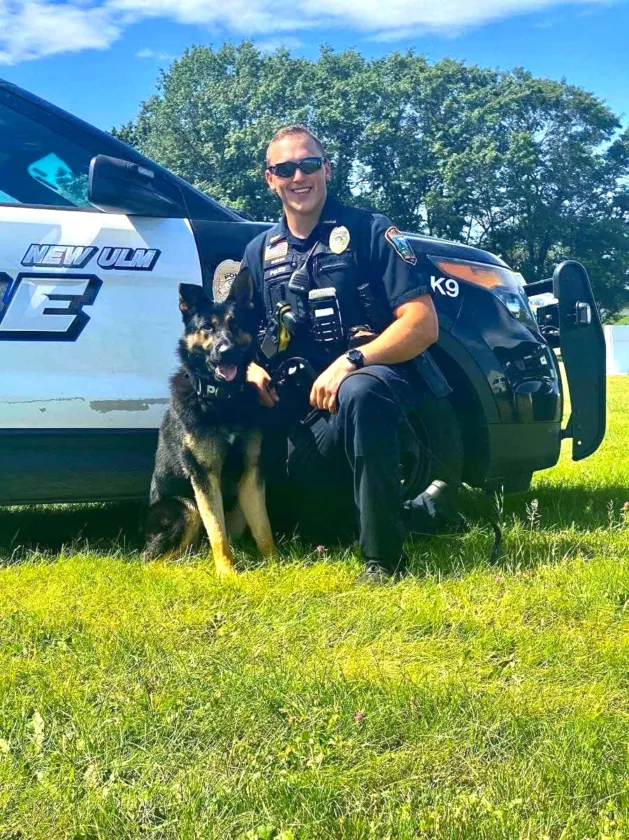
Officer Andrew Kuester and K9 Hank pose by the department’s custom K9 squad. The vehicle is equipped with thermostat-controlled sensors, automatic heat and air conditioning, alarms and remote door release that allows the department to safely kennel Hank. (Photos courtesy of the New Ulm Police Department)
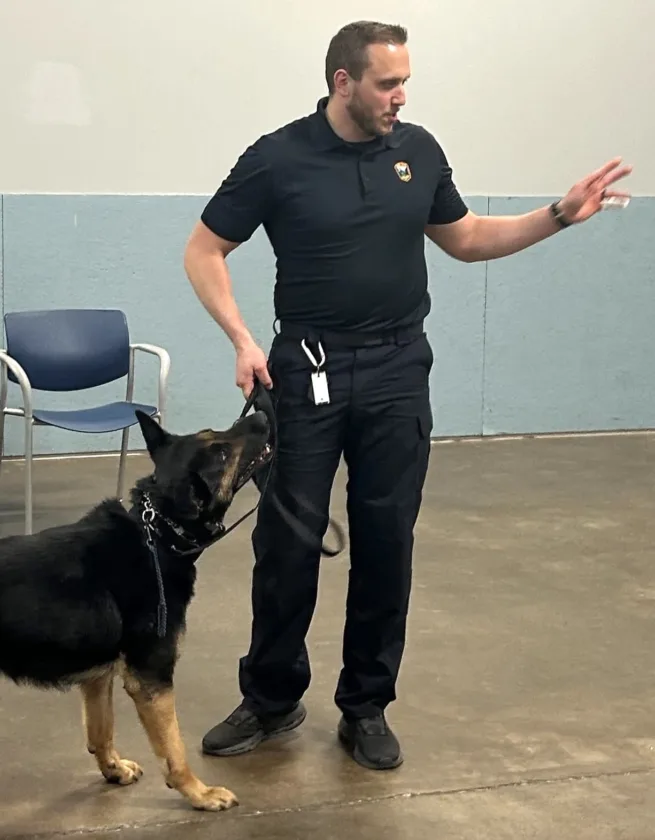
Officer Andrew Kuester works with K9 Hank during a community demonstration. Hank, a 3-1/2-year-old German Shepherd, and Kuester recently recertified in patrol and narcotics through the National Police Canine Association. (Photos courtesy of the New Ulm Police Department)
K9 Hank sits with his National Police Canine Association Patrol and Narcotics Detection certifications. The dual certification is required each year for a police K9 to remain operational in Minnesota. (Photos courtesy of the New Ulm Police Department)
Officer Andrew Kuester and K9 Hank pose by the department’s custom K9 squad. The vehicle is equipped with thermostat-controlled sensors, automatic heat and air conditioning, alarms and remote door release that allows the department to safely kennel Hank. (Photos courtesy of the New Ulm Police Department)
Officer Andrew Kuester works with K9 Hank during a community demonstration. Hank, a 3-1/2-year-old German Shepherd, and Kuester recently recertified in patrol and narcotics through the National Police Canine Association. (Photos courtesy of the New Ulm Police Department)
Trending
NEW ULM -- New Ulm Police Department's canine, Hank, is certified for another year after passing his National Police Canine Association trials in patrol and narcotics.
Hank, a 3-and-a-half-year-old German Shepherd, and Officer Andrew Kuester have been partners for over three years. The dual NPCA certification is required every year for any police dog to remain operational in Minnesota.
“The hardest part is all the prep work that goes into leading up to it,” Kuester said. “Getting them ready for all the different activities that you have to participate in.”
New Ulm Police Chief Dave Borchert said the test is not guaranteed.
“It’s difficult. There’s people historically that were having difficulty passing it,” Borchert said. “Statewide there has been officers that get sent up there, and they’re good officers, but they just simply can’t pass. It’s not what we refer to as the gentleman’s course where we’ll pass you. You either pass or you don’t, and the criteria is very strict.”
Minnesota recognizes a few accredited bodies, including NPCA, USPCA and NAPWDA. Without yearly certification, a department cannot use a dog for police work.
Kuester and Hank started with three months of training in the Twin Cities. Now they work patrol and dedicate one day each month to K9 training, plus daily maintenance. Both handler and dog must stay fit. Borchert said conditions like hip dysplasia can end a dog’s career.
Borchert calls Hank a force multiplier, vital in rural Minnesota.
“We use it for narcotic enforcement, for drug enforcement, and then also for search and rescue,” Borchert said.
That rescue work is what residents see most. Borchert cited cases like a child who walks away from home or an adult with dementia who walks away from assisted living. In those searches, Hank can do what would otherwise take dozens of people.
Hank’s best tool is his nose.
“He likes to use his nose a lot. I would say he’s really good with his nose,” Kuester said.
Humans have 10 to 20 million olfactory receptors. German Shepherds have about 225 million, letting them detect and separate odors far beyond human ability.
The most misunderstood part of the program is Hank’s vehicle, because people ask why a police K9 can stay in a squad car when pet owners are told not to leave pets in parking lots.
New Ulm’s K9 squad is not a regular squad. It is custom-built around Hank’s kennel with a sophisticated, thermostat-controlled safety system, and it is the reason the program costs what it does.
The vehicle has temperature sensors that monitor the kennel constantly. If it gets too hot or too cold, alarms sound. The system automatically starts the engine and runs heat or air conditioning to bring the kennel back into a safe range. If it continues to rise, windows are programmed to drop, auxiliary fans kick on, and a remote door release allows Hank to exit. Motion sensors alert Kuester on his portable radio.
“Sometimes you’ll get the argument like, ‘Well, I can’t have my animal in the parking lot.’ I get called on that unattended animal in the vehicle. Why can you do it? We can because we’ve got pretty sophisticated equipment. We can legally do that,” Borchert said. “They have alarms that’ll go off. It’ll automatically start up whether it needs to activate the air conditioning unit or a heater.”
Borchert said a new K9 squad with all the kennel equipment costs about $77,000. The dog plus vendor training costs $17,000 to $20,000. He budgets $11,000 per year into a reserve account. About every seven to eight years he replaces the dog, and normally when he replaces the canine he also purchases a new squad. With vehicle, dog, training and premiums, the total is about $100,000.
“It’s through our regular budget process. We get some donations, but it’s actually through our regular budget,” Borchert said.
Borchert said he is proud of how Kuester handles the extra work and the public role.
“I’m very pleased that they continue to do the good work, and they pass the certification,” Borchert said. “I think Officer Kuester also, as far as being an ambassador representing New Ulm, does a very nice job. He’s a very good public speaker. We want to get that out there, promoting what we offer and letting people know that New Ulm is a safe community because of this resource.”
For Kuester, the K9 assignment has shaped his career.
“It’s definitely a unique part of the police department. There’s a lot of training that goes into it,” Kuester said. “He’s taken me a lot of different places I don’t know if I would have gone naturally in my career, which is super fun for me.”
What should people know about Hank?
“That it’s an important resource that he’s well trained and certified to basically help with search and rescue, with narcotic enforcement, and he’s one of our partners. We consider him one of our professional police partners,” Borchert said.