
MLC students trace New Ulm’s Gilded Age roots at BCHS
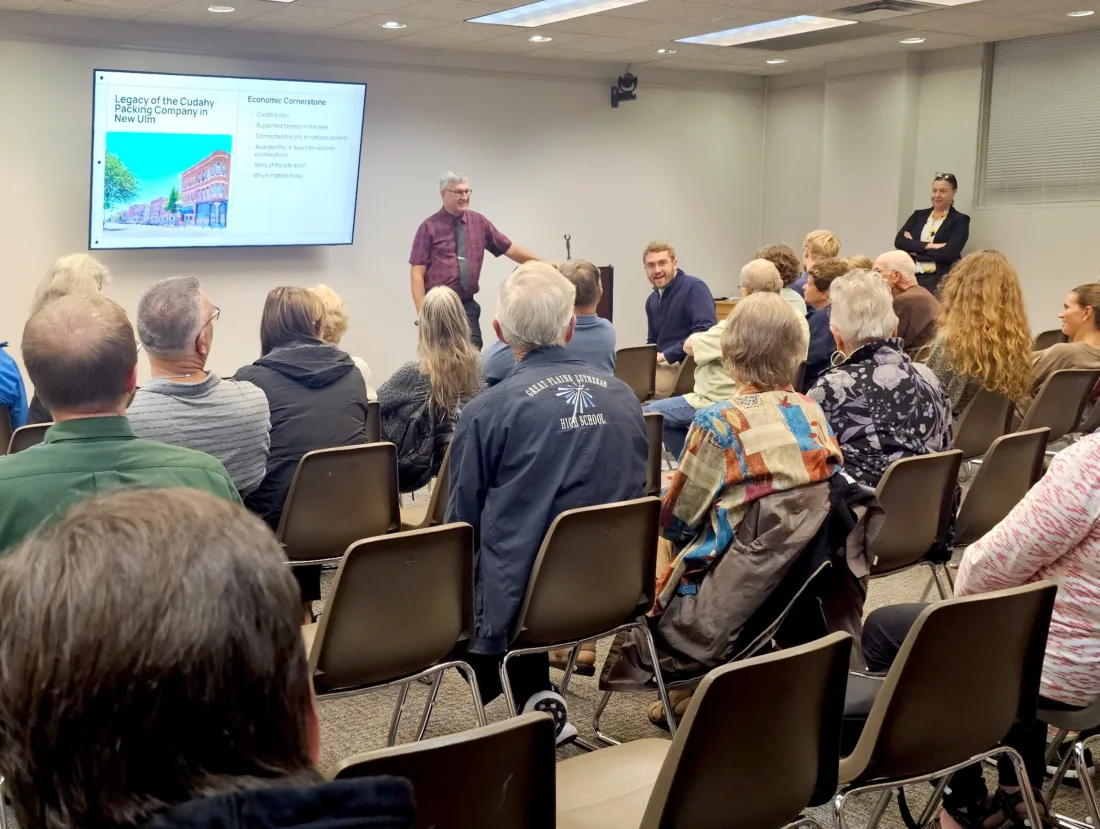
Community members fill the Brown County Historical Society annex to listen to student history presentations led by Professor Peter Baganz. (Photo by Amy Zents)
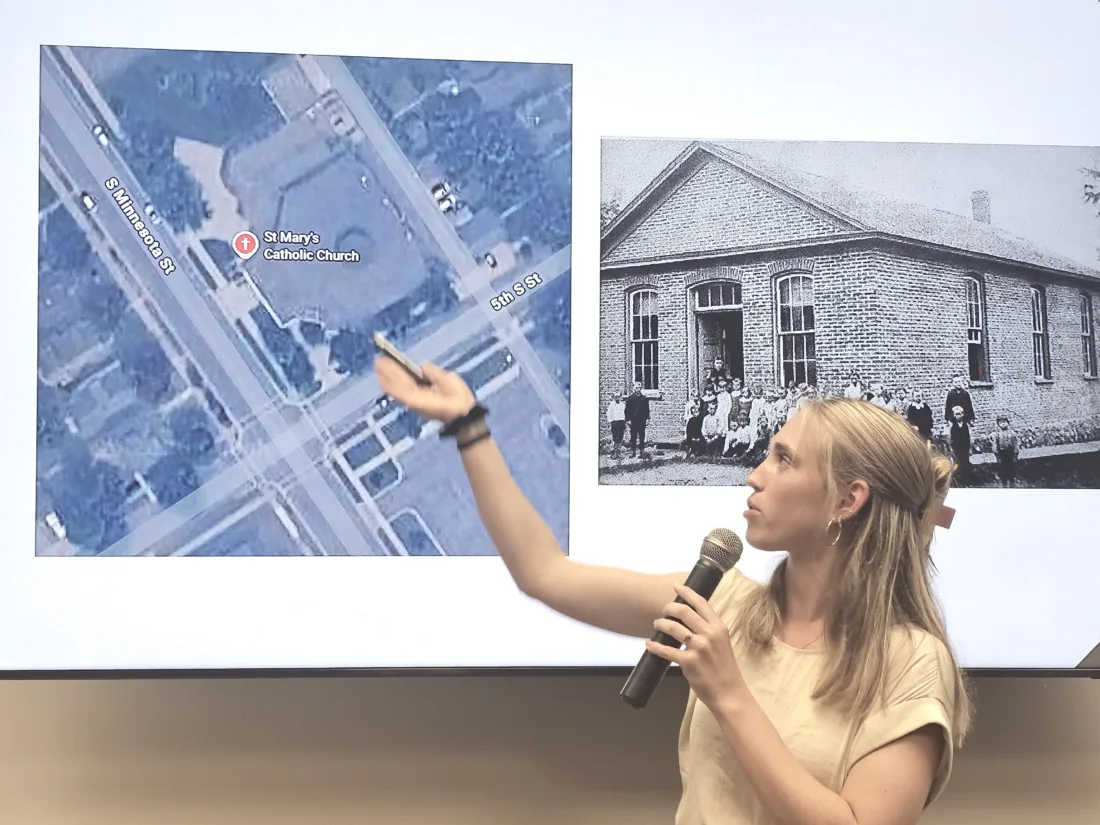
Martin Luther College senior Sydney Buch references historical maps and archival photos while presenting on the development of New Ulm’s public school system. (Photo by Amy Zents.)
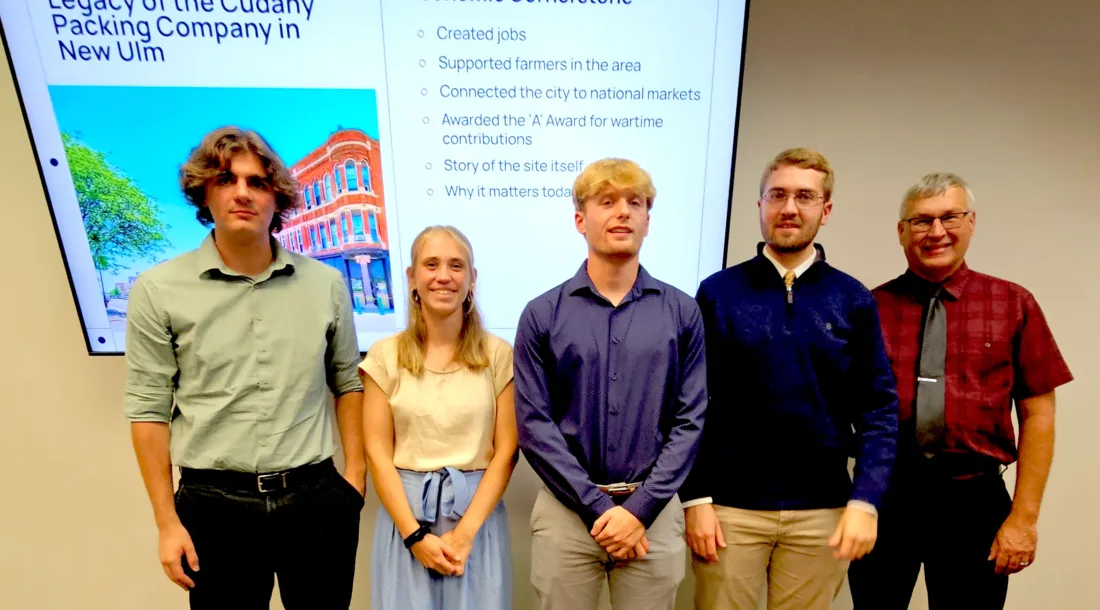
Martin Luther College student researchers and faculty gather following their presentations, from left: Nathan Sauer, Sydney Buch, Lucas Holz, August Wall, and Professor Peter Baganz. (Photo by Amy Zents)
Community members fill the Brown County Historical Society annex to listen to student history presentations led by Professor Peter Baganz. (Photo by Amy Zents)
Martin Luther College senior Sydney Buch references historical maps and archival photos while presenting on the development of New Ulm’s public school system. (Photo by Amy Zents.)
Martin Luther College student researchers and faculty gather following their presentations, from left: Nathan Sauer, Sydney Buch, Lucas Holz, August Wall, and Professor Peter Baganz. (Photo by Amy Zents)
Trending
NEW ULM -- History came alive Thursday evening at the Brown County Historical Society annex as Martin Luther College students presented research detailing how local schools, milling operations, manufacturing firms and agricultural processing plants forged a thriving regional economy during the Gilded Age and Progressive Era.
Organized through Professor Peter Baganz's history elective course, four undergraduate researchers shared presentations backed by primary documents.
“Our students are not professional historians,” Baganz said. “They are not really even history majors. Two of them are training to be history teachers. Two of them are actually training to be pastors. But they did, I think, do some excellent work with their research.”
Senior Sydney Buch opened the student presentations by tracing the evolution of New Ulm's public school system, explaining that education served as a vital foundation for industrialization.
“Education is a very big deal,” Buch said. “We need to have workers that are educated to be able to have a good workforce.”
Founded after the city’s 1854 settlement, early education began in a modest log cabin on North Minnesota Street under August Westfall, the city’s first teacher and later county superintendent.
Following the destruction of early school buildings during the 1862 U.S.-Dakota War, private residences bridged the gap until the construction of the German Park School in October 1865.
Subsequent facilities like the Union School in 1884, the Franklin School, and the Emerson School expanded educational access, culminating in the January 1915 dedication of New Ulm High School by Governor W.S. Hammond.
Senior August Wall shifted focus to agriculture and milling, observing that the era represented a transformative period for the region.
“The idea of the Gilded Age is that if something’s gilded, it’s just covered over with gold, but underneath, it’s maybe something cheaper like wood or stone like that,” Wall said. “But if this is the gilded age for everything else, this really is the golden age for farming.”
Wall recounted early river-powered enterprises like the Cottonwood Mill and Globe Mills, alongside the massive scale of the Eagle Roller Mill, founded in 1856.
By the early 20th century, the facility boasted a daily capacity of 6,000 barrels, producing trademarked items like Daniel Webster flour, rye flour, and cornmeal, making it the largest country mill in the world.
Wall mentioned a private telephone wire connecting the New Ulm office directly to the floor of the Minnesota Chamber of Commerce, providing grain merchants with instant market updates.
Sophomore Nathan Sauer explored the industrial footprint of the New Ulm Manufacturing Company, established in 1871.
“Somehow, freshman me was like, it would be a great idea. Let’s take a hard class,” Sauer joked about joining the upper-level course.
Despite suffering devastating planing-mill fires in 1874 and 1879, the company persevered with salvaged machinery and temporary workspaces.
The enterprise experienced a major resurgence under inventor William Aab, whose precision engine-repair tools gathered widespread acclaim.
During World War II, the company secured a $500,000 contract with the U.S. Navy and Marines, scaling operations by 1,200 percent between 1942 and 1943.
Manager Noel Iverson later reassured workers of a robust post-war backlog, leading the company to pivot into manufacturing wagon running gears and tractor components.
Future history teacher Lucas Holz concluded the student presentations with the history of the Cudahy Packing Company and its Sunlight Produce subsidiary.
The plant occupied the site of New Ulm's first brewery, established in 1858 by Augustus Johann Freytag and Andrew Betz, which was destroyed in 1862, rebuilt as the City Brewery, and later operated as Tivoli Gardens before closing during Prohibition.
In 1926, Cudahy established a produce and dairy operation that purchased eggs, cream, and poultry from farmers within a 50-to-75-mile radius.
“It made New Ulm more than just a local town; it was now linked to the national food economy, which was pretty exciting for the town,” Holz said.
During World War II, the facility shifted exclusively to drying and packaging eggs for the federal “Lend-Lease” program, earning the prestigious U.S. Government “A” Award twice before closing in 1954.
Historical Society Director Amy Johnson and Program Coordinator Christina Miller-Koester announced upcoming museum events to close the evening.
These include a presentation by Mayor Kathleen Backer on Oct. 15, a costume jewelry fundraiser sale on Oct. 17, a Halloween scavenger hunt on Oct. 24, and the annual meeting on Nov. 12 focusing on the Ku Klux Klan in Southwest Minnesota during the 1920s.
Community member Rosemary Geer praised the students during the closing remarks, expressing deep admiration for their efforts.
“It’s really rare to have college students who can speak so eloquently and really connect to the audience the way all of them did,” Geer said. “It was beautiful.”