
Hoppe on the trail
Exploring the Superior Hiking Trail with local ambassador
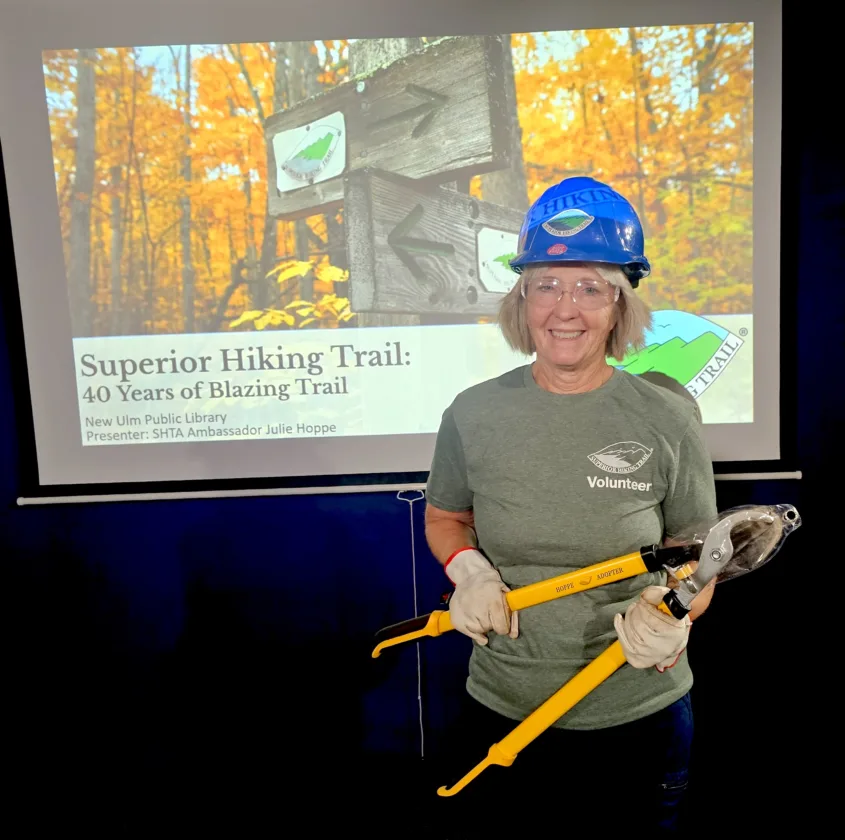
Superior Hiking Trail Association Ambassador Julie Hoppe poses with trail maintenance loppers and safety gear following her presentation on the 310-mile footpath at the New Ulm Public Library. (Photo by Amy Zents)
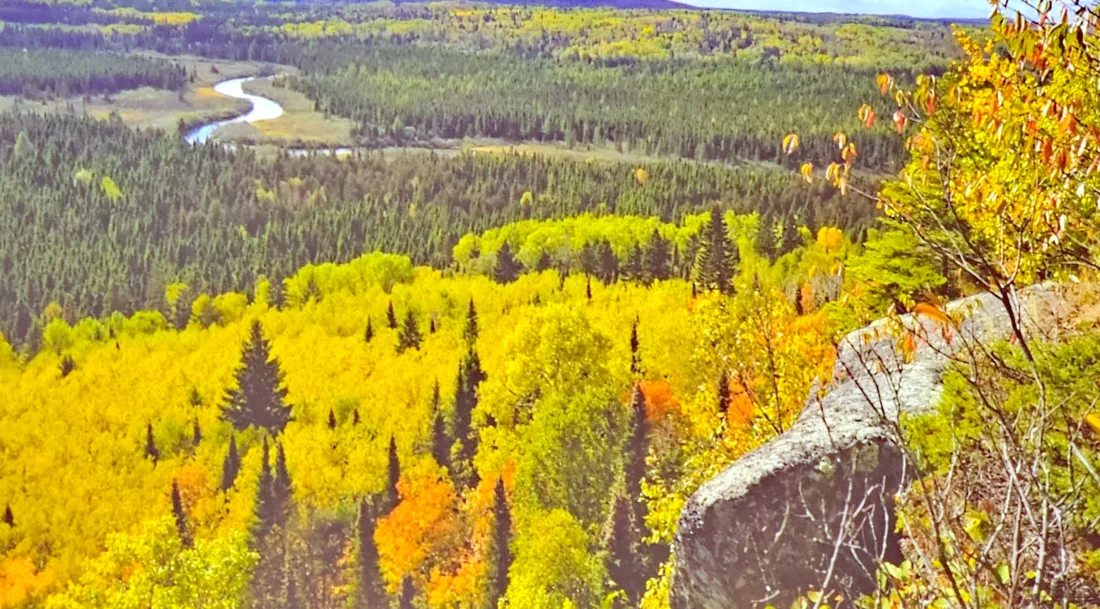
A scenic overlook along the Superior Hiking Trail Submitted photo
Superior Hiking Trail Association Ambassador Julie Hoppe poses with trail maintenance loppers and safety gear following her presentation on the 310-mile footpath at the New Ulm Public Library. (Photo by Amy Zents)
A scenic overlook along the Superior Hiking Trail Submitted photo
Trending
NEW ULM -- For outdoor enthusiasts dreaming of rugged overlooks, cascading waterfalls and deep forest solitude, Minnesota's North Shore offers a world-class wilderness destination right in our backyard.
Julie Hoppe, a New Ulm resident and early childhood special education teacher in Mankato, spoke Thursday night at the New Ulm Public Library to share her extensive experiences, practical advice and deep passion as an official Superior Hiking Trail Association ambassador.
Hoppe, who has been hiking the trail for roughly eight years and proudly maintains a 5-mile adopted section, gave attendees an in-depth look at what it takes to explore and support the iconic 310-mile footpath.
Celebrating four decades of public access, Hoppe emphasized that the trail remains a unique treasure for nature lovers.
“It’s been 40 years since they’ve had this trail open to the public, and it’s free. You don’t have to pay to hike on the trail,” Hoppe told the gathering.
“You can camp on the trail. That’s free, as long as you’re willing to pack it all up and put it on your back and hike out there.”
The route officially opened in 1986 and now winds 310 miles from the Wisconsin border all the way up to the Canadian border. It traverses four counties, eight state parks, including Jay Cooke, Gooseberry Falls, Split Rock, Cascade River, Temperance River and George Crosby Manitou, as well as the Superior National Forest and private lands.
Hoppe said that the association works collaboratively with private landowners for access, and comprehensive maps and details can be found at superiorhiking.org.
The path features 64 trailheads spaced roughly 5 to 10 miles apart, 94 backcountry campsites, and welcomes approximately 400,000 visitors each year.
Campsites typically offer a social area with benches set around a fire ring and a vault-style latrine maintained by local volunteers.
Hoppe emphasized strict safety rules regarding campfires, explaining that fires should only be lit in designated rings because the ground underneath has been cleared of roots, preventing underground fires from spreading to nearby trees.
She also cautioned hikers about wildlife attraction: “Any food you bring in, do not throw it in the woods. Do not throw it in the river. Do not throw it in the latrine.”
While campsites operate on a first-come, first-served basis, the trail community follows a welcoming unwritten rule to make room for everyone, especially exhausted thru-hikers arriving late after a long day on the path.
“They do have to allow anybody who shows up to get in. So they try to make room,” Hoppe explained.
Navigating the rugged North Shore terrain requires thoughtful preparation, and Hoppe recommends starting with the official guidebook with the 10th edition now available alongside data books for elevation tracking and digital mapping tools like Gaia or Avenza.
Because cell service is notoriously unreliable along much of the trail, having offline GPS and maps is essential, though service often reappears near trailheads.
Weather near Lake Superior can change rapidly, prompting Hoppe to stress the importance of proper preparation and gear.
With numerous creeks, ponds and rivers along the route, hikers should always pack a reliable water filter: “There’s lots of opportunities to filter water on the trail. There’s often creeks, there’s ponds, rivers that you can filter water.” Hoppe said.
Rain gear and extra layers are also non-negotiable.
Hoppe reminds hikers, “Bring your raincoat, make sure you have that, and have an extra shirt or something for warmth.”
Furthermore, sturdy hiking boots featuring ankle support and rock plates help protect feet from sharp roots and deep mud.
Encountering thick mud is inevitable, and Hoppe reminds hikers that muddy boots are a badge of honor.
She advises walking straight through puddles rather than stepping around them, which widens the trail and damages delicate surrounding flora.
The Superior Hiking Trail Association operates primarily through grassroots dedication.
Hoppe shared that the association relies on just eight paid staff members, consisting of five full-time and three part-time employees, alongside roughly 600 active volunteers and over 3,500 members.
“All the work is done by volunteers,” Hoppe said. “Even the crew leaders are volunteers.”
Sixty percent of annual funds directly support trail maintenance and construction, ensuring the path remains permit-free.
Volunteers handle everything from painting blue blazes and clearing brush with loppers and hand saws to organizing specialized crews, such as all-female trail-building parties.
To celebrate the trail’s 40th anniversary this year, the association is hosting a special 40-Mile Challenge, stepping in for the traditional 50-Mile Challenge.
Hikers log their miles on the honor system to receive a commemorative certificate and a birch beaver patch.
“You go in there if you hike any 50 miles on the trail, doesn’t matter what. Say that you did it, and you get a cute certificate with your name on it and a little birch beaver badge,” Hoppe explained, adding proudly, “I’m only 60 miles away from mine to finish it.”
For those looking to stay informed, Hoppe encourages hikers to check superiorhiking.org for real-time updates on trail conditions, fire bans, and weather hazards.
Hikers can also submit online incident reports for downed trees or washouts, and subscribe to the monthly Trail Mix newsletter or the biannual Ridgeline publication.
About a dozen people gathered for the talk Thursday night, and Hoppe stayed after to answer questions and share patches and stickers from the association.
The New Ulm Public Library recorded the presentation, which will be made available on its YouTube channel for those who were unable to attend in person.