
Two migrations made New Ulm
Sveine details the political climate that led to NU\'s founding
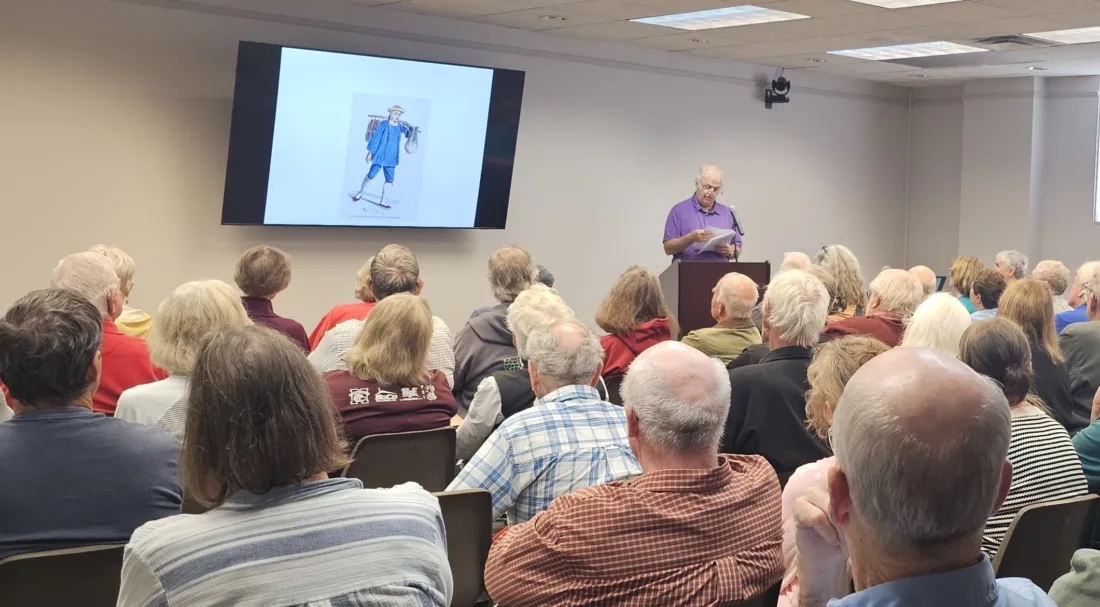
A full room gathers for Lunch and a Bite of History Sept. 17 at the BCHS Annex to hear Terry Sveine presents on the political developments that led to New Ulm’s founding. Photo by Amy Zents

Sveine cited five major national developments during the 1840s and 1850s that intensified anti-immigrant sentiment across the United States the ultimately led to New Ulm's founding. Photo by Amy Zents
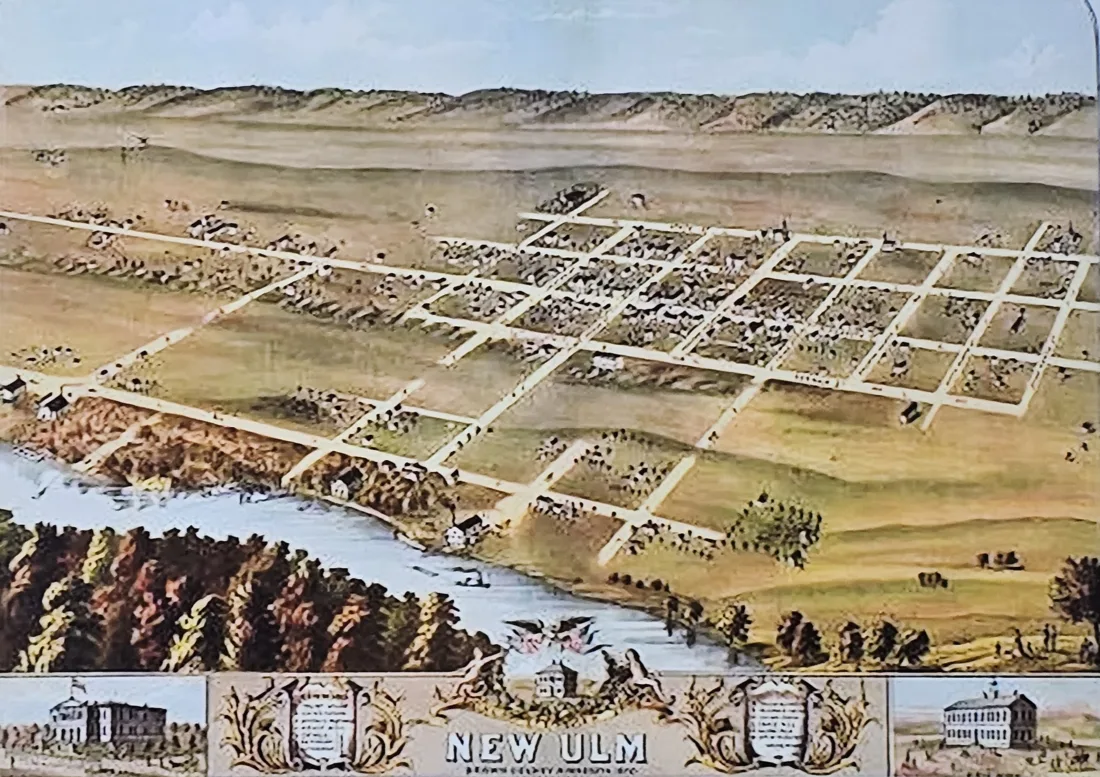
1870 bird's-eye view of New Ulm showing the town plat above the Minnesota River, displayed at the BCHS Museum Annex.
A full room gathers for Lunch and a Bite of History Sept. 17 at the BCHS Annex to hear Terry Sveine presents on the political developments that led to New Ulm’s founding. Photo by Amy Zents
Sveine cited five major national developments during the 1840s and 1850s that intensified anti-immigrant sentiment across the United States the ultimately led to New Ulm's founding. Photo by Amy Zents
1870 bird's-eye view of New Ulm showing the town plat above the Minnesota River, displayed at the BCHS Museum Annex.
Trending
“That is the myth,” historian Terry Sveine said Thursday at the Brown County Historical Society Museum Annex during the “Lunch and a Bite of History” series.
“The town was settled as an organized German utopian town because immigrants had simply had enough of prejudice in the East,” Sveine said. “New Ulm was settled as a Germanic utopian town on the frontier due to anti-immigrant sentiment across the country.”
He explained that two distinct groups drove the creation of the community: the Chicago Land Society and the Turner Colonization Society of Cincinnati.
Sveine cited five major national developments during the 1840s and 1850s that intensified anti-immigrant sentiment across the United States: the Mexican-American War, the California Gold Rush, the crisis of Irish immigration, the European revolutions, and the creation of the Chicago Land Society and Cincinnati Turners.
During the Mexican-American War, the U.S. annexed Texas in 1845 and fought Mexico from 1846 to 1848, gaining vast territory in the 1848 Treaty of Guadalupe Hidalgo.
Although Mexican residents were legally classified as white, they faced discrimination and violence. Sveine cited historian Alicia Delaney, noting more than 500 lynchings of former Mexican citizens in the decade after the war.
After gold was found at Sutter’s Mill in 1848, more than 20,000 Chinese immigrants arrived from Guangdong in 1852 alone. Cast as perpetual foreigners and targeted by California’s Foreign Miners Tax, they were attacked in Eastern papers by editors who had never met them, including Horace Greeley, who called them a “flood of ignorant, filthy idolaters.”
Irish immigration to the U.S. began during the potato famine from 1845 to 1850, which killed over one million and drove mass emigration. By the 1850s the Irish were 42 percent of the foreign-born population.
As mostly Catholics, they faced Protestant fears of papal influence that fueled the Know-Nothing Party and violence such as the 1844 Bible Riots in Philadelphia.
The fourth, the European revolutions, explains who came to New Ulm. Between 1848 and 1849, more than 50 failed revolutions swept Western Europe. Participants known as Forty-Eighters were labeled traitors, facing imprisonment or execution.
More than one million Germans left for the U.S. between 1849 and 1854. Many were educated, liberal young single men, politically active.
They celebrated Sundays with picnics, parades and beer and maintained German societies, Turnverein clubs and freethinker lodges.
Guidebook author F.W. Bogen advised immigrants in 1851 to learn English quickly, but many resisted assimilation, making them visible targets.
Frederick Beinhorn, born in Germany in 1821, arrived in Chicago in 1853. After realizing the high cost of a colony, Beinhorn learned English and tutored five other Germans.
They formed the Chicago Land Society, electing Beinhorn president. Membership included lot ownership, and in October 1854 about 35 members left Chicago by rail and wagon to St. Louis, then by steamboat up the Mississippi to St. Paul, then overland to the confluence of the Cottonwood and Minnesota rivers. They filed claims that fall.
Chicago grew hostile. In 1855, Levi Boone was elected mayor on the Know Nothing platform.
He enforced a Sunday closing law aimed at beer gardens and imposed a $300 liquor license, about $7,000 today, triggering the Lager Beer Riots at the Clark Street Bridge on April 21, 1855. A German and Irish coalition defeated Boone in March 1856, but many Germans had decided to leave.
Cincinnati Turners faced similar hostility. In 1855, Wilhelm Pfaender and Jacob Nix formed the Turner Colonization Society, raising over $100,000 through 1,300 shares at $15 each.
Turners endured assaults nationwide, including a mob attack in Hoboken in 1851, thrown animal blood in Baltimore and gunfire at a Cincinnati ballot box.
The climax came in spring 1856 near Covington, Kentucky, where about 160 Turners held a picnic and gymnastic exhibition. Youths snatched a beer and brandished a pistol. A mob attacked with stones and pistol shots, wounding the city marshal. At the ferry landing, crowds shouted threats.
Federal troops refused to intervene. Thirty-one Turners were indicted for felony, facing $2,000 bail each, totaling $62,000, though all were acquitted. That convinced them they needed a frontier colony.
Getting them to New Ulm was difficult. Cincinnati families traveled by Ohio River steamer to the Mississippi, then north to St. Louis and St. Paul, waiting for the Minnesota River to rise.
On May 7, 1857, the shallow-draft steamer Franklin Steele finally pushed up the Minnesota River and landed at the levee below New Ulm with 60 to 70 families, furniture, tools and Turnverein equipment aboard.
They joined the Chicago settlers who had held the townsite through two winters. Together, those two organized migrations, not lone families in wagons, made New Ulm.
“Having left everything behind in Europe had to be a major event,” Sveine said. “Despite efforts by some to suppose that we were settled by various unattached Germans in a romantic, non-violent manner, we need to know that it was national prejudice against immigrants that drove the founding of New Ulm. The settlers simply had enough of negative conditions in the East.”