
125 years of Hanska history
Hanska celebrates community exhibit at BCHS
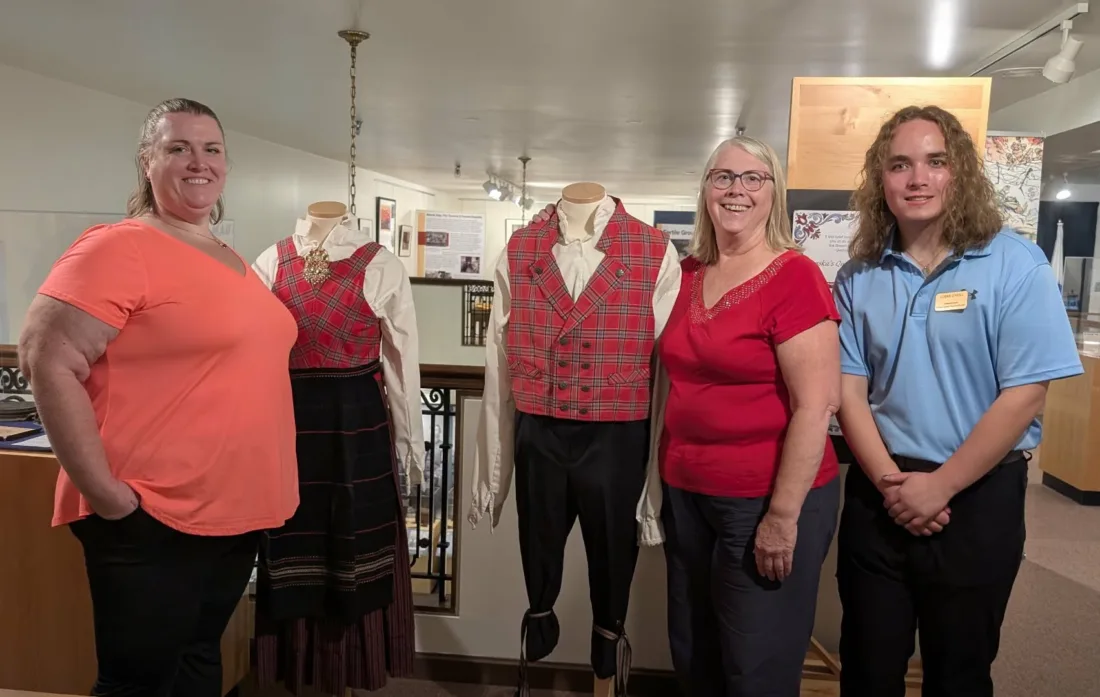
From left to right, Sarah Lueck, Nancy Anderson Hanson, and Brown County Historical Society Museum Curator Logan O'Neill pose alongside mannequins displaying traditional Norwegian bunads at the Hanska quasquicentennial exhibit on the museum's second floor. (Photo by Amy Zents)
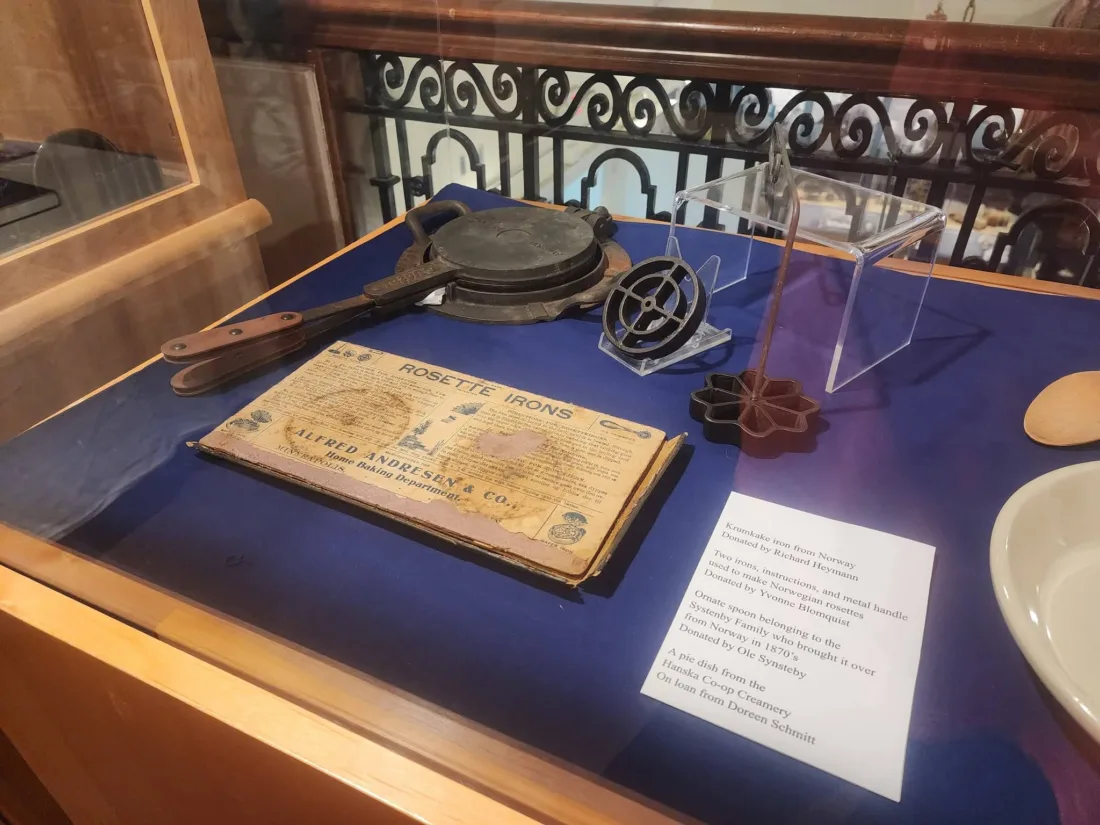
Traditional Scandinavian baking tools and pioneer artifacts on display at the Brown County Historical Society include a cast-iron krumkake iron, rosette irons with original Alfred Andresen & Co. instructions, an 1870s Synstenby family spoon, and a pie dish from the Hanska Co-op Creamery. (Photo by Sarah Lueck)
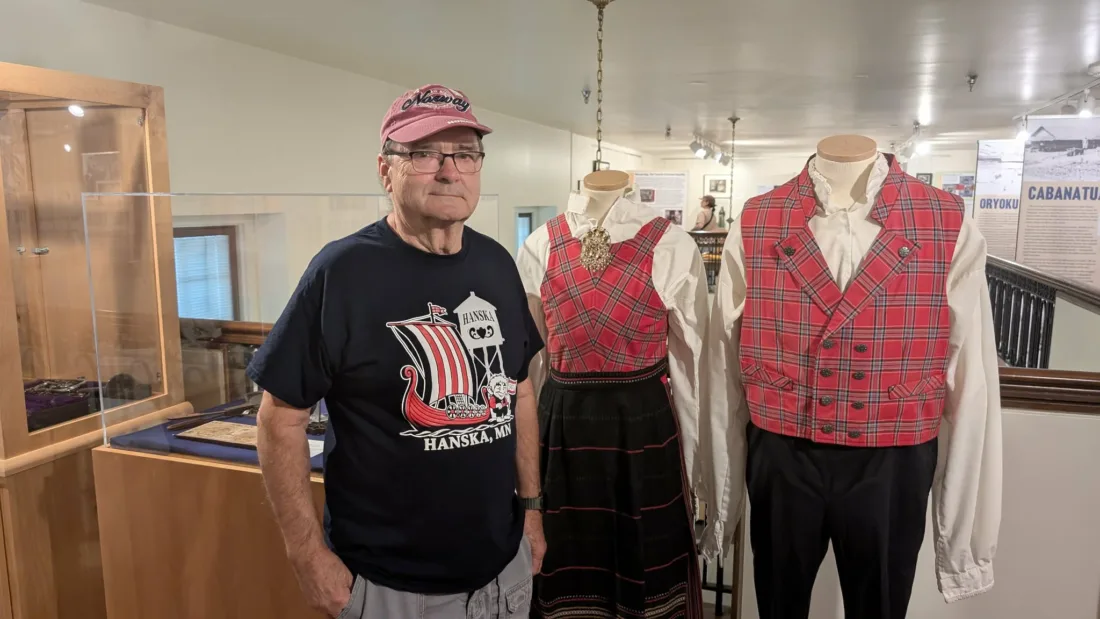
Larry Harbo, founder of the Hanska Historical Society and Brown County Historical Society board member, stands beside traditional Norwegian bunads on display at the Hanska quasquicentennial exhibit on the museum's second floor. (Photo by Amy Zents)
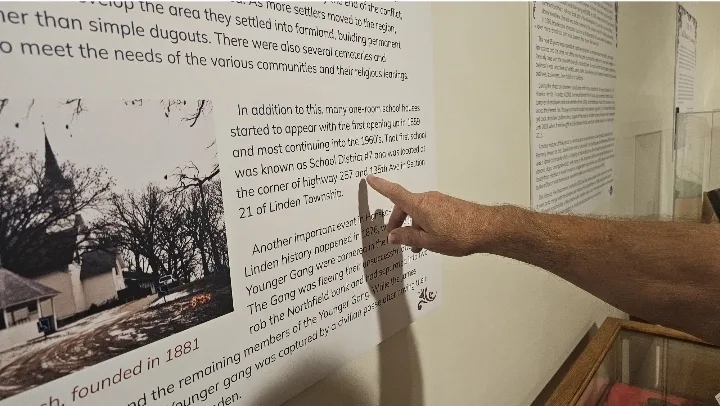
Larry Harbo points to a panel detailing the history of School District #7 in Linden Township, where he attended elementary school prior to rural school consolidation in 1957. (Photo by Amy Zents)
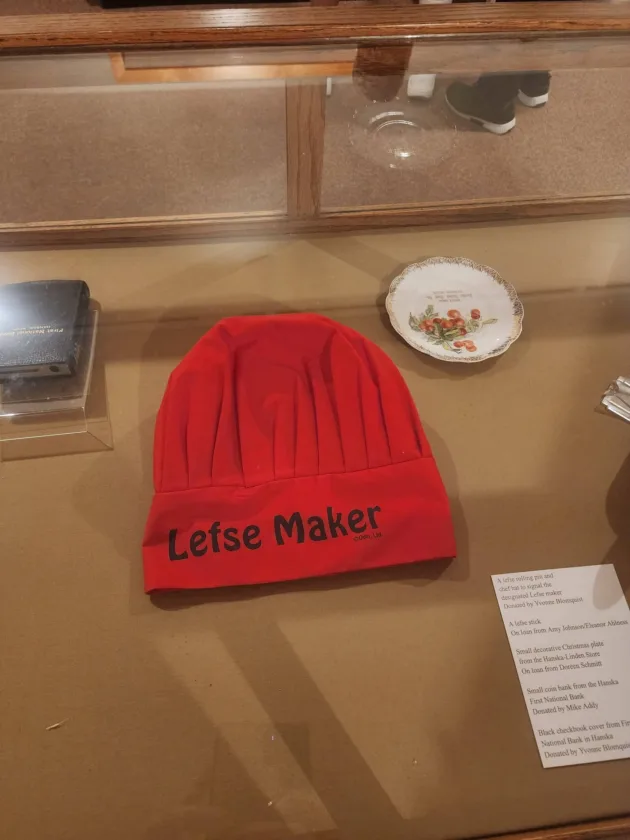
A red "Lefse Maker" chef’s hat donated by Yvonne Blomquist highlights a display case featuring a Hanska-Linden Store decorative plate, a local First National Bank coin bank, and a pioneer lefse stick on loan from Amy Johnson and Eleanor Ahlness. (Photo by Sarah Lueck)
From left to right, Sarah Lueck, Nancy Anderson Hanson, and Brown County Historical Society Museum Curator Logan O'Neill pose alongside mannequins displaying traditional Norwegian bunads at the Hanska quasquicentennial exhibit on the museum's second floor. (Photo by Amy Zents)
Traditional Scandinavian baking tools and pioneer artifacts on display at the Brown County Historical Society include a cast-iron krumkake iron, rosette irons with original Alfred Andresen & Co. instructions, an 1870s Synstenby family spoon, and a pie dish from the Hanska Co-op Creamery. (Photo by Sarah Lueck)
Larry Harbo, founder of the Hanska Historical Society and Brown County Historical Society board member, stands beside traditional Norwegian bunads on display at the Hanska quasquicentennial exhibit on the museum's second floor. (Photo by Amy Zents)
Larry Harbo points to a panel detailing the history of School District #7 in Linden Township, where he attended elementary school prior to rural school consolidation in 1957. (Photo by Amy Zents)
A red "Lefse Maker" chef’s hat donated by Yvonne Blomquist highlights a display case featuring a Hanska-Linden Store decorative plate, a local First National Bank coin bank, and a pioneer lefse stick on loan from Amy Johnson and Eleanor Ahlness. (Photo by Sarah Lueck)
Trending
NEW ULM -- A new exhibit highlighting the 125th anniversary of Hanska celebrated its official grand opening on Saturday on the second floor of the Brown County Historical Society.
Titled “125 Years of Heritage: Hanska’s Quasquicentennial Celebration,” the exhibit features historic artifacts, photographs, and traditional Scandinavian items from the Hanska community's past.
Museum Curator Logan O’Neill said attendance for Saturday’s grand opening was strong, welcoming visitors with free museum admission and traditional refreshments.
“I’m happy with the amount of people who have showed up,” O’Neill said regarding the public response to the opening display.
The exhibit opening was attended by Larry Harbo, founder of the newly established Hanska Historical Society and a board member of the Brown County Historical Society. Harbo, a 1965 Hanska High School graduate whose family settled in the area in 1856, started the organization to document the town’s history following the loss of local businesses, church congregations, and schools over the decades.
Harbo commended O’Neill’s work on the display, praising the overall execution and presentation of the town’s history.
“Logan did a very nice job putting this together,” Harbo said regarding O’Neill’s work on the exhibit.
Harbo also shared his perspective on the community’s changing landscape, explaining that the loss of local institutions gradually altered the town’s character as Hanska transitioned into a residential community where residents commute to surrounding cities for work.
“We’re not only losing our history, but they’re losing their identity,” Harbo said. “So that’s what spurred me to start a historical society.”
Pointing at one of the exhibit displays featuring historic photographs, Harbo identified a picture of the District Seven schoolhouse. The one-room country school was built on his great-grandfather’s farmland in Linden Township, where Harbo completed his early education.
”I was in one room with 13 kids,” Harbo said, noting he was there “till fourth grade, 1957.”
In the fall of 1957, rural country schools consolidated into Hanska, moving Harbo from being the sole student in his grade to a class of 26 pupils meeting at the local community center. The high school eventually closed in 1968, sending local students to surrounding districts like New Ulm.
The Hanska Historical Society organized its nine-member board on April 26. Instead of establishing a permanent museum facility immediately, the group holds monthly educational programs at the Hanska Community Center to engage the public.
Upcoming events organized by the society include a historical lecture on the Younger Brothers scheduled for Sept. 13 at the Hanska Community Center, featuring guest author Russ Swanson. Harbo said hosting educational programming remains the board’s primary focus for bringing residents together before securing a physical museum location.
During the town’s 125th anniversary celebration earlier this year, the Hanska Historical Society coordinated an interactive community display at the local Union Hall. The exhibit, titled “Hanska Historical Society Construction Under Construction,” encouraged local residents to bring in family heirlooms, photographs, and historic items to display around the building perimeter.
Saturday’s grand opening featured authentic Norwegian treats made by Sarah Lueck and her mother.
Lueck grew up in Hanska and operates a seasonal cottage food baking business out of Brooklyn Park, works alongside her mother to prepare traditional items including lefse, krumkake, and rosettes.
Lueck shared her excitement about supplying the traditional treats for the event.
”With my deep connections to Hanska, I was thrilled that my little cottage bakery was asked to provide the baked goods,” Lueck said.
”My great-grandmas were always making lefse and krumkake,” Lueck added. “I love being part of people’s family memories when they tell me about them.”
Lueck learned the recipes from her aunt Mary, who adapted them from her grandfather's first cousin. The recipes are also preserved in the Zion Lutheran Church cookbook, a community collection featuring recipes from local families. Lueck bakes using an electric griddle alongside inherited equipment, including her great-grandmother's stove-top krumkake iron.
”I have my great-grandma’s krumkake iron that I used once,” Lueck said, adding that an electric iron helps maintain a more consistent heat for mass baking during peak seasonal order periods.
Hanson pointed out traditional Norwegian bunads on display. Bunads are traditional Norwegian folk costumes, typically tailored from wool and adorned with hand-stitched embroidery and silver fittings, historically worn to signal regional origin and rural family heritage. Hanson explained that different regions in Norway feature distinct embroidery and plaid patterns on these garments.
”Each different valley has a different bunad,” Hanson said, adding that some designs include everyday garments while others feature coastal embroidery like seagulls.
Lueck said her family’s connections to Norway remain active, with her sister living on Norway’s west coast for nearly eleven years. Lueck uses language-learning applications to keep up with the Norwegian language and traditions, gathering inspiration from childhood memories of community events in Hanska.
”Syttende Mai was big when I was growing up,” Lueck said. “I just always remember serving the meals at church during that, and we always had lefse.”
Museum Curator Amy Johnson connected family lineages directly to preserved artifacts, pointing to a historic commemorative volume and a quilt over 100 years old tied to the pioneer Allness family.
“My grandpa’s grandpa would have been Christian Allness,” Johnson said, explaining that her great-great-grandfather's book and family records help document the deep local roots tied to the items on display.
Johnson said public feedback on the exhibit has been consistently positive.
Museum Programs Coordinator Christina Koester said the exhibit aligns with the museum’s upcoming winter programming.
“That’s our theme this year. It is going to be a Scandinavian holiday,” Koester said.
O’Neill said the Hanska exhibit will remain on the second floor for two and a half months until the end of November, at which point the collections curator will transform the space into a seasonal Scandinavian holiday display.