
Peter Wendinger discusses 65 years of New Ulm polka
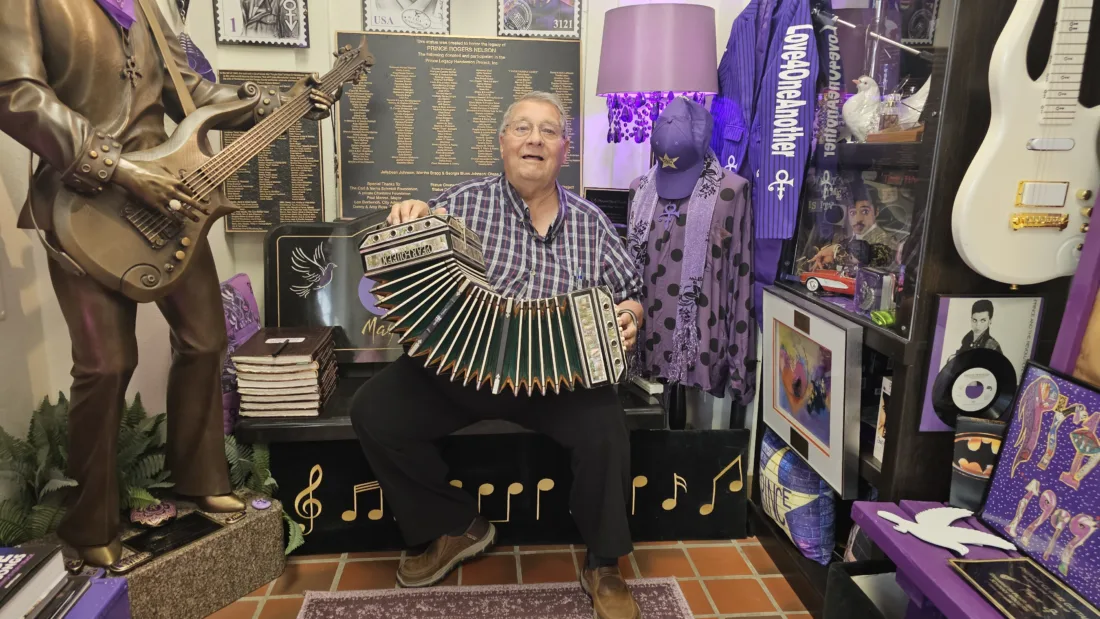
Peter Wendinger poses with a concertina inside the Minnesota Music Hall of Fame in New Ulm, surrounded by memorabilia celebrating Minnesota's rich musical history. (Photo by Amy Zents)
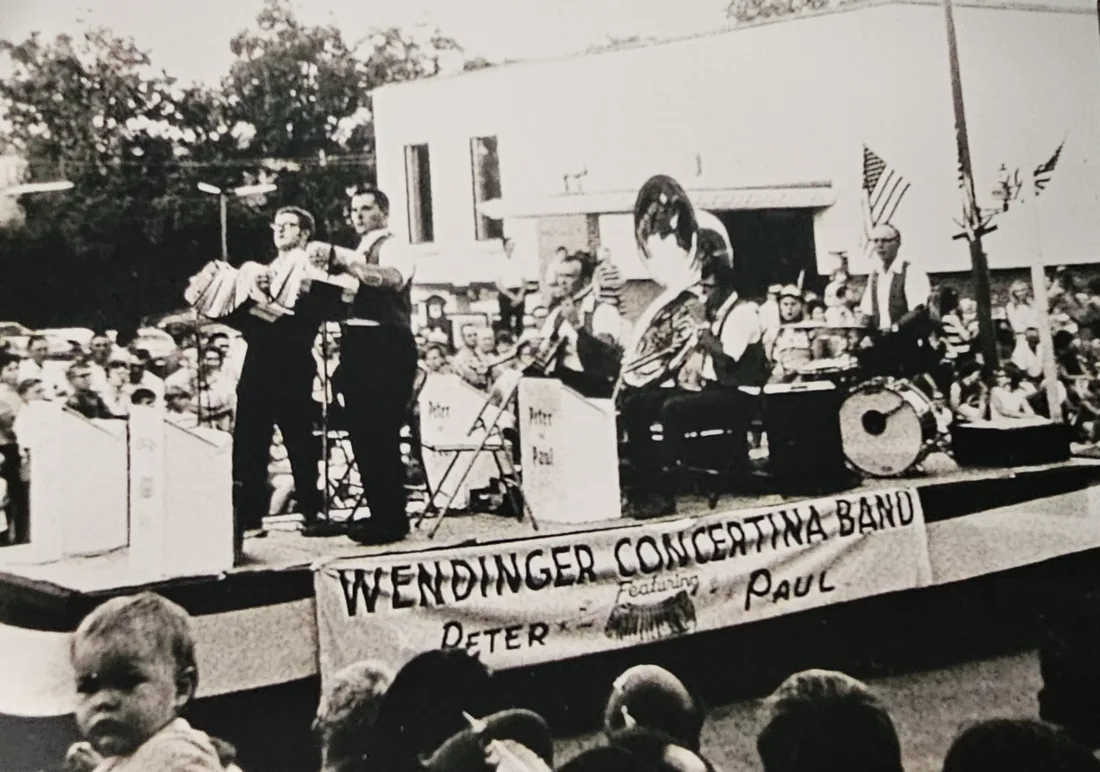
Peter and Paul Wendinger ride a parade float during Polka Days in the 1960s in this archival black-and-white photograph. (Courtesy of Peter Wendinger)
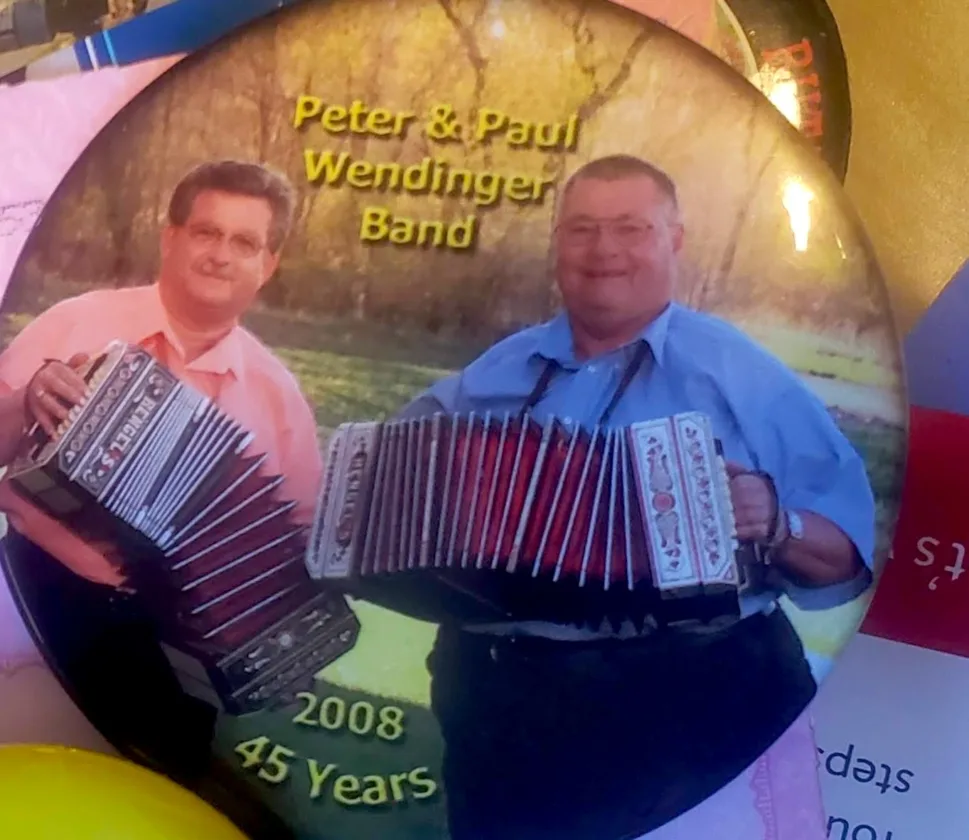
A commemorative button marks 45 years (1963–2008) of the Peter & Paul Wendinger Band, depicting the twin concertina brothers posing with their instruments.(Photo by Amy Zents)
Peter Wendinger poses with a concertina inside the Minnesota Music Hall of Fame in New Ulm, surrounded by memorabilia celebrating Minnesota's rich musical history. (Photo by Amy Zents)
Peter and Paul Wendinger ride a parade float during Polka Days in the 1960s in this archival black-and-white photograph. (Courtesy of Peter Wendinger)
A commemorative button marks 45 years (1963–2008) of the Peter & Paul Wendinger Band, depicting the twin concertina brothers posing with their instruments.(Photo by Amy Zents)
Trending
NEW ULM -- Musician Peter Wendinger spoke at the Minnesota Music Hall of Fame during Bavarian Blast weekend in July about his career and the history of polka music in New Ulm.
“I live right outside of New Ulm, in a little village of St. George. And when you associate my name, you’ve got to associate it with my brother’s name, Peter and Paul,” Wendinger said.
They played together for 50 years. His brother Paul died 16 years ago in 2010.
“In our heyday for 35 years, we played 160 nights a year. The most we ever played was the year the Mall of America opened up, and we played 180 jobs that year. Of those 160 nights that we played, 65 percent of them were down in Iowa,” Wendinger said. “We were headed for the Iowa border all the time.”
While polka traditions in New Ulm date back to 19th-century German and Bohemian settlers, Wendinger said his and his brother's start in music began at a Concertina Jamboree in 1962.
At the time, a nun in Montgomery had been teaching concertina to local high school boys, and Wendinger's father saw them perform at the event.
“My dad was 40 years old when I was born, so he was almost a grandpa,” Wendinger said. “He saw those young men play those concertinas. He just put it in his mind, ‘My boys could do that too.'”
His father bought a $135 concertina at that event for his sons. The instrument sat unused for a month before his father arranged lessons.
They went to Hutchinson for lessons. Their first teacher left after six weeks for an out-of-state job. A retired schoolteacher who played accordion taught them for a year, followed by Johnny Helget in New Ulm for about a year.
“My dad dragged us to school plays, birthday parties, bars, we played in little bars for a while and it just progressed. All of a sudden we’re playing clubs and we’re playing anniversaries, wedding receptions. All of a sudden we’re playing at the Gibbon Ballroom. All of a sudden we’re traveling to Minneapolis and all of a sudden to Iowa, and we were doing that before I even had a driver’s license,” Wendinger said.
His father or the band’s drummer drove them to performances.
Wendinger said polka music in New Ulm started in the 1800s with immigrants from Germany and Bohemia.
His great-grandmother was a Muehlbauer who married into the Biley family, both of which maintain musical traditions today.
Wendinger said his father was friends with area polka musicians.
“Harold Loeffelmacher, Fezz Fritsche, Elmer Scheid, as little boys they were all at our place all the time,” he said.
Wendinger said Fezz Fritsche held season tickets for the Minneapolis Millers. When Wendinger was 6 and his brother was 4, Fritsche took them to a Millers game before the Minnesota Twins franchise existed.
Wendinger said 26 bands operated out of New Ulm on any given Saturday night.
“Just think, 26 bands. They were mostly polka bands, but there was Guy DeLeo with his big band, a modern band. The Trail Riders had a country band. Most of those bands were 8, 9, 10 piece bands, so it was an industry by itself that operated out of New Ulm,” he said.
New Ulm operated four ballrooms. One was located on the road to Hanska in the valley. The New Ulm Ballroom was located near Kraft Foods. A third venue across the river was moved to Lafayette and converted into a Catholic church. George’s Ballroom was built in 1947.
“It was billed as the most beautiful ballroom west of Chicago,” he said. “George’s Ballroom shut down in the 1990s and was torn down a year and a half ago.”
During his high school years from 1965 to 1970, Wendinger played with Harold Loeffelmacher and the Six Fat Dutchmen. He and his brother alternated turns so only one played per job.
“We couldn’t make too many jobs because the Wendingers were already booked,” Wendinger said.
He played with the Six Fat Dutchmen group from 1965 to 1970. His final performance with them was a two-night job in Fargo in 1970.
His brother Paul played a three-day schedule from St. Cloud to Brainerd to Silver Bay, returning in time for school.
“The biggest injustice that I ever had in life, Harold Loeffelmacher asked me to do his 10-day Texas trip,” Wendinger said. “My parents thought it was best for me to go to school instead of going to Texas.”
His favorite band growing up was the Elmer Scheid Band.
Scheid played with the Six Fat Dutchmen, then with the Babe Wagner band until Wagner died in 1949.
Wagner’s brother Swede took over the band before Scheid formed his own group in 1953.
“Probably the most popular New Ulm band that ever existed was the Elmer Scheid Band,” Wendinger said.
Scheid played 10 consecutive nights at George’s Ballroom for wedding dances. Saturday nights at George’s Ballroom were reserved for public dances.
For 30 years, Scheid played a rotating Sunday night schedule among ballrooms in Searles, Gibbon, Klossner, and Sleepy Eye.
“Everybody was home for work bright and early on Monday morning,” he said.
Wendinger said Jerry Schuft started a band in 1950 with trombone player Earl Schmidt and tuba player Hilary Hauge. Schuft played for Wendinger’s wedding dance at George’s Ballroom on a Wednesday night.
“We had 1,800 people there for our wedding dance that night,” he said.
He and his brother were inducted into the World Concertina Hall of Fame, the Minnesota Music Hall of Fame, and the International Polka Hall of Fame (IPA.)
Wendinger said the International Polka Hall of Fame is a Polish-Slavic organization that recognizes Bohemian-German music.
“My brother died in 2010 and was inducted in 2012 in the deceased category. I was inducted two years ago in Pittsburgh, Pennsylvania,” he said.
New Ulm has seven or eight members in the International Polka Hall of Fame, including Whoopee John Wilfahrt, Harold Loeffelmacher, Fezz Fritsche, Babe Wagner, Cliff Hermel, and the Wendinger brothers.
Wendinger said he and his brother missed the era when polka was full-time employment, when bands traveled six days a week. The Wendinger band began with weekend jobs.
“Polka Days” started in 1954 as a band concert at Johnson’s Ballpark. Some other dance bands played downtown on the freshly paved Minnesota Street that year, which Collier’s magazine called Oom-pah Day. Until then Minnesota Street had been gravel.
The following year, six New Ulm bands played on Minnesota Street on a Monday night, formally establishing what became Polka Days. Within a few years, the event drew 20,000 people to town.
KNUJ Radio began broadcasting in 1949, one month after Wendinger was born and three months before Babe Wagner died. The station was known as “the polka station of the nation.”
Peter Wendinger was on the original board of the Minnesota Music Hall of Fame. His wife, Dodie, who was the executive director of the MMHOF for 30 years, currently serves as the treasurer.
The Minnesota Music Hall of Fame continues its live series celebrating Minnesota musicians every Saturday.
The next presentation features a live performance and meet-and-greet with 2024 nominee Jeff Dayton this Saturday, Sept. 5, from 11 a.m. to 2 p.m. at the Minnesota Music Hall of Fame, 1 N. Broadway St., New Ulm.