
How a hillbilly brought country music north
The story of Texas Bill Strength
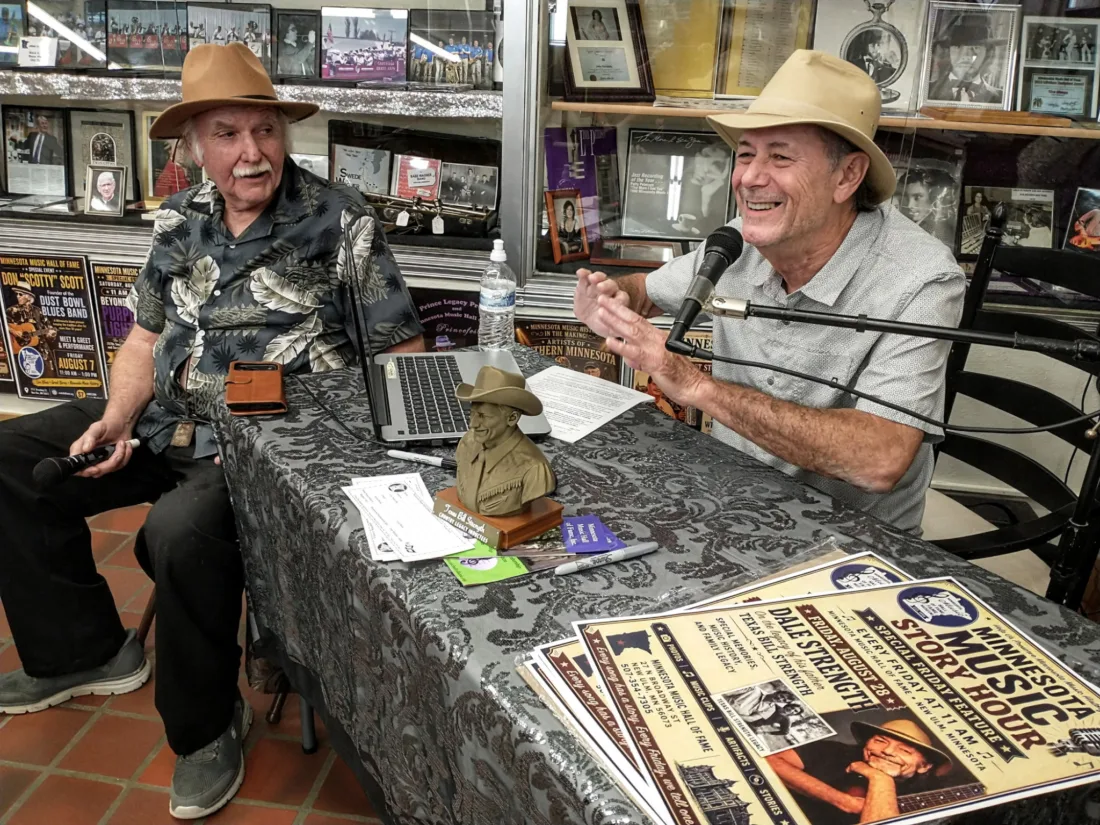
Neal Bond (left) and Dale Strength (right) share stories at the Minnesota Music Hall of Fame during a special presentation in New Ulm highlighting the life and music career of Texas Bill Strength. (Photo by Joel King)
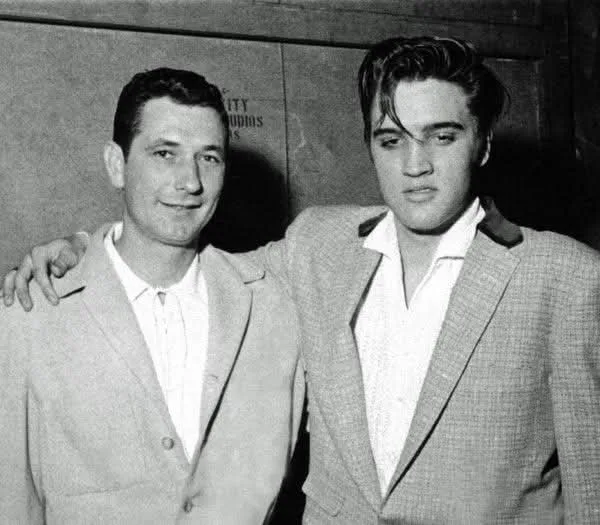
Country singer and disc jockey Texas Bill Strength stands alongside Elvis Presley during the 1950s Memphis era. (Photo courtesy of Dale Strength)
Neal Bond (left) and Dale Strength (right) share stories at the Minnesota Music Hall of Fame during a special presentation in New Ulm highlighting the life and music career of Texas Bill Strength. (Photo by Joel King)
Country singer and disc jockey Texas Bill Strength stands alongside Elvis Presley during the 1950s Memphis era. (Photo courtesy of Dale Strength)
Trending
NEW ULM -- “If anybody who wasn’t born in Minnesota could become a Minnesotan, that’s what happened to the old man.”
That is how Dale Strength described his father, Texas Bill Strength, Saturday morning at the Minnesota Music Hall of Fame in New Ulm.
The presentation covered the life of Texas Bill Strength and detailed how country music, rock and jazz fusion expanded across Minnesota through his work and the work of his family and fellow musicians.
Texas Bill Strength was born in Alabama and began his performing career at age 16 in Houston, where he acquired his nickname. During that era, the style was commonly referred to as hillbilly or old-time music.
By 1955, the family lived in Memphis, where Strength worked as a radio DJ on KWEM alongside Elvis Presley, Johnny Cash and Carl Perkins.
He also recorded for Sun Records and owned a nightclub in Atlanta.
When Bill Strength decided to move to Minnesota in 1955, his fellow performers held a farewell event for him.
“He played a concert at the Ellis Auditorium in Memphis that year where Elvis and Carl dedicated the show to him,” Dale Strength said. “They dedicated it to him because he was moving to Minnesota to show the Yankees what country music was all about. He called it going up to Paul Bunyan country.”
Upon moving north, Bill Strength began booking country acts at the Flame Cafe in Minneapolis, including Ernest Tubb, Tex Ritter, George Jones, Jimmy Dean, and Audrey Williams.
He hosted a children’s television program on KMSB Channel 9, operated a record shop in the Foshay Tower, recorded at Kay Bank Studios, and promoted regional performers.
“Women had an awful lot to do with the country music scene up here in Minnesota,” Dale Strength said, citing regional performers Shirley Linde, Barbara Lee and Betty Riedel. “My dad used a lot of women in his bands. Very proud of that.”
Dale Strength was joined at the presentation by keyboardist and guitarist Greg Inhofer.
The two met in high school and played together in a band called The City Strangers, which later became the rock group Pepperfog.
After attending a live performance by the Mahavishnu Orchestra, the group shifted its musical style toward jazz fusion and progressive rock.
They performed compositions by King Crimson and Emerson, Lake & Palmer, including the 18-minute side of the album “Tarkus.”
The group later changed its name to Gold Street and eventually became This Oneness.
While rehearsing in Minnesota, members of This Oneness met singer Olivia Newton-John, who was preparing for her first tour in the United States in the early 1970s and looking for backing musicians.
“She was just sitting on the grass, hanging out alone,” Inhofer said. “She says to Dale, ‘You play country?'”
Dale Strength was wearing cowboy boots at the time and confirmed he played country music.
“We bought an Olivia Newton-John album at Kmart on the way home,” Dale Strength said. “Went back that evening and rehearsed, and the next morning we left on the bus. Rehearsed all the way.”
The group spent nearly three years touring as Newton-John’s backing band. During that period, the group performed on the television program “The Midnight Special,” where Newton-John yielded a performance slot so This Oneness could perform an original song.
The tour also included a backstage encounter with Billy Joel before he achieved national prominence.
Inhofer also played keyboards, bass and guitar on Bob Dylan's 1975 album “Blood on the Tracks,” appearing on five of the ten final tracks.
Inhofer described the recording session for “Tangled Up in Blue,” which was initially performed in the key of G.
“Kevin Odegard said, ‘G is a folk key, A key is more of a rock key,'” Inhofer said. “Dylan said, ‘Let’s try it.’ One take, and it was perfect. That’s the take that’s on the record.”
Inhofer also recalled an instance when Texas Bill Strength brought an animal home following a card game.
“He once won a goat in a card game,” Inhofer said. “Came out to our house with the goat in the front seat of his Cadillac convertible. He said, ‘Boys, I’m leaving the goat with you.’ We had a watch goat in our front yard that would jump on the hoods of people’s cars.”
Dale Strength recalled an incident outside Kay Bank Studio in Minneapolis when an irate driver pointed a gun at him over equipment blocking an alleyway.
“The old man sees this from inside the studio,” Dale Strength said. “He comes out the door, takes the gun from my head, puts it against his own head, and says, ‘Okay, shoot me.’
He kept pushing him back until the guy got in his car and drove away.”
Texas Bill Strength and his sons, Dale and Bobby Strength, are among more than 100 nominees under consideration for induction into the Minnesota Music Hall of Fame this year.
The Hall of Fame board accepts induction suggestions from the public through a submission box at the facility.
Dale Strength credited historian Jeanne Anderson and her archive website, TwinCitiesMusicHighlights.net, with preserving historical records of Minnesota musicians.
“My dad’s story would have been lost to time if it wasn’t for Jean,” Dale Strength said. “When she put this project together, it really helped me put my life together. I could match the events to the days and the years.”
To conclude the event, Dale Strength presented a video recording featuring an audio track of his late father singing Frankie Laine’s “That Lucky Old Sun” paired with modern instrumental accompaniment.