
Solid Gold veteran Wayne Liebhard teaches songwriting at MMHF
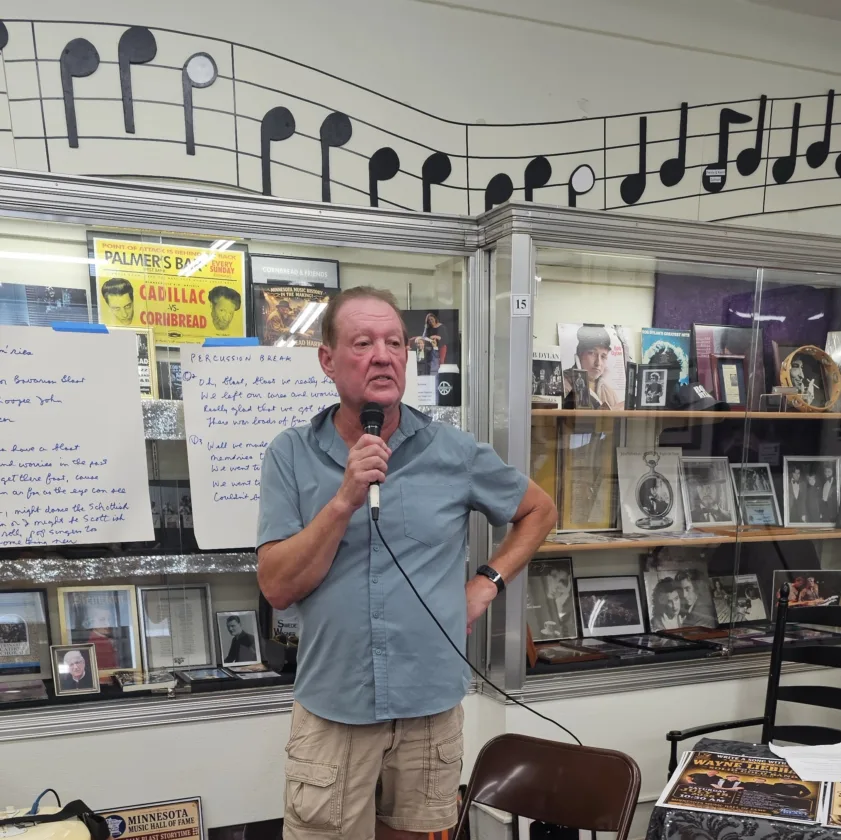
Minnesota Music Hall of Fame board member and 2023 nominee Wayne Liebhard leads attendees through the mechanics of songwriting during his "Write a Song with Wayne" workshop in New Ulm.(Photo by Amy Zents)
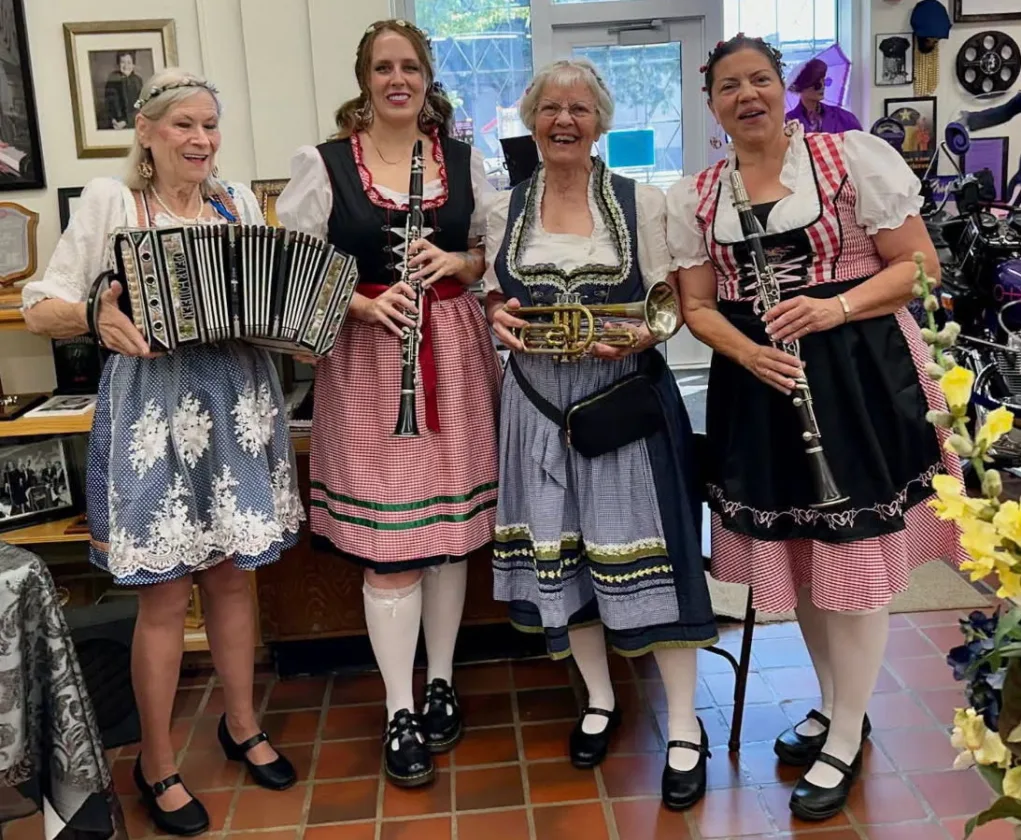
Workshop participants (left to right) Cat Rossing, Sylvia Kass, Connie Kass, and Barb Schmidt clad in traditional dirndls, have fun holding up a variety of instruments at the Minnesota Music Hall of Fame on Saturday, July 18. (Photo by Amy Zents)
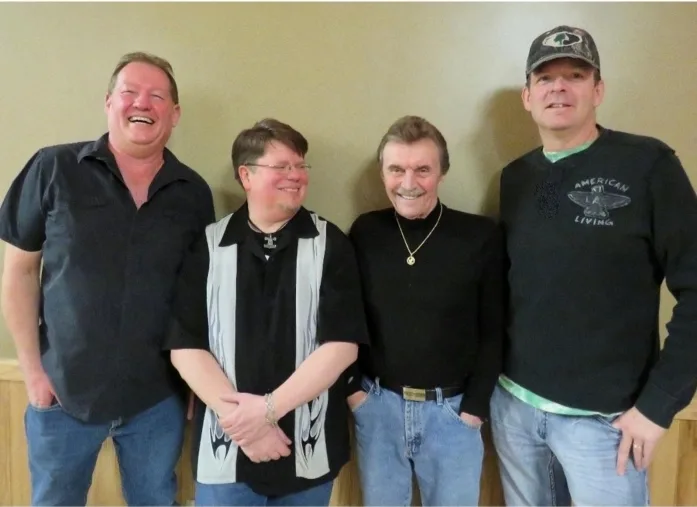
The current lineup of the Solid Gold Band (left to right: Wayne Liebhard, Terry Partington, Paul Musikov, and Gary Barnes) brings together decades of experience as they continue to tour and perform across Minnesota and the Upper Midwest. (Photo submitted by the Solid Gold Band)
Minnesota Music Hall of Fame board member and 2023 nominee Wayne Liebhard leads attendees through the mechanics of songwriting during his "Write a Song with Wayne" workshop in New Ulm.(Photo by Amy Zents)
Workshop participants (left to right) Cat Rossing, Sylvia Kass, Connie Kass, and Barb Schmidt clad in traditional dirndls, have fun holding up a variety of instruments at the Minnesota Music Hall of Fame on Saturday, July 18. (Photo by Amy Zents)
The current lineup of the Solid Gold Band (left to right: Wayne Liebhard, Terry Partington, Paul Musikov, and Gary Barnes) brings together decades of experience as they continue to tour and perform across Minnesota and the Upper Midwest. (Photo submitted by the Solid Gold Band)
Trending
NEW ULM -- Last month, Minnesota Music Hall of Fame was host to a special songwriting workshop with Wayne Liebhard.
Liebhard is a hall of fame board member and 2023 nominee. He set up an electric guitar and a collection of hand percussion instruments.
The session invited participants to learn about the mechanics of songwriting and work together to write a song with Wayne on “Bavarian Blast” and get credited on a video that will run on the hall website.
“Music allows us to organize our emotions,” Liebhard said. “Writing songs allows us to connect to and express our emotions.”
Liebhard brought over 50 years of songwriting and performing experience to the session. He serves on the board with Neal Bond.
He joined the Solid Gold Band at age 19 after starting in church guitar groups and playing his first rock gig at age 13. He later also studied vocal music under former Vienna Choir Boy Axel Theimer at St. John’s University and recently won their prestigious Alumni Achievement Award for his contributions to music, medicine, authorship, and community service.
Formed in Waconia in the fall of 1973, the Solid Gold Band recorded five original studio albums written and produced by Wayne, and three music videos. Jim Donna of The Castaways also contributed to the albums.
The group’s current lineup brings together decades of regional touring and national stage experience and continues to perform active dates across Minnesota and the Upper Midwest.
Primary songwriter Wayne Liebhard leads on guitar and vocals and has won national awards as a music composer and as an author (www.wayneliebhard.com).
Bassist, keyboardist and vocalist Paul Musikov brings a touring background that includes being on the road with Prince and Rick James.
Drummer and vocalist Terry Lee is a multi-instrumentalist who has opened for Foghat and the Marshall Tucker Band.
Guitarist, vocalist and bassist Gary Barnes has performed professionally since age 16 and has shared stages with Three Dog Night and Gary Puckett.
Co-founder, keyboardist and saxophonist Ron Johnson, a former high school band director currently on hiatus, helped shape the group’s multi-instrumental arrangements.
Outside of music, Liebhard practiced medicine for 40 years, spending two decades in family practice and obstetrics and two decades in urgent care. He is also an award-winning author of seven books, three of those being novels where the protagonist is a doctor and a musician, and where the stories delve into the Minnesota music scene.
The session focused on practical mechanics, starting with choosing a core emotional theme such as happiness, love, or fun.
“I look at it as identifying which emotion you want to express, and that becomes the theme of your song,” Liebhard said.
He said country music is particularly effective for narrative storytelling.
“Lyrics to me are probably more important than anything,” Liebhard said.
Addressing composition methods, Liebhard explained why he prefers starting with lyrics.
“I am a lyrics-first guy just because lyrics come to me,” Liebhard said. “Though I do feel limited by later trying to pigeonhole a melody into the lyrics, or throwing a quick placeholder melody at your lyrics and then not being able to get that out of your head.”
He said melody-first writers often rely on temporary placeholder words. He said Paul McCartney used “scrambled eggs” while composing “Yesterday” and Phil Collins used “Sussudio” as a placeholder and kept it because he liked the sound.
He said a third method is collaboration, where one person writes lyrics and another writes melody. He said examples include Lennon and McCartney and Simon and Garfunkel.
He said another method used by Led Zeppelin was for each band member to bring multiple licks to the studio.
Liebhard said song structure can sometimes mirror a narrative arc.
“Tell them what you’re going to tell them, that’s the intro,” Liebhard said. “Tell them, that’s the body. And then tell them again, that’s the conclusion.”
He said pop songs generally consist of verses, choruses and sometimes a bridge. He said the Beatles referred to the bridge as the “middle eight.”
Demonstrating basic harmonic theory, Liebhard showed how foundational chords make songwriting accessible.
“Every note in the major scale can be found in three chords,” Liebhard said.
He said the three chords are the 1, 4 and 5 chords based on their position in the major scale. He said in the key of C, the chords are C, F and G. He said thousands of songs have been written using those three chords in different orders.
“If you add one more chord, the six minor, then you can cover a great many of the songs you’ve heard on the radio,” Liebhard said.
To put theory into practice, Liebhard introduced a song titled “Bavarian Blast,” for which he wrote the words and music, written in an upbeat pop style.
He distributed tambourines, maracas and shakers to attendees, forming a group he introduced as Wayne Liebhard & The Bavarian Blasters.
“Let me introduce you to the fabulous Bavarian Blasters, a group that’s been together a long time, about 28 seconds, something like that,” Liebhard laughed. “We just threw this little song together because we love the Bavarian Blast.”
The ensemble recorded the song on video live in a single take at the conclusion of the workshop.
The performance was captured without artificial intelligence tools or synthetic audio. The video was made available for viewing on YouTube and the Hall of Fame website, crediting the participant lineup.
Liebhard said educational workshops help preserve local music history and encourage community participation.
He continues to perform active dates with the Solid Gold Band across Minnesota. The band’s website is www.thesolidgoldband.net. Their music is available on all major streaming services.
“When you write a song that connects with someone, it stays with them,” Liebhard said.