
E-rate at risk
FCC contemplates cutting connections
Trending
NEW ULM - For 30 years, the federal government has helped fund internet access to libraries and schools across the nation through the E-rate program.
The program has made internet access affordable to many public institutions, but following a recent review from the Federal Communication Commission (FCC), the funding source could reduce or eliminate the E-rate funding.
On Aug. 14, the FCC published its proposed rule change on the Federal Register, asking if the E-rate policy needed to be reformed or eliminated. The FCC argued that the program began 30 years ago and potential updates were needed, especially since much had changed in terms of how internet is used in the last three decades.
The FCC is also questioning if E-rate policies need to change as a method of protecting kids from screen time.
The E-rate program was created in 1996, when former President Bill Clinton signed the Telecommunication Act. At that time, access to internet was limited to many communities. For many, the local library was the primary source of internet access and the E-Rate program made it possible.
New Ulm Public Library director April Ide said the E-rate program is a vital assist for the New Ulm library.
In fiscal year 2026, the New Ulm Public Library received a discount of $9,619.08 from E-rate program.
Traverse de Sioux (TDS) library cooperative applies for the program on behalf of all the libraries in its nine-county region. In 2026, TDS received $250,000, which is divided between all the libraries in the region.
Ide said the $9,619.08 the New Ulm library received from the program covers 71% of the library's total internet costs. The rest is covered through state Regional Library Telecommunication Aid funding.
Ide said the E-rate program ensured the library has dependable internet access. Ending the program would reduce library budgets and put years of network improvements at risk and widen the gap for communities without the resources to replace the funding.
Ide confirmed that without reliable internet access, the essential services would no longer run.
"If our internet goes down, we are pretty handicapped in terms of our operating system," she said. "It is vital for what we're doing."
Library material circulations, account managements, collection acquisitions, and building systems.
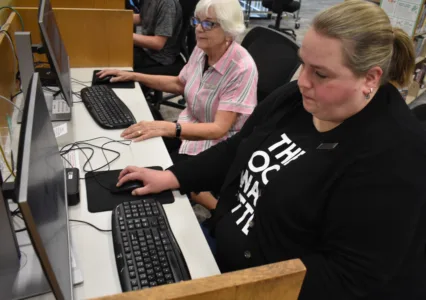
Internet access is also needed for the public. Ide confirmed the library still has patrons come to the library to access its broadband and wireless internet to complete school work, work remotely or attend a zoom call.
"We've seen our public computer use go up in the last year," Ide said. "You would think with people having smart phones in their pocket, that would not be the case, but it is true."
There is also a lot of patrons who use the library internet to access and print state and federal forms.
Ide said are also some patrons who need help using online tools and come to the library for addition help from staff.
Ide said the loss of reduction of the E-rate program would hurt New Ulm library, but others would be impacted as well. She said the budgets of smaller libraries like those in Hanska or Comfrey would be affected.
It's also a problem for public schools. When the E-rate program began in 1996, it was also designed to eliminate barriers for schools to access the internet.
According to the National Center for Education Statistics, in 1995, only 8% of public classrooms had internet access. By 2003, classroom internet access had jumped to 93%. This was a direct result of the E-rate program. Without continued federal funding of the program, the cost of providing stable internet access to schools and libraries would fall back on local tax payers.
The FCC's stated in its notice of a proposed E-rate rule change that it was evaluating whether the program is needed since the majority of schools were connected to the internet. In addition the FCC is asking whether reforms are needed to limit student screen time.
As part of the review, the FCC is accepting public comments whether to terminate or limit the E-rate program by scope or geography.
Comments are due on or before Oct. 13, 2026.
The Schools, Health, and Libraries Broadband Coalition offers information at SaveOurErate.com on how to file comments with the FCC and contact elected officials about the importance of E-Rate funding.
Ide said by filing comments and contacting elected officials, community members can help protect a program that has ensured libraries and schools can provide affordable, reliable internet access.
She said continued support for E-Rate is essential to sustaining this progress and meeting the evolving informational and educational needs of the community.