
Pioneer Cemetery Tour examines tragic toll of 1862 U.S.-Dakota War
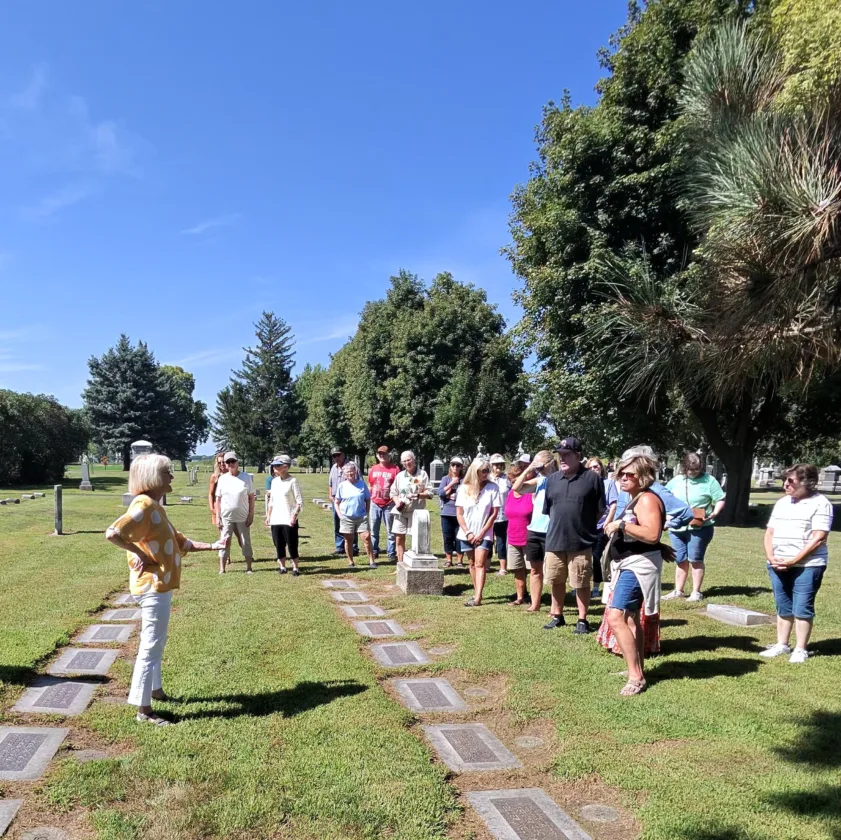
Research librarian Darla Gebhard speaks to a crowd gathered in Tract A of the New Ulm City Cemetery during Sunday's educational tour. (Photo by Amy Zents)
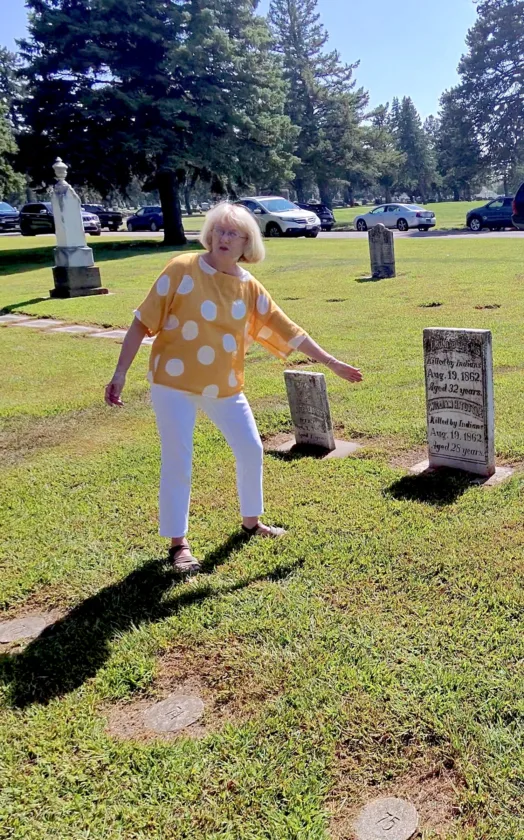
BCHS Research Historian points to headstones of Dakota War victims in the pioneer section of families lost in 1862, including members of the Zettel, Drexler, and Zeller families, would be permanently remembered. (Photo by Amy Zents)
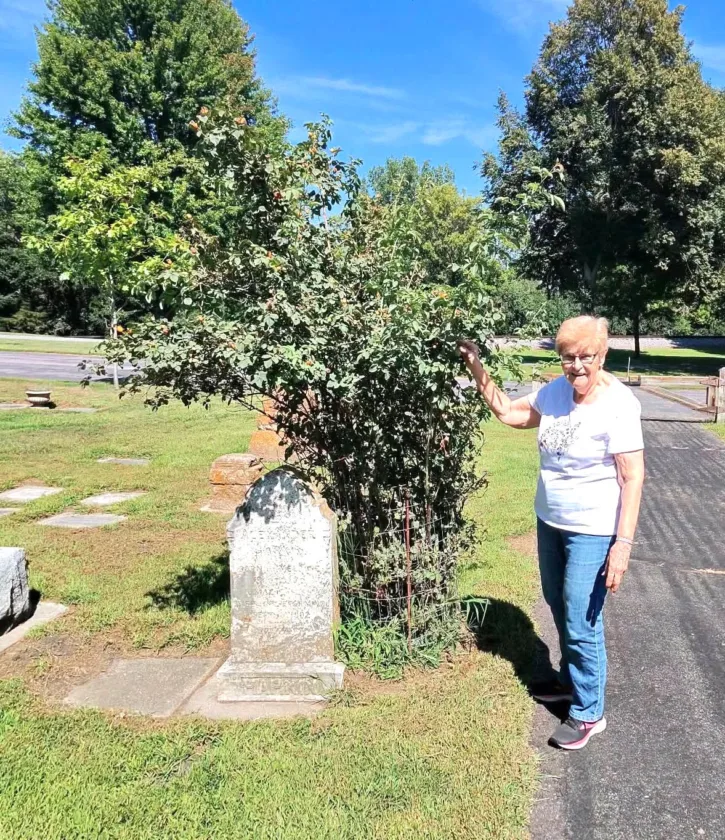
Opal DeWanz stands beside the headstone of Alexander Harkin and the living rose bush planted at his grave in the New Ulm City Cemetery. Harkin brought the bush from Scotland when he emigrated, planting it at his store before it was transplanted to his grave plot following his death in 1907. (Photo by Amy Zents)
Research librarian Darla Gebhard speaks to a crowd gathered in Tract A of the New Ulm City Cemetery during Sunday's educational tour. (Photo by Amy Zents)
BCHS Research Historian points to headstones of Dakota War victims in the pioneer section of families lost in 1862, including members of the Zettel, Drexler, and Zeller families, would be permanently remembered. (Photo by Amy Zents)
Opal DeWanz stands beside the headstone of Alexander Harkin and the living rose bush planted at his grave in the New Ulm City Cemetery. Harkin brought the bush from Scotland when he emigrated, planting it at his store before it was transplanted to his grave plot following his death in 1907. (Photo by Amy Zents)
Trending
NEW ULM -- The Brown County Historical Society marked the anniversary of the 1862 U.S.-Dakota War with an educational tour Sunday through the older pioneer section of the New Ulm City Cemetery.
Research librarian Darla Gebhard, with volunteer guides Sue Ullery and Wayne Wagner, led visitors through the cemetery, including Tract A.
Gebhard explained that Tract A became the central site for Dakota War burials only after the siege.
“The dead were first buried wherever it was convenient, in streets and yards, because it was not safe to go to the cemetery,” Gebhard said.
In November 1862, after the town was reoccupied, the bodies were exhumed and reinterred in Tract A.
Some victims were buried two to a grave. Gebhard said there are stones with two names on them indicating two people in that grave.
Standing near a carved marker, Gebhard pointed to a stone that belongs to Jacob Castor.
“He is the first Dakota War victim we will talk about today,” Gebhard said.
As word came from attacks in Milford Township, where more than 50 settlers were killed the morning of Aug. 18, panic spread and more than 1,000 refugees flooded into New Ulm.
Nearly 2,000 people were crammed into a three-block barricaded sanctuary. Gebhard said Castor had a bakery across from where the New Ulm Public Library is now, right outside the barricades.
People were hungry inside the barricaded area. Gebhard said Castor left the barricade to get supplies from his bakery.
“On one of those trips, he put a buffalo robe over his head to sneak back, and he was shot and killed,” Gebhard said.
Gebhard pointed out what is written on his stone is different from what some narratives say.
“It says on his stone ‘Ermordet von den Indianer,’ which means ‘killed by the Indians,'” Gebhard said. “However, documents say he was killed in friendly fire, and we will never know how he was killed.”
As word came from Milford, Sheriff Charles Roos turned command over to Jacob Nix, a Turner and veteran with prior military training in Germany.
“It was Jacob Nix who became commandant of New Ulm and set up the barricades and decided how we were going to militarily survive this attack,” Gebhard said.
Gebhard pointed out another ambush that morning along County Road 29 near Anton Henle’s farm, where a Civil War recruiting party was caught off guard.
“Whenever Lincoln needed more men, each county in each state had to meet a quota,” Gebhard said. “And so they would have a group of men to go out, knock on farm doors and say, ‘Is there any young men here that would like to sign up to be part of Brown County’s quota for the Civil War?’ Well, they were out on County Road 29 and when they got as close as Anton Henle’s farm, where there is a ravine, Dakota came up out of the ravine and shot and killed them.”
One survivor, John Nunn, was on horseback and fled back into New Ulm to report the attack.
During the first battle of New Ulm on Aug. 19, Nix was wounded.
“During the first battle of New Ulm, Nix was shot through his ring finger,” Gebhard said.
Gebhard paraphrased from Nix’s own narrative describing his visit to the town doctor.
“He said after the battle was over, I went into Doctor Carl Weschke’s office to get my finger, which had been shot completely off, tended to,” Gebhard said. “He was leaning up against the wall in his office with his eyes shut, sleeping standing up. That’s how worn out he was. Nix said, ‘And I was ashamed of myself for such a paltry wound.’ So he said, ‘I just found a woman to bandage my hand.'”
Gebhard said Weschke was the only doctor in New Ulm during the first battle.
Gebhard said relief arrived ahead of the second battle when Charles Flandrau reached town from St. Peter with volunteer reinforcements.
Additional doctors, including Dr. Asa Daniels, eventually arrived to help.
On the south perimeter, Dakota warriors occupied the blacksmith shop owned by August Kiesling. The shop stood just outside the barricades.
Flandrau and Nix led men over the barricades to clear the shop, burning it to the ground. Out of about 250 structures in New Ulm, about 190 were burned during the war, set ablaze by both the Dakota and by the settlers themselves to deny the Dakota cover.
Gebhard also highlighted the grave of Alexander Harkin, founder of the historic Harkin Store.
When Harkin emigrated from Scotland, he brought a rose bush with him that was planted at the store site. Following his death in 1907, the rose bush was transplanted to his grave plot, where it continues to bloom today.
In 2013, the Junior Pioneers installed flat stone markers over previously unmarked graves of Dakota War victims in the pioneer section. This ensured that families lost in 1862, including members of the Zettel, Drexler, and Zeller families, would be permanently remembered.
The tour concluded at the family plot of Friedrich Beinhorn, who organized the Chicago Land Company that brought the first settlers to the area in 1854.
“He immigrated with an idea in his head before he came over that he wanted to found a town somewhere in the Midwest in the USA,” Gebhard said.
“While he was attending night school in Chicago to learn English, he shared this vision with other settlers, including the Henles, Zettels, and Zellers, which led to the formation of the Chicago Land Company and the eventual founding of New Ulm.”
Darla explained that the Chicago group chose the name “New Ulm” after Ulm, Germany.
She said that this area is near Württemberg, which is where many of the founding settlers were from.
Opal DeWanz praised Gebhard’s cemetery tour, saying she had never heard several of the historical stories shared during the talk.
DeWanz said about the tour, “I loved it.”
DeWanz also offered a poignant piece of her own family history, recalling how her relatives buried in the Evangelical United Brethren Cemetery near Courtland tragically lost nearly a child a day during the region's diphtheria epidemic.
Through the preservation of these gravesites and the retelling of their stories, the legacy of those who lived and died through Brown County’s hardest trials remains intact for future generations.