
Remembering the Lake Shetek attack and the Fool Soldiers
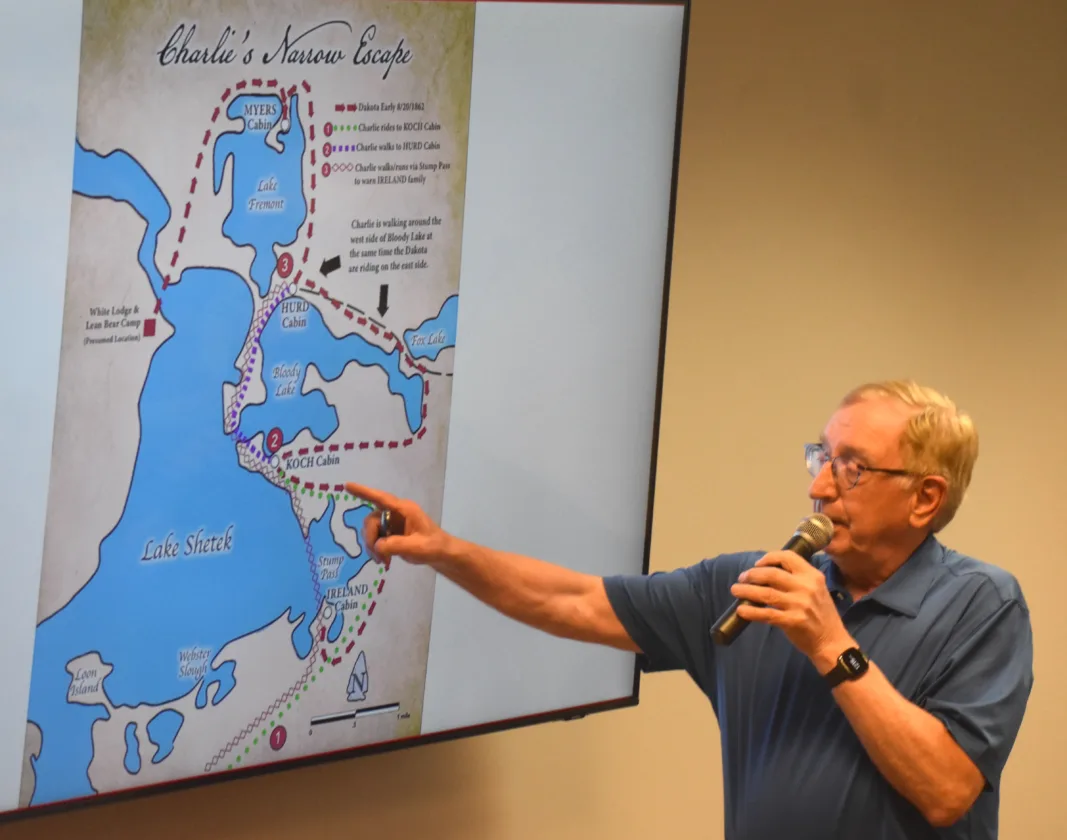
Dr. Paul Carpenter points out the route his great-grandfather, Charlie Hatch, took to warn settlers about the attack on Lake Shetek on Aug. 20, 1862. Photo by Clay Schuldt
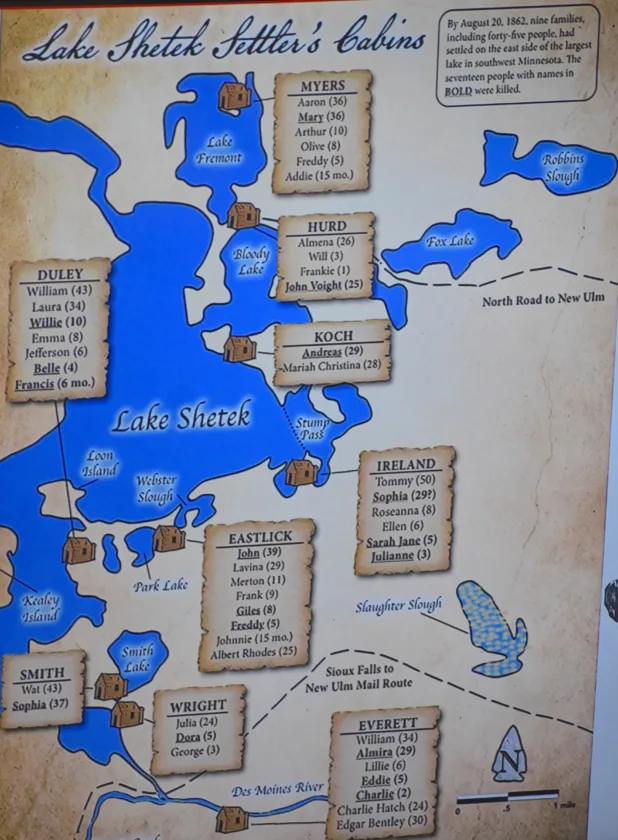
A map of Lake Shetek and the location of settler cabins at the time of the Dakota attack on Aug. 20, 1862. The map was part of a presentation from Dr. Paul Carpenter. The map includes the names of settlers living in each cabin. The names in bold were those who would not survive the conflict.
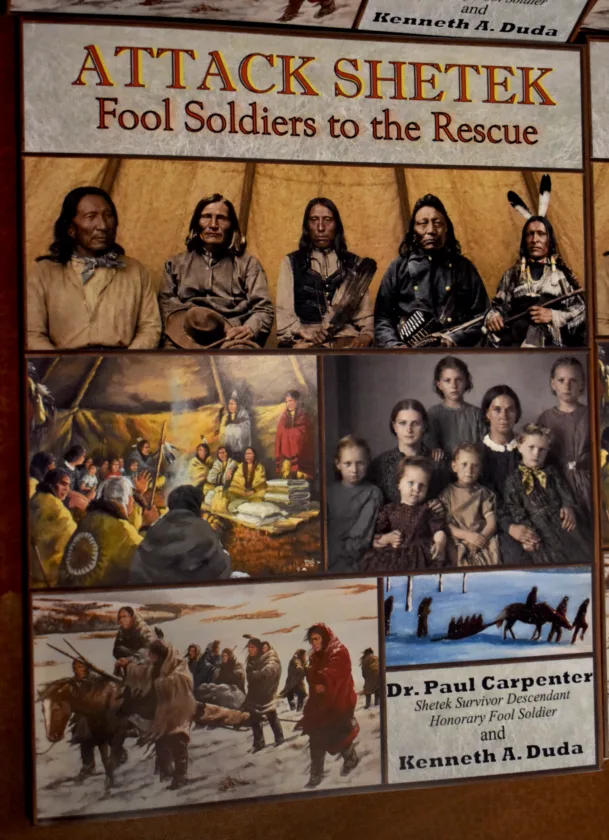
The cover of a book written by Dr. Paul Carpenter and Kenneth A. Duda. The book “Attack Sheteck Fool Soliders to the Rescue” tells the story of how a group of how 11 Lakota men work to negotiate the release of captives taken at Lake Shetek.
Dr. Paul Carpenter points out the route his great-grandfather, Charlie Hatch, took to warn settlers about the attack on Lake Shetek on Aug. 20, 1862. Photo by Clay Schuldt
A map of Lake Shetek and the location of settler cabins at the time of the Dakota attack on Aug. 20, 1862. The map was part of a presentation from Dr. Paul Carpenter. The map includes the names of settlers living in each cabin. The names in bold were those who would not survive the conflict.
The cover of a book written by Dr. Paul Carpenter and Kenneth A. Duda. The book “Attack Sheteck Fool Soliders to the Rescue” tells the story of how a group of how 11 Lakota men work to negotiate the release of captives taken at Lake Shetek.
Trending
NEW ULM - Brown County Historical Society's (BCHS) U.S.-Dakota War remembrance week continued Thursday, with a presentation on the Dakota attack on Lake Shetek.
In August 1862, Lake Shetek, in Murray County, was home to approximately 45 White settlers. Their location near Dakota territory and relative isolation made them an early target, and hostilities broke out during the Start of the U.S.-Dakota War
Dr. Paul Carpenter spoke at the BCHS Annex, recounting how the attack happened, what happened to the survivors and ultimately how a group of 11 Lakota helped free the captives.
"Every year on Aug. 20 [my] family is very aware that today is a special day," Carpenter said.
His great-great-grandfather Charlie Hatch was a survivor of the attack. Hatch's niece was taken captive during the attack and later freed.
Carpenter said he could spend hours detailing all the incidents of the attack, but wanted to tell the story of the Fool Soldiers, a group of young Lakota who decided on their own to rescue White captives.
Carpenter said the attack on Lake Shetek began early in the morning around 6 a.m. on Aug. 20, 1862. All of the settler cabins were located on the east side of the lake. The attack started at the Meyers cabin, on the northern part of the lake.
Aaron Meyers served as the local physician and even treated Dakota people. For this reason, it was believed the family was initially spared. The attacking Dakota only knocked down his fence before moving on to the Hurd cabin, where they shot and killed John Voight, who was staying with Alemena Hurd while her husband was away. After killing Voight, the Dakota allowed Alemena Hurd to flee east with her two children toward New Ulm.
The Dakota continued south to the Koch cabin, which is where Carpenter said things got personal.
His great-grandfather Charlie Hatch, who was 24 at the time, was staying with his sister at the Everett Cabin far south of Lake Shetek near the Des Moines River. That morning, Hatch was riding a horse north to borrow oxen from the Koch and Hurd families. He took a shortcut to the Hurd cabin through a marshy area, which required him to leave his horse.
Hatch reached the Hurd cabin and found Voight dead. Realizing the settlement was under attack. Hatch turned around to warn the settlers, first reaching the Koch cabin right as the Dakota were surrounding the cabin. Andreas Koch had already been killed.
Hatch was able to avoid the Dakota as he traveled south, warning other Shetek settler families along the way. The Lake Shetek families all gathered in the Wright cabin as it was two story and believed to be the easiest to defend.
This eventually led to a standoff between the Dakota and Lake Shetek settlers. Inside the Wright cabin, there were eight men, seven women and 19 children. The settlers were outmatched; however, a friendly Sisseton named Old Pawn agreed to negotiate on behalf of the White settlers. He said if the settlers left and followed the Shetek to New Ulm trail, they would be unharmed. If they refused to leave, the Dakota would burn the cabin.
At that time, the settlers were unaware a wider conflict was starting and fleeing seemed like the better option.
Carpenter argued that the Dakota would have likely waited until the settlers were out of supplies if they had remained.
"It may have turned out worse if they had stayed in the cabin," he said.
The settlers began the long journey to New Ulm. Hatch collected a wagon from the Everett cabin to help carry the group of settlers down the trail.
Carpenter said the settlers made it a few miles to Slaughter Slough before the Dakota decided to pursue them.
"The wagon couldn't go fast enough," Carpenter said. "They ended up running into the slough; it was the only place where they had any protection."
Two of the men with the settlers fled, leaving six men to defend in the slough. John Eastlick was killed early in the firefight. William Everett, Tommy Ireland and Hatch were severely wounded.
Carpenter said his great-grandfather was shot through the wrist and became useless in the fight. After two hours, the settlers were out of ammunition.
Once again, Old Pawn helped negotiate a deal with the settlers. The Dakota promised to take the women and children as captives.
Carpenter said it was not a great option, but it was a better alternative than having the Dakota charge the slough. He said despite the promise, three women and eight children were killed after leaving the slough.
"The men could not do anything to prevent it," he said.
After most of the settlers were taken captive, the remaining survivors gathered at a cabin along Dutch Charley Creek. Other survivors of the attack would reach this cabin over the next few days before traveling on to New Ulm. The group did not take a direct route to New Ulm. The group decided to stay off the main roads to avoid further encounters with the Dakota.
The group was headed in the direction of Lake Crystal, but on Aug. 22, Aaron Meyer separated form the party to find medical help in New Ulm for his wife and Will Everett.
He reached New Ulm on Aug. 23 and was involved in the defense of New Ulm. On Aug. 24 he left New Ulm and traveled to St. Peter. From there he traveled to Mankato, arriving on Aug. 26. There he was reunited with his wife, who had been brought to Mankato by U.S. soldiers. Unfortunately, his wife died two hours after they were reunited.
Carpenter said Will Everett and his great-grandfather eventually recovered in Mankato.
The women and children who were taken captive at the slough were moved into Dakota territory by a Sisseton Dakota chief named White Lodge. A fur trader encountered the Dakota group and their captives about a hundred miles north of Fort Pierre. The trader promised to pass on word of their location once he reached Fort Pierre.
By September, word of the Shetek captives reached a group of Lakota who had created an organization called the Strong Heart Society. The organization was dedicated to promoting peace. The Strong Heart Society urged rescuing the Shetek captives, for which their fellow Native American groups called them crazy, leading to the nickname "Fool Soldiers."
By Nov. 17, a group of 11 Fool Soldiers found out where the captives were being held and traveled to negotiate with White Lodge. The Fool Soldiers eventually traded their horses for the release of captives. After which, they needed to travel back to Fort Pierre during a blizzard. None of the captives had winter clothing since they were captured in August.
The Fool Soldiers gave the captives their blanket. They were able to trade extra with other tribes along the way, but the Fool Soldiers were successful in reuniting the captives with their families.
"The Fool Soldiers were never really recognized nor repaid for anything they gave in bartered items," Carpenter said. "It was one of my relatives that was rescued; I can't be more thankful for the Fool Soldiers."
Carpenter said last month he traveled to Eagle Butte to visit with the descendants of the Fool Soldiers. He said many of the descendants were unaware of what their relatives had done.
Carpenter said a special scholarship fund has been set up for the descendants of the Fool Soldiers. Proceeds from a book Carpenter wrote with Kenneth A. Duda called "Attack Shetek Fool Soldiers to the Rescue," will go to the scholarship fund.
Carpenter said his great-grandfather returned to Wisconsin after the Shetek attack. He eventually married and return to Minnesota, living in Huntley, Minnesota, to raise a family.
Charlie Hatch would write a poem about the day of the attack, which was passed down through the family. Carpenter said his father recited the poem every Aug. 20 to all his siblings.
The only Shetek survivor to return to Lake Shetek was Tommy Ireland. He lived in the area for another 10 years, but Carpenter said none of the other families returned as their lives were changed by the experience.
The Dakota War commemoration week will continue through the weekend. From 10:30 a.m. to 11:30 a.m. Saturday, Aug. 22 the BCHS will host a downtown walking tour of U.S.-War sites.
The Kiesling House will be open from 11 a.m. to 3 p.m. Saturday, Aug. 22 and will host the New Ulm Battery.
From 2-3 p.m. Sunday, Aug. 23, the BCHS will hold guided tours of the Pioneer section of the New Ulm Cemetery.