
Preserving the story of Wood Lake Battlefield
WLBPA member recounts battle story for BCHS
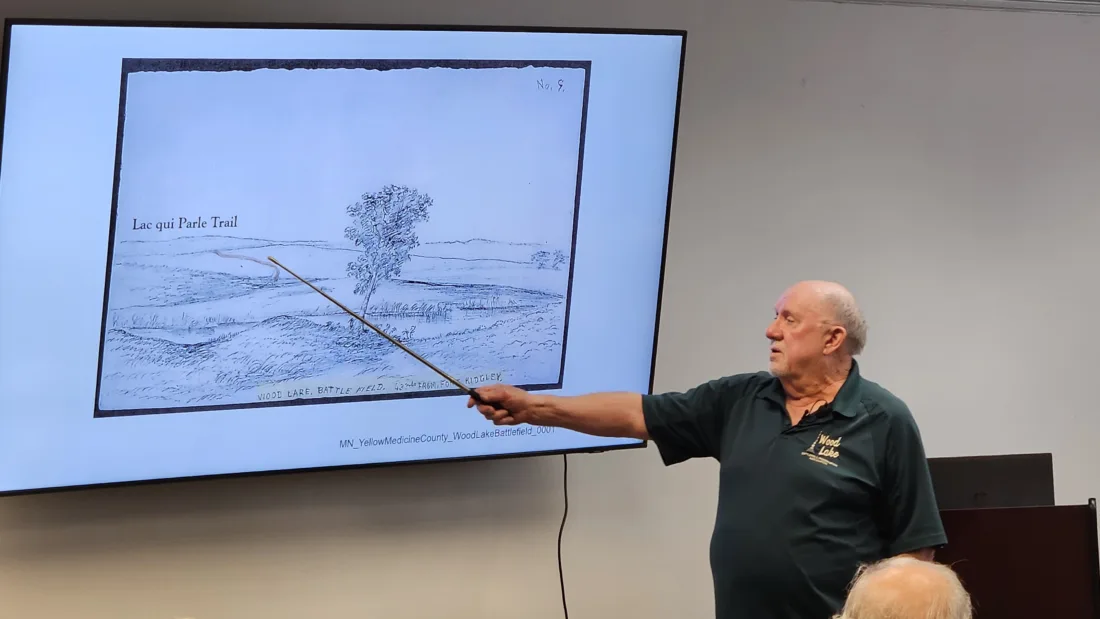
During a history presentation at the Brown County Historical Society (BCHS) Wednesday, Denny Dahmes of the Wood Lake Battlefield Preservation Association (WLBPA) describes the path Col. Henry Hastings Sibley took from Fort Ridgely to the Wood Lake battle site in Sept. 1862. An illustrator named Albert Colgrave was with Sibley during the expedition and sketched some of the locations. One of Colgrave sketches depicts the Lone Tree Lake camp site. Photo by Clay Schuldt
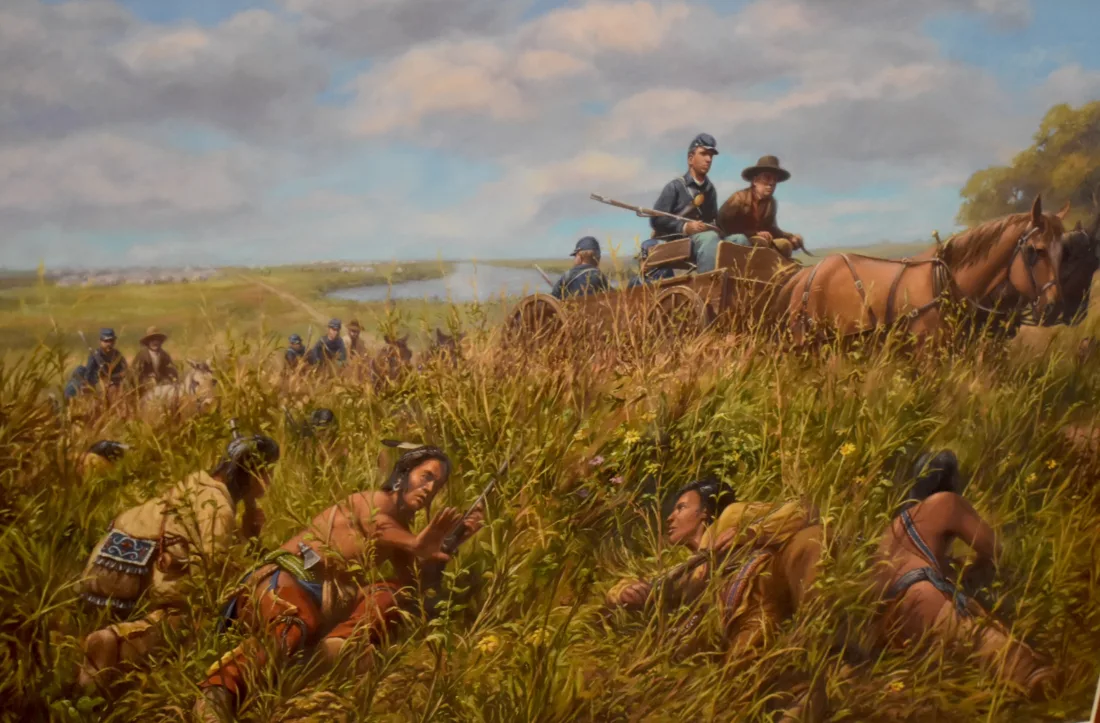
A painting by David Geister titled “Surprise at Wood Lake” illustrates a foiled Dakota ambush that began the Battle of Wood Lake on Sept. 23, 1862. Submitted photo
During a history presentation at the Brown County Historical Society (BCHS) Wednesday, Denny Dahmes of the Wood Lake Battlefield Preservation Association (WLBPA) describes the path Col. Henry Hastings Sibley took from Fort Ridgely to the Wood Lake battle site in Sept. 1862. An illustrator named Albert Colgrave was with Sibley during the expedition and sketched some of the locations. One of Colgrave sketches depicts the Lone Tree Lake camp site. Photo by Clay Schuldt
A painting by David Geister titled “Surprise at Wood Lake” illustrates a foiled Dakota ambush that began the Battle of Wood Lake on Sept. 23, 1862. Submitted photo
Trending
NEW ULM - Wednesday, as part of the Brown County Historical Society’s (BCHS) U.S.-Dakota War remembrance week, the museum hosted a presentation on one of the final battles of the conflict, Wood Lake.
The Battle of Wood Lake took place a month after the two Battles of New Ulm and the start of the U.S.- Dakota conflict on Sept. 23, 1862. The battle occurred in Yellow Medicine County, a few miles south of Granite Falls.
Denny Dahmes of the Wood Lake Battlefield Preservation Association (WLBPA) gave a presentation on the battle and its significance. He described the Battle of Wood Lake as the story of an attempted Dakota ambush on a U.S. military force that was foiled by providence when U.S. soldiers, foraging for food, sprang the trap early.
Days before the Battle of Wood Lake began, Col. Henry Hastings Sibley was at Fort Ridgely waiting for reinforcements.
The Battle of Birch Coulee, which two weeks early had severely diminished Sibley's fighting forces. He needed more troops and more supplies before pursuing hostile Dakota in western Minnesota. Those supplies arrived on Sept. 14. After waiting out a heavy rainstorm, Sibley and his expedition force departed Fort Ridgely on Sept. 19, 1862, with about 1,450 men. Dahmes said while marching, Sibley's train of men was about a mile long.
Many of these troops were from other organizations, including Renville Rangers, the 3rd Minnesota, 6th Minnesota and 7th Minnesota.
Dahmes said Sibley's convoy also included mounted men with cattle. It is not clear how many head of cattle were with the army, but this raised questions about why the soldiers needed to forage for extra provisions.
Dahmes describes the route of Sibley's troops across western Minnesota. During the campaign, an illustrator named Albert Colgrave, who was embedded with Sibley's forces, would sketch images of where the party stopped. Some of these sketches have survived, giving present-day historians an idea of what the landscape looked like in 1862. Dahmes incorporated some of these sketches in his presentation.
As early as Sept. 20, 1862, the expedition force was running low on food, Dahmes said; this was confusing since the team left Fort Ridgely with cattle. It is unclear how the team could already have meager food provisions. It is known that some of the men began scavenging for food at the Lower Sioux Agency during their first night in camp.
On Sept. 22, Sibley and his men reached Lone Tree Lake, which would become the Wood Lake Battle Site.
Dahmes said there was some question over the name of the battlefield. At the time of the conflict, the soldiers were camped near a body of water called Lone Tree Lake. However, there was a community a few miles west named Wood Lake. In 1894, one of the Dakota Chiefs, Big Eagle, was interviewed about the battle. He said the Dakota name for Lone Tree Lake was also Wood Lake.
Sibley's men set up a camp near Wood Lake on Sept. 22, 1862, around noon. Dahmes said the Dakota scouts were watching the army's march for some time. Some of Sibley's men had spotted the scouts. The camp was setup with defenses to protect against attack, but Sibley expected fighting to occurred to take near the Yellow Medicine River about two miles north.
The evening of Sept. 22, 1862, the Dakota held a council to discuss how and when to attack Sibley's forces.
Little Crow suggested a surprise night attack, but his men were concerned about the pickets. They did not believe a night attack would work. They favored an ambush in the morning when the army was on the march.
Dahmes said Sibley's wagon train was over a mile long. If attacked while on the march, the smaller force of Dakota could defeat a larger force. Sibley had about 1,450 men. The Dakota forces were estimated at 740 soldiers. However, Dahmes said there were many Dakota who did not participate in the attack.
During the dark of the night, Dakota warriors hid in the tall grass along a path they expected the soldiers to take out of camp. Crouched down, it would have been impossible for the soldiers to see them until it was too late.
The plan would have worked except that the U.S. soldiers were low on food. A group of men from the 3rd Minnesota left camp earlier to forage for supplemental food. They did not technically have permission to leave camp, but they took a four or five wagons with them.
About a half mile outside of camp after crossing a bridge and ravine, the group of 3rd Minnesota soldiers was nearly at the ambush site when the lead wagon veered onto the path and headed directly toward concealed Dakota warriors. The Dakota had no choice but to spring their trap early or risk being run over by the wagon.
The Dakota opened fire on the foraging U.S. troops and the Battle of Wood Lake began.
Back at camp, the soldiers heard the fighting and realized the foragers with the 3rd Minnesota were in trouble.
Major Abraham Welch, who was in charge of the 3rd Minnesota, did not wait for orders and took a group of 200 men to reinforce their fellow soldiers.
Sibley would eventually order Welch and his men back to the defenses of the camp. Welch initially refused to leave the battle, but eventually ordered the bugler to sound the retreat, but there was one problem. The bugler did not know the signal for retreat.
This led to confusion on the battlefield. Some of the U.S. troops knew to retreat; others tried to rally. During the retreat back to the camp, several members of the 3rd Minnesota were wounded or killed. Major Welch was one of the officers wounded. He was shot in the leg while attempting to help another wounded soldier.
The 3rd Minnesota sustained the most casualties on the retreat. To reach the safety of the camp, the men of the 3rd Minnesota needed to cross a creek and ravine, which slowed them down. However, once they crossed the creek, the U.S. troops were able to return fire across the ravine at the advancing Dakota.
Sibley was also able to bring in artillery units, which resulted in Dakota casualties and ultimately forced their retreat.
Dahmes said there are 14 Dakota warriors buried on the Wood Lake battlefield on the opposite side of the ravine.
In the aftermath of the battle, seven U.S. soldiers were killed. Four were killed on the battlefield, and three died later.
Dahmes said the majority of casualties were from the 3rd Minnesota. In addition to the three killed, another 27 were wounded.
It is unknown how many Dakota were killed in the battle. At least 14 were buried on the battlefield, but casualties could have been as high as 30.
After the Dakota fled, Sibley chose not to immediately pursue the Dakota. He knew there were 269 hostages being held by the Dakota at Camp Release. Some of the friendly Dakota had been in communication with Sibley and offered to help free them. Sibley decided against a heavy pursuit for fear the hostile Dakota would harm the hostages.
Sibley waited until Sept. 24 to begin marching again. He arrived at Camp Release on Sept. 26, at which time the captives were turned over to him.
The Battle of Wood Lake was the last major offensive from the Dakota. Today, the battlefield site is listed on the National Register of Historic Places.
Dahmes is one of the organizing members of the WLBPA, which was founded in 2006 for the purpose of interpenetrating the battlefield.
Dahmes said the WLBPA has been involved in several preservation efforts over the last 20 years. In 2016, there was an archaeological study conducted that uncovered spent shells from the battle, which help where the soldiers were on the battlefield.
For more information on the Battlefield and ongoing preservation methods, visit https://woodlakebattlefield.com/battle-history/