
Downtown U.S.-Dakota War tour details battles
Next walking tour set for 10:30 a.m. Saturday
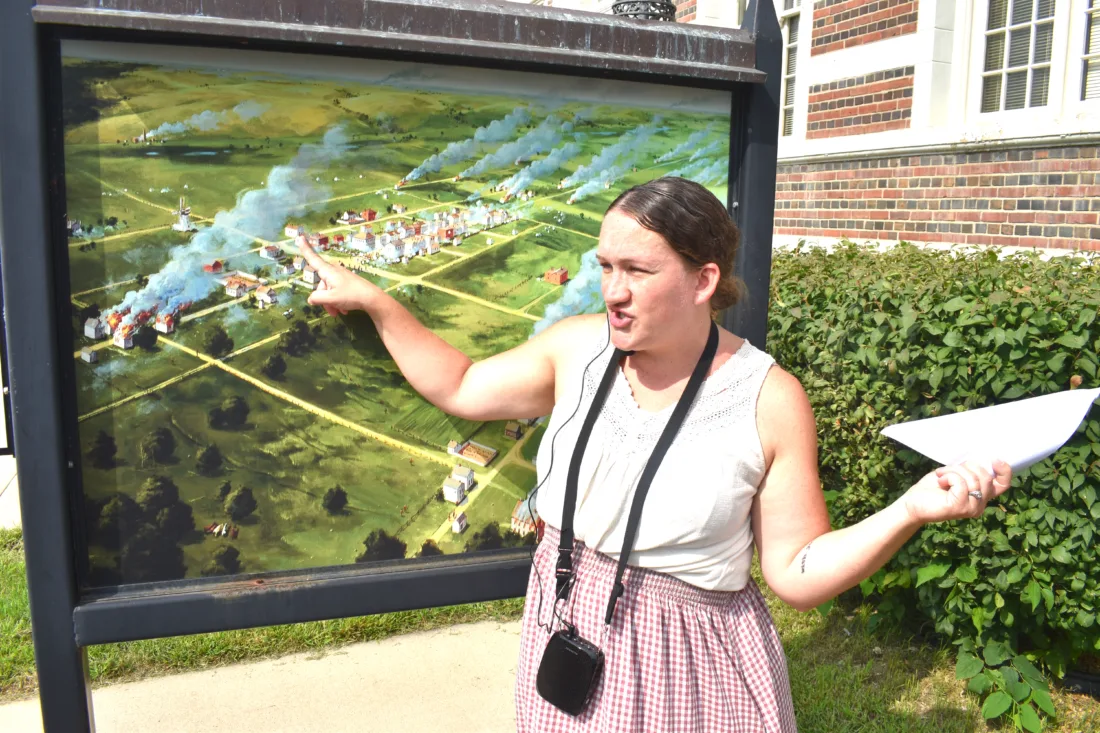
Staff photo by Fritz Busch Brown County Historical Society (BCHS) Program Coordinator Christina Koester describes a painting by Michael Eischen that depicts a moment during the second battle of New Ulm with Dakota Indians. New Ulm defenders struggled to hold on to the core of the city while most of it burned to the ground. Koester led a walking tour of New Ulm’s U.S.-Dakota War sites Thursday. She will lead another New Ulm walking tour that begins at the BCHS Museum at 10:30 a.m Saturday.
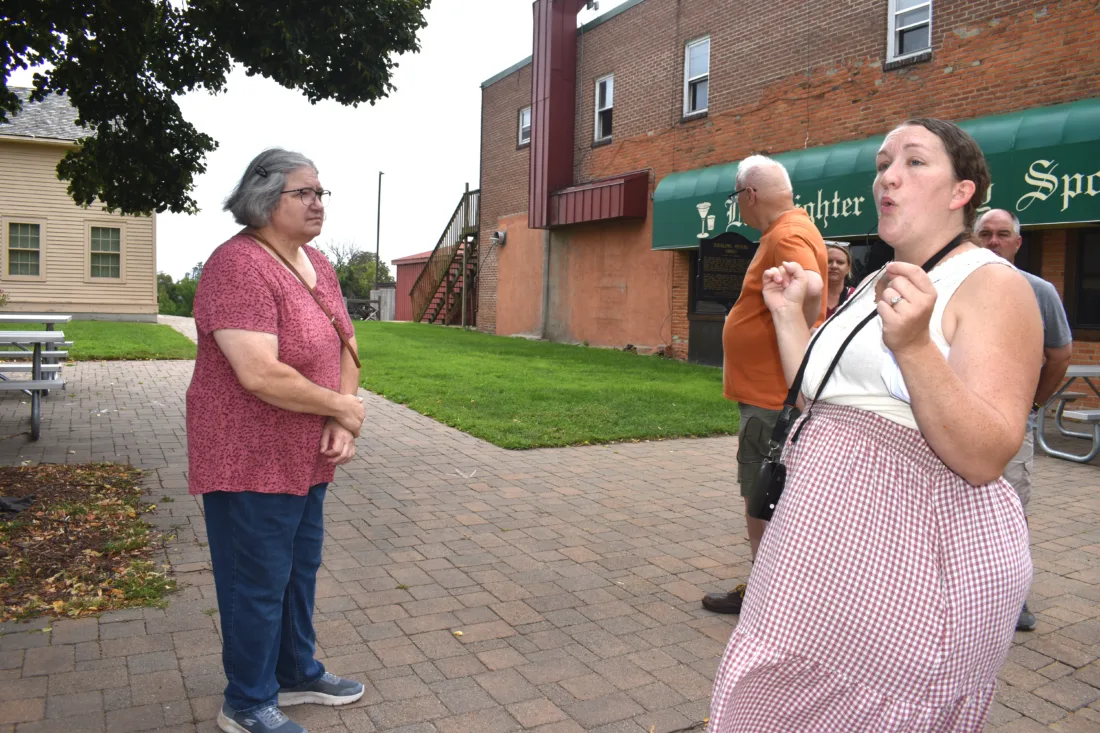
Staff photo by Fritz Busch Brown County Historical Society Program Coordinator Christina Koester talks in front of the Kiesling House while leading a walking tour of New Ulm U.S.-Dakota War sites Thursday. The Kiesling House was one of the few wood-frames houses in town after the U.S.-Dakota War. Reenactments of heritage trades, chores and activities are held in or near the house on the 200 block of Minnesota Street North.
Staff photo by Fritz Busch Brown County Historical Society (BCHS) Program Coordinator Christina Koester describes a painting by Michael Eischen that depicts a moment during the second battle of New Ulm with Dakota Indians. New Ulm defenders struggled to hold on to the core of the city while most of it burned to the ground. Koester led a walking tour of New Ulm’s U.S.-Dakota War sites Thursday. She will lead another New Ulm walking tour that begins at the BCHS Museum at 10:30 a.m Saturday.
Staff photo by Fritz Busch Brown County Historical Society Program Coordinator Christina Koester talks in front of the Kiesling House while leading a walking tour of New Ulm U.S.-Dakota War sites Thursday. The Kiesling House was one of the few wood-frames houses in town after the U.S.-Dakota War. Reenactments of heritage trades, chores and activities are held in or near the house on the 200 block of Minnesota Street North.
Trending
NEW ULM -- Brown County Historical Society Program Coordinator Christina Koester led a downtown walking tour passionately detailing U.S.-Dakota War sites to 20 individuals Thursday.
Koester said in 1851, the treaties of Traverse de Sioux and Mendota forced the Dakota Indians to sell much of southern Minnesota's millions of acres of land to the federal government for about five cents an acre.
"The federal government turned around and sold the land to settlers for about $1.25 an acre," she said. "It was not a great deal for the Dakota. They were then placed on a reservation from about 15 miles up the Minnesota River from New Ulm to South Dakota."
Koester said the Dakota were promised annual payments, education on how to build modern buildings and farm.
"The Dakota received very few of the things they were promised," she said. "There was a bad harvest in 1861 followed by a very harsh winter. By July 1862, the Dakota were starving with no food. On top of that, the federal government was involved with the Civil War when things came to a head when the Dakota were not able to repay credit traders extended to them. The Dakota annuity payments had not arrived."
Koester said the U.S.-Dakota War began Aug. 17, 1862, on a farm near Acton, south of Grove City when four Dakota braves got into a disagreement with white settlers, stole horses and rode back to their reservation.
"There were many Dakota against going to war, including Chief Little Crow, because they didn't think it would end well for them, there were was enough clamor for them to decide to go to war," she said.
The next day, Milford Township settlers and a Civil War recruiting party were attacked by the Dakota several miles west of New Ulm. Fifty-three individuals died and others were taken to New Ulm with serious injuries.
Barricades were quickly erected on three blocks of Minnesota Street.
The first of two attacks on New Ulm happened Aug. 19 when about 100 Dakota were driven back.
New Ulm defender Jacob Nix had a finger shot off during the first battle of New Ulm but continued to lead barricaded settlers in stopping a fierce Dakota attack.
Nix emigrated to America from Germany during the 1848 revolution. A captain in the revolutionary "Free Corps," he was captured, charged with high treason and sentenced to be shot as a revolutionary, but escaped. Three years later, he helped settle New Ulm.
The walking tour stopped at the Kiesling House, one of three downtown New Ulm buildings that survived the U.S.-Dakota War. Koester said the wood frame house was representative of houses built near the time New Ulm began.
New Ulm defenders marked the house to be burned, filling it with straw and other flammable materials in case Dakota attacks broke through downtown barriers. Downtown defenses held although the city lost about three-fourths of its buildings to fire.
A blacksmith, Frederick W. Kiesling's home was on the eastern edge of New Ulm's downtown barricade that also survived an 1881 tornado that destroyed much of New Ulm.
"Frederick Kiesling came to New Ulm with his wife because two of his brothers had already settled in New Ulm," said Koester. "One of the brothers, August, was also a blacksmith who built a replica, makeshift cannon with an anvil and stove pipe that sounded like once when gunpowder was ignited inside it and tricked the Dakota into thinking New Ulm defenders had a cannon."
On Aug. 23, the second attack on New Ulm raged all day with the outcome often in doubt. About 300 New Ulm defenders included volunteers from St. Peter, Mankato, and Le Sueur. The next day, more New Ulm defense reinforcements appeared, driving the Dakota up the Minnesota River Valley.
Faced with a shortage of food and ammunition and the fear of disease, 2,000 New Ulm refugees began walking to Mankato the next day. Most of them returned within a few weeks to rebuild the community.
Reenactments of heritage trades, chores and activities are held in or near the Kiesling house on the 200 block of Minnesota Street North. The house was listed on the National Registry of Historical Places in 1972.
The Kiesling House will be open 11 a.m. to 3 p.m. Saturday, Aug. 22 with the New Ulm Battery and its cannon. A walking tour of New Ulm's U.S.-Dakota War sites begins at the BCHS Museum at 10:30 a.m., Aug. 22. A tour of the New Ulm City Cemetery Pioneer Section begins at 2 p.m., Sunday. Aug. 23. Participants can meet at the cemetery maintenance building.