
Songwriter tells MN history through music
Trending
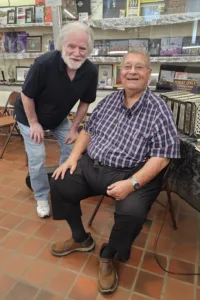
NEW ULM -- Songwriter Doug Noble presented Legends, Heroes, Ghosts and Gangsters: The History of Minnesota in Music at the Minnesota Music Hall of Fame last month.
Noble created the project with hall of fame board member Neal Bond to bring Minnesota’s rich history to life in a musical anthology. The two have written together for 50 years, since college when they performed as the band Braxton Bragg during the Vietnam era.
“We have a number of songs on the album that we wrote together,” Noble said.
What started as The Minnesota Project in 2020, an album of original songs about Minnesota history, grew into a full-length documentary film released in 2024. The film weaves songs about the Great Northfield Minnesota Raid, the Dakota War of 1862, the early voyageurs and the lumber trade with stories of industry giants like James J. Hill and Charles Pillsbury.
Bond said Noble first brought the purple-cover album to the hall of fame several years ago, where Joel King put it in the display. It has been there for three or four years. The July 17 program included a clip from that original 2024 film.
Noble, who now lives in Howard Lake, said he is originally from Wayzata. His earlier claim to fame was being a DJ at a station in northern Florida, where he was the first DJ in the country to play Steely Dan on the airwaves.
For this New Ulm presentation, Noble focused on one chapter of the larger project, the Dakota War, because this week in August is the anniversary week of the Uprising, which began Aug. 18, 1862.
“We are on the second battle line of what happened in the 1860s,” Noble said. “The country was in a civil war with the South at that time and in August and September 1862 the Dakota War happened in Minnesota.”
He traced the war to the Treaty of Traverse des Sioux in 1851, which took more Dakota land.
“The Dakota were woodland hunters,” Noble said. “They were told they were going to be farmers in southern Minnesota along the Minnesota River.”
Federal land at the time was typically sold for about $1.25 an acre, Noble said, but the government told the Dakota it would pay about 1.4 cents per acre and then sell it to settlers for much more.
Noble said the government created an annuity of $1.4 million in gold that was chronically late. There was a drought, and the Dakota were starving.
“The gold was supposed to be there in June,” Noble said. “It arrived about two days late.”
At the Lower Sioux Agency in August 1862, trader Andrew Myrick’s refusal to extend credit to starving Dakota people became one of the most cited flashpoints of the war.
According to accounts recorded by the Minnesota Historical Society, when asked to provide food, Myrick said, “So far as I am concerned, if they are hungry, let them eat grass or their own dung.”
Noble said four young Dakota hunters in Acton Township, Meeker County, killed four or five settlers on Aug. 17 and brought word back to the chiefs.
“It was taken to Chief Little Crow,” Noble said. “Little Crow said they did not want to go to war but knew there would be real problems.”
On Aug. 18, when the Dakota attacked the Lower Sioux Agency, Myrick was among the first killed, and his body was later found with grass stuffed in his mouth in retaliation.
“They found Myrick outside the store with his mouth stuffed with grass,” Noble said. “That was payback for ‘let them eat grass.'”
“There were about 300 people huddled in a small area near the hall of fame,” Bond said.
Noble said a company of Minnesota troops was in town on a recruitment drive and helped hold New Ulm.
“They held the town and then attacked Fort Ridgely,” Noble said. “There was no stockade. People who have been to Fort Ripley know there is no stockade like the old western movies. Soldiers set up cannons in the corners between the buildings and held off the Dakota.”
Noble said the second battle of New Ulm on Aug. 23, 1862, involved more than 600 Dakota.
“It was the largest battle over a U.S. town since 1776,” Noble said.
He described the subsequent battles at Birch Coulee near Morton, where about 75 settlers burying the dead were surrounded for three days in an open field by about 250 Dakota, until Henry Sibley arrived from Fort Ridgely with cannons and about 400 men.
Noble said the Battle of Wood Lake was effectively the last battle of the war. The Dakota surrendered at Camp Release on Sept. 26.
“Lincoln reviewed the cases and went from over 300 to 38,” Noble said. Thirty-eight Dakota men were hanged in Mankato on Dec. 26, 1862.
Noble said the full anthology is broader than the Dakota War story alone. Following the main project, Bond created a dedicated spinoff video focus -- HEROES - THE FILM -- which focuses on specific prominent historical figures featured in their song catalog.
“The Heroes film was my spinoff of that project,” Bond said.
Heroes - The Film features original music and lyrics composed by Neal Bond. The theme song “Legends, Heroes, Ghosts, and Gangsters” was created by Doug Noble and Neal Bond, including “Unsung Heroes Song,” “Angel of Good Deeds,” “Champion of the Common Man,” “The Night St. Peter Became St. Paul,” “A Man With a Plan” about J.J. Hill, and “Rolling Down the River” about the lumbermen. Lyrics are copyright 2025 Neal Bond, with instrumental arrangements created using Suno AI software.
Noble said he is currently working to bring a live stage show of the full project with multiple hall of fame inductee Gwen Matthews sometime in 2026-27.
The project is available on USB and CD through the Minnesota Music Hall of Fame.