
BCHS holds Heritage Chores Camp at Kiesling House
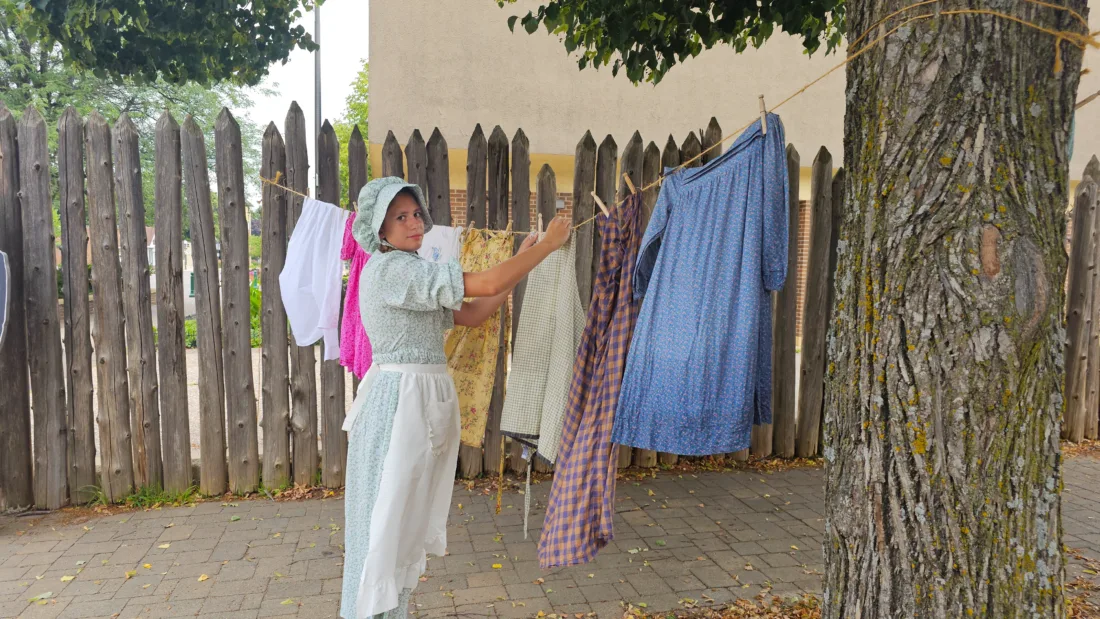
Eleanor Goerdt hangs laundry on the clothesline outside the Kiesling House during the Heritage Chores Camp. (Photo by Amy Zents)
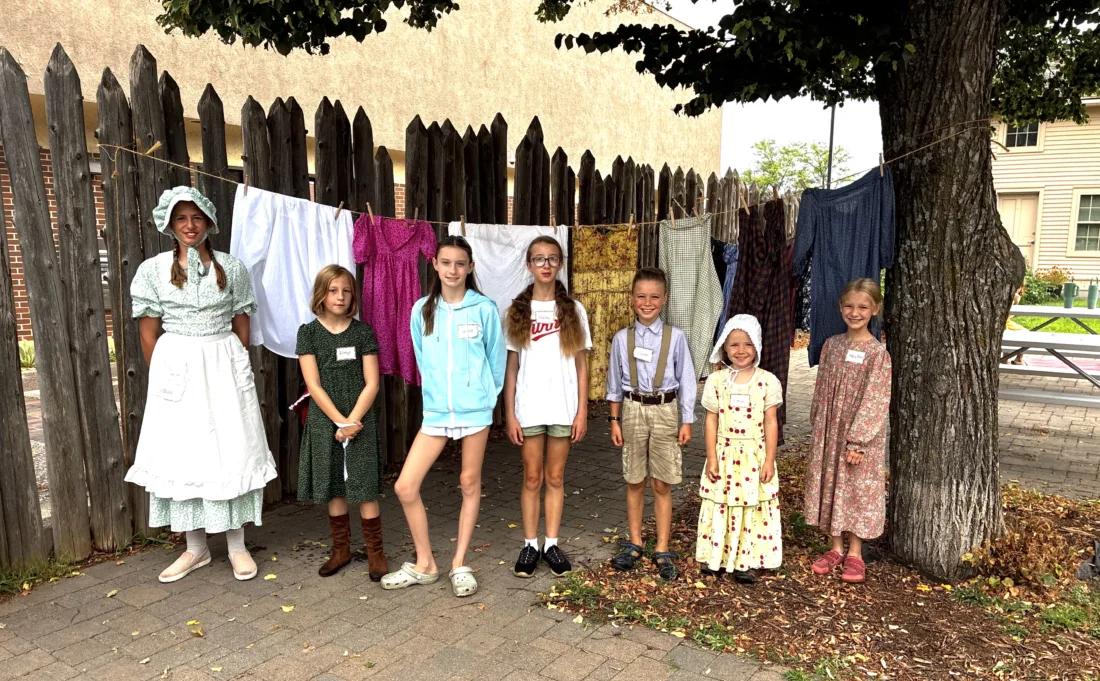
From left, Eleanor Goerdt, Evelyn McMahon, Jaycee Nilson, Haley Hoffmann, Everett Schroers, Evelyn Schroers and Mary Anna Bressler pose during the Heritage Chores Camp Friday at the Kiesling House. (Photo by Amy Zents)
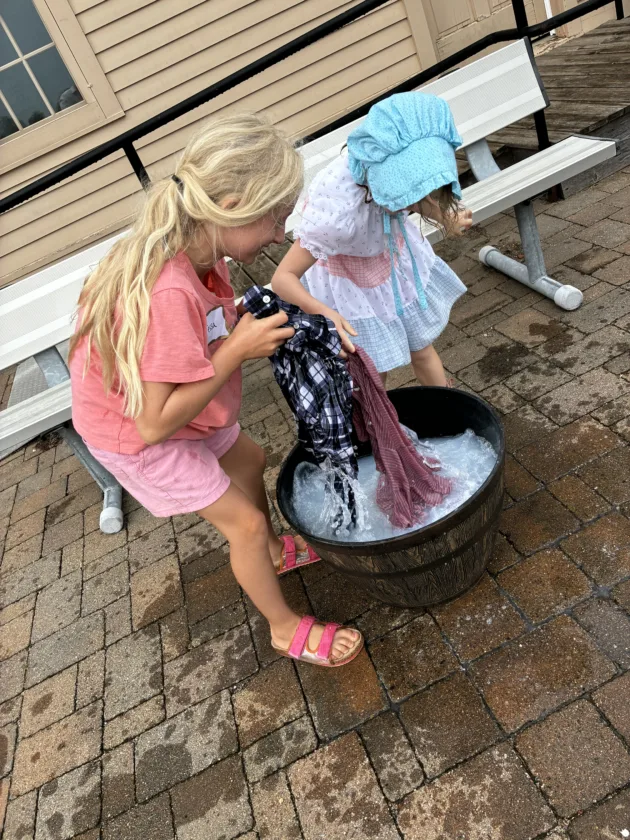
Tessa Hoffmann, left, and Cecilia McMahon, in the blue bonnet, wring out laundry during the Heritage Chores Camp at the Kiesling House. (Photo by Christina Miller Koester)
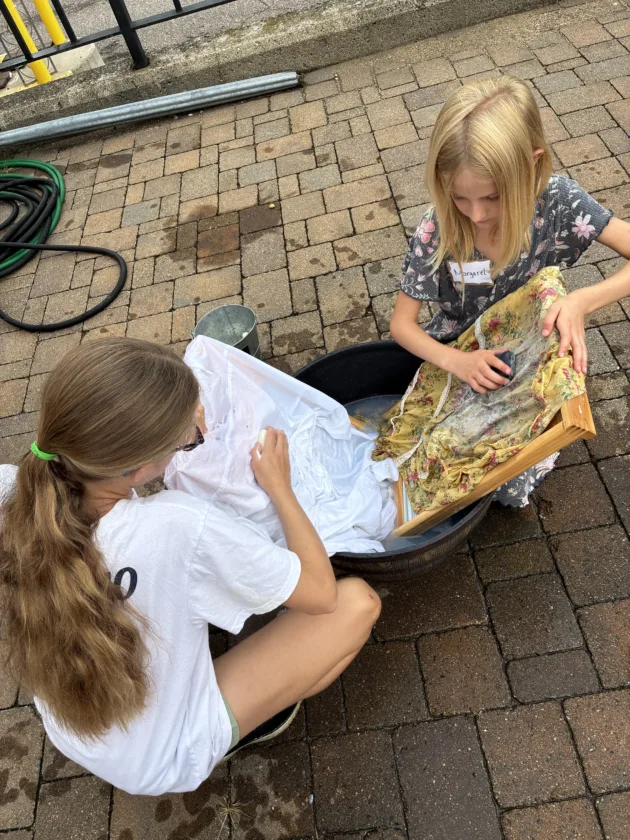
Haley Hoffmann and Margaret Bressler scrub laundry on washboards during the Heritage Chores Camp Friday at the Kiesling House. (Photo by Christina Miller Koester)
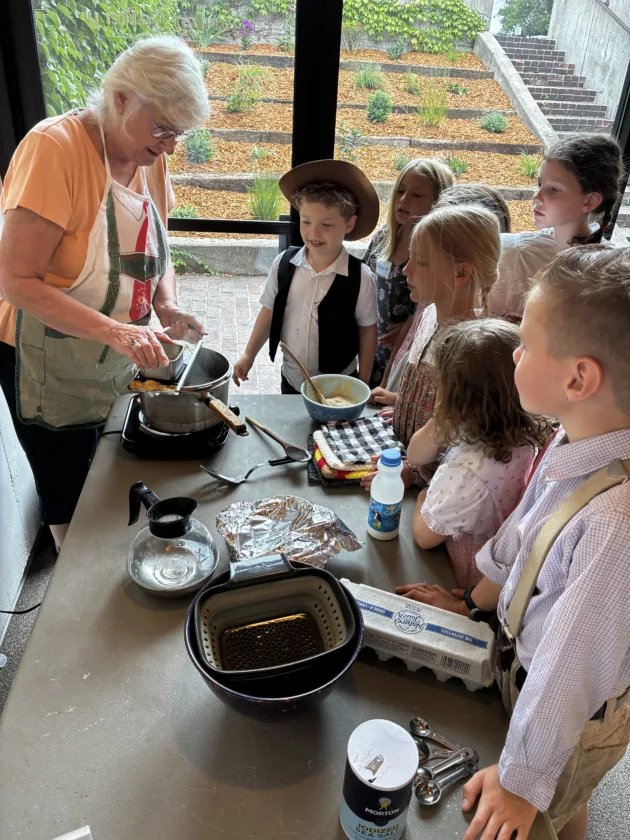
Ellie Sveine from the Sister Cities Commission shows campers how to make spaetzle during the Heritage Chores Camp at the Kiesling House. The Sister Cities Commission collaborated with the Museum Heritage Day camp. (Photo by Christina Miller Koester)
Eleanor Goerdt hangs laundry on the clothesline outside the Kiesling House during the Heritage Chores Camp. (Photo by Amy Zents)
From left, Eleanor Goerdt, Evelyn McMahon, Jaycee Nilson, Haley Hoffmann, Everett Schroers, Evelyn Schroers and Mary Anna Bressler pose during the Heritage Chores Camp Friday at the Kiesling House. (Photo by Amy Zents)
Tessa Hoffmann, left, and Cecilia McMahon, in the blue bonnet, wring out laundry during the Heritage Chores Camp at the Kiesling House. (Photo by Christina Miller Koester)
Haley Hoffmann and Margaret Bressler scrub laundry on washboards during the Heritage Chores Camp Friday at the Kiesling House. (Photo by Christina Miller Koester)
Ellie Sveine from the Sister Cities Commission shows campers how to make spaetzle during the Heritage Chores Camp at the Kiesling House. The Sister Cities Commission collaborated with the Museum Heritage Day camp. (Photo by Christina Miller Koester)
Trending
NEW ULM -- The Brown County Historical Society held its Heritage Chores Camp last Thursday at the Kiesling House on Minnesota Street in New Ulm.
The camp teaches children who have completed kindergarten through fifth grade what a typical day was like in the 1800s. Activities included hand-washing laundry, making butter, baking spätzle and making hand-dipped candles.
The program is run by Christina Koester, who has led youth programming for the historical society for two years.
Koester said the program has grown to two sessions of one-room schoolhouse and two sessions of heritage chores camp each summer.
Campers started with heritage chores and games. They hand-washed laundry and hung it on a clothesline outside the Kiesling House, made butter, and had a snack break with French bread and butter.
Carolyn Marti-Smith and Ellie Sveine from the Sister Cities Commission led a spätzle demonstration. Campers helped mix the dough.
“They let the kids help mix and then everyone got to taste the spaetzle, and they ended up making like three batches because the kids just kept wanting more and more,” Koester said.
Campers topped the spätzle with the butter they had made that morning.
“We put our homemade butter right on the spaetzle,” Koester said.
Lunch was outside on the lawn. After lunch, campers chose heritage games including ball and cup, hoop and stick, game of graces and hula hoops.
Koester said she changed the schedule this year to allow more time per activity.
“Last year I had such a busy schedule because I was so worried that there was going to be downtime,” Koester said. “So this year, I changed and I am like you learn as you go. Fewer activities, give them more time.”
The new activity this year was hand-dipped candles. Koester said it was the first time she has done dipped candles with a group. She has made poured candles before.
She tested the method at home using a baked bean can on her stove. At the Kiesling House, which does not have a stove, she used a crock pot to melt the wax.
The wicks were prepared with small washers tied on the end for weight.
“The washers are on there to keep, to add some weight so that your candle gets nice and straight,” Koester said.
She said she stayed up until midnight the night before cutting wick and tying washers.
For the activity, two children shared one container of wax. Koester said sharing forces a pause between dips.
“If you dip it in right away, it doesn’t give the wax enough time to solidify,” Koester said. “If you just keep dipping it in without letting it solidify, it’s never going to add layers to it.”
She told campers to wait about a minute between dips.
“The longer you take to dip the candles, the wider they get and the longer they will last or burn,” Koester said.
Each camper made two small candles to take home.
Before moving to the basement for candle making, Koester instructed campers on safety around hot wax.
“We need to be very careful because we are using hot wax,” Koester said. “There should be no reason why anyone gets burned or gets any hot wax on them, but we need to be very careful around the containers of hot wax.”
Ann Koch assisted with the camp. Koch is from Gaylord. Koester said Koch has helped at every one-room schoolhouse and Heritage Chores Camp she has led.
Koch previously volunteered at the Harkin Store and the Wanda Gag House.
“She’s retired, she doesn’t want to be the one in charge,” Koester said. “She’s got such a way with kids, and she’s got the knowledge of history.”
Children are encouraged to wear period clothing, but it is not required.
“When we send out the information, we tell them it’s not required to dress, but it adds to the fun,” Koester said.
Koester said some families find dresses at thrift stores and some sew them. One camper wore a dress her mother made that she shares with her sister, who has attended past camps.
Attendance has increased and is drawing from outside Brown County.
Last Thursday, campers included two girls from Melrose, near Sauk Centre, and families from St. Peter.
Koester said families have come from as far as 200 miles and that she previously had campers from Hutchinson.
Koester said families find the camp through social media and word of mouth.
“People aren’t doing this,” Koester said. “So when they find out that New Ulm is holding these activities, people are coming from far.”
Koester said interest in pioneer life remains strong.
“This type of thing, it’s like kids are still reading Laura Ingalls Wilder,” Koester said. “You talk about Laura Ingalls Wilder to these kids and they know what I am talking about. They’re like, ‘My doll is named Charlotte because Laura named her Charlotte.'”
The Kiesling House is located on Minnesota Street. Koester said many people do not know it is there.
The property includes large glass windows and a garden maintained by volunteers.
That day, there was no produce to pick and no need to water because of recent rain, so the gardening activity was skipped.
The program runs until 1:30 p.m. The day includes time for free play with heritage toys.
Koester said future expansion ideas include a Victorian tea party at the Lind House and programming focused on Native American history. She said art and painting classes have also been discussed.
The Sept. 19 camp will follow the same format: hand washing laundry, butter making, textile arts and other 1800s chores at the Kiesling House.
For information, contact the Brown County Historical Society at 507-233-2616.
The Historical Society has added a second session on Saturday, Sept. 19. Cost is $25 per camper. Registration forms are available at the Brown County Museum at 2 North Broadway, on the BCHS website, or by emailing education@browncountyhistorymn.org. Campers bring a cold lunch. Camp size is limited.