
‘Democracy is the work of talking together’
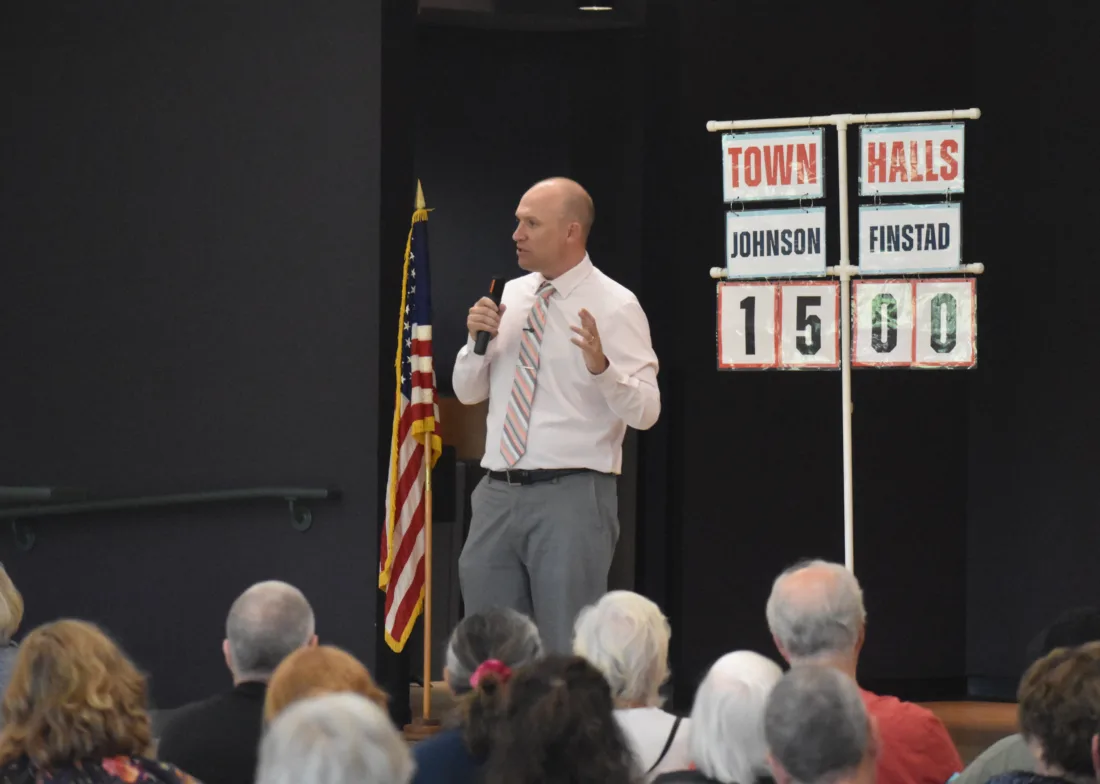
Jake Johnson, Democratic party nominee for Minnesota’s 1st Congressional District, holds a town hall at the New Ulm Community Center, Monday. This was Johnson’s 15th town hall since starting his campaign. His goal is to host a town hall in every county in the congressional district. Photo by Clay Schuldt
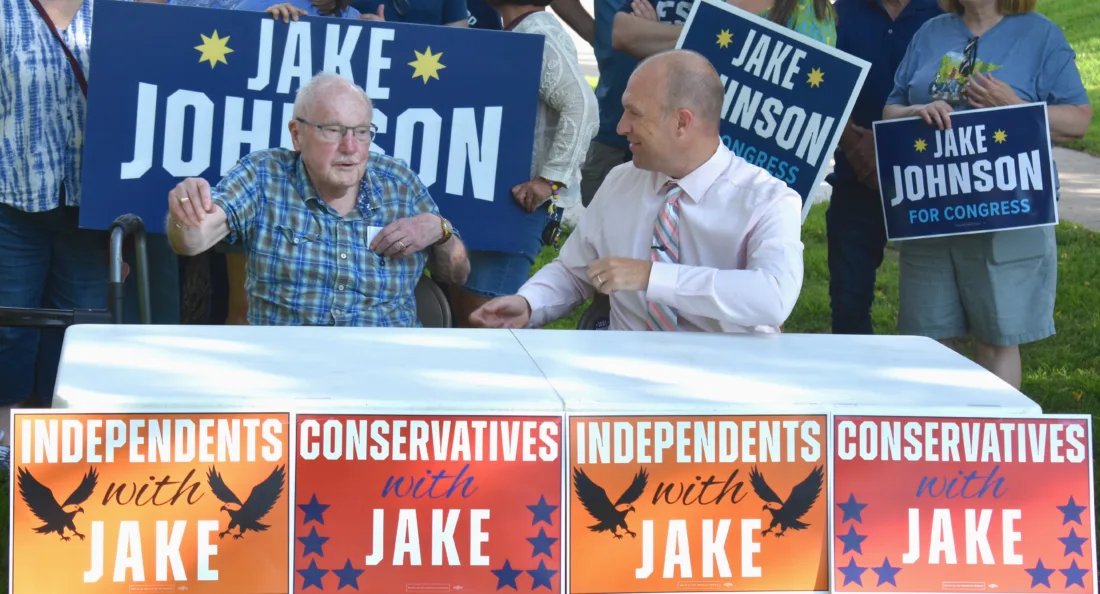
Ahead of his New Ulm town hall, Democratic nominee for Minnesota’s 1st Congressional District, Jake Johnson (right) held a press conference in German Park with Gerald Woodley (left), who was endorsing Johnson for Congress. Woodley is a longtime supporter of Republican candidates and even served as Brad Finstad’s first campaign chair, getting him elected to his first political office as state house representative in 2002. Photo by Clay Schuldt
Jake Johnson, Democratic party nominee for Minnesota’s 1st Congressional District, holds a town hall at the New Ulm Community Center, Monday. This was Johnson’s 15th town hall since starting his campaign. His goal is to host a town hall in every county in the congressional district. Photo by Clay Schuldt
Ahead of his New Ulm town hall, Democratic nominee for Minnesota’s 1st Congressional District, Jake Johnson (right) held a press conference in German Park with Gerald Woodley (left), who was endorsing Johnson for Congress. Woodley is a longtime supporter of Republican candidates and even served as Brad Finstad’s first campaign chair, getting him elected to his first political office as state house representative in 2002. Photo by Clay Schuldt
Trending
NEW ULM - Democratic nominee for Minnesota's first congressional district, Jake Johnson, visited New Ulm for a town hall meeting on Monday.
This was the 15th town hall held by Johnson during his campaign for Minnesota's first district. Johnson said part of the reason for holding the town halls was because incumbent Congressman Brad Finstad has refused to hold town halls.
Ahead of Johnson's town hall, he held a special press conference in which Finstad's former campaign chair, Gerald Woodley, chose to endorsed Johnson for Congress.
Woodley served as Finstad's campaign chair, getting him elected to his first political office as state house representative in 2002. He continued to support Finstad over the next two decades, including when he first ran for Congress in 2022.
Woodley said he had appreciated some of the work done by Finstad, but believed the Congressman had traded his leadership for loyalty to President Donald Trump.
"As the owner of two small farms in Southern Minnesota that are farmed by two family farmers, I am concerned about the effect of tariffs on increased production costs and decreased foreign demand," Woodley said. "As a senior citizen with health issues, I also am concerned with the decrease in rural health facilities and pharmacies. Brad Finstad has not helped to solve those issues."
Woodley later introduced Johnson at the start of the town hall held at the New Ulm Community Center.
Since starting his campaign, Johnson said a top issue he hears across the district is that things are too expensive.
Johnson believed there were actions Congress could take to improve the cost of living in southern Minnesota, including ending the tariffs, restoring funding for rural healthcare, ending the Iran War and standing up to the executive branch.
Johnson fielded multiple questions about artificial intelligence (AI) technology, including the uses of the technology and the data centers needed to sustain it.
Johnson said he believed there is a way for AI technology to be helpful for moving society forward, but the reality is there is justifiable fear of what AI could do if misused.
"We need a Congress that recognize to make sure the benefits of AI are economic benefits to southern Minnesota while protecting against the potential harm," he said. "We also have to make sure the gains are not just realized by tech billionaires."
Johnson said the question of AI data centers and their impact on natural resources had come up at each of his town halls.
He supports a moratorium on data centers in the country until four metrics are achieved. First, eliminating non-disclosure agreements for elected officials. He said there needed to be an open public conversation about data centers. Second, assurances of protection for natural resources and increased electrical costs are not pushed on to local citizens. Third, if the data centers are built it, it needs to be done by local union workers. Fourth, any profits gained from the data center must stay in the state.
"Anything short of those four metrics being achieved represents an extraction and exploitation of our way of life," he said.
Asked how he would support education with ongoing budget cuts to public education, Johnson said: "The best way the federal government can support our local public schools is to fully fund special education."
Johnson explained that when the law governing special education was first implemented, the federal government promised to pay 40% of the cost of the programs, but was only paying 13%, leaving the states or local property tax payers to make up the difference.
Johnson believed the federal government need to pick up its share of the cost, saying, "How we spend our money as a country is an expression of our values."
Johnson criticized Congress for finding $30 billion for the Iran War, but not fully funding special education.
"With $30 billion we could fund special education across the country for an entire year," he said. "Don't tell me we don't have the money; we just don't have a Congress that values our kids or public schools."
A Minnesota State University Mankato employee informed Johnson that international enrollment had plummeted in the last 18 months due to rules and regulations put forth by the federal government. As a direct result, staff at MSU were being laid off due to declining enrollment. She asked how they could make the U.S. a destination for education again.
"We do have a broken immigration system and it needs fixing," he said, "but what we saw in our state for immigration enforcement was both cruel and foolish."
He believed there was some bipartisan support for fixing the US immigration system that secured the border, deported violent offenders and offered a pathway to citizenship for immigrants. However, he acknowledged it would take time to rebuild the US's standings as a welcoming country.
Asked about the War in Iran, Johnson said he opposed the War in Iran, calling it a complete disaster with no plan or end in sight. He said the Strait of Hormuz is closed, raising the price of gas and fertilizer and emboldening Iran.
"Congress has somehow forgotten they have the power of the purse; they do not have to do the president’s bidding," he said.
On how to maintain healthcare and emergency service in rural Minnesota, Johnson called for Congress to undo the $87 billion in cuts to rural healthcare that were in the Big Beautiful Bill.
"We have to restore that funding, and if we don't do that, the cuts will get worse," he said.
In addition, he wanted to bring insurance costs down by creating a robust public option. This would force the private insurance companies to lower costs and improve care to be competitive.
"That is a way we can work toward universal coverage in this country for all Americans," he said.
At the end of the town hall, Johnson said this was not a one-off event. He said if elected, he would continue to hold town halls in each county of his district until the voters kick him out.
"If this responsive leadership appeals to you, I ask you to get involved with this campaign," he said. "My door will always be open to my constituents. We will always be having conversations moving forward. We might not always agree, and that's OK. Democracy is the work of talking together."